 Retro Replay Retro Replay gaming reviews, news, emulation, geek stuff and more!
Retro Replay Review
Gameplay
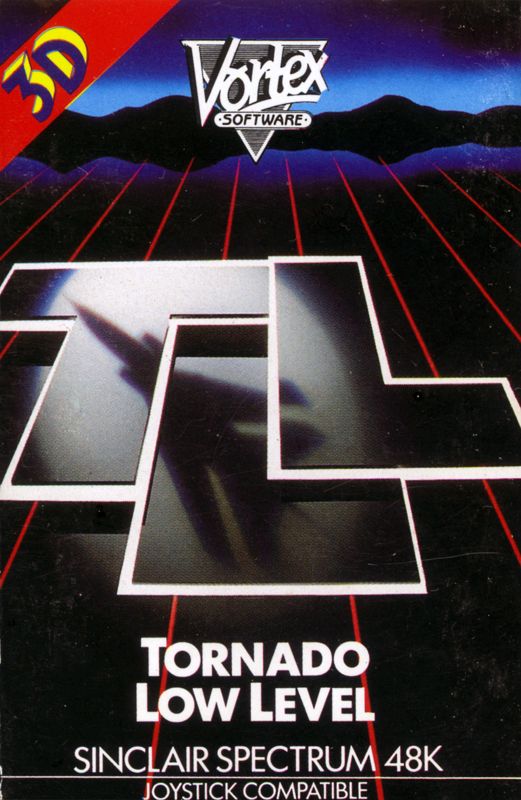
TLL: Tornado Low Level places you in the cockpit of a specialized attack aircraft on a high-stakes mission: destroy six enemy discs hidden among densely built-up urban areas. The core mechanic revolves around altitude management. As you approach each disc, you must lower your plane to gain firing accuracy, all while weaving between treetops and rooftops. This delicate balance of height and positioning creates a tense, pulse-pounding experience that keeps you on the edge of your seat.
(HEY YOU!! We hope you enjoy! We try not to run ads. So basically, this is a very expensive hobby running this site. Please consider joining us for updates, forums, and more. Network w/ us to make some cash or friends while retro gaming, and you can win some free retro games for posting. Okay, carry on 👍)
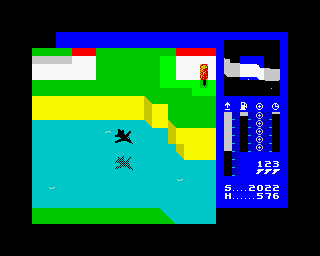
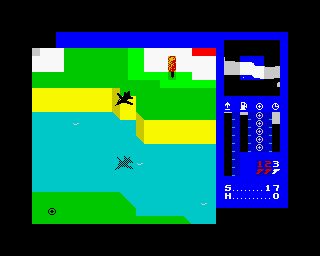
The game uses a vertically scrolling, pseudo-3D perspective that calls to mind classics like SWIV. Your plane moves automatically towards the top of the screen, which simplifies the control scheme but also removes a layer of simulation realism. Instead of managing speed, your primary focus lies on lateral movement and height adjustments. This design choice streamlines the action and makes the game more accessible to newcomers, though it may disappoint sim purists looking for throttle control.
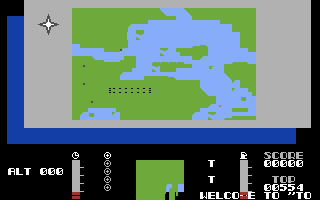
Adding another strategic layer is the fuel management system. Your remaining fuel and current altitude are always visible on the side panel, alongside a handy mini-map. Fuel depletes steadily, forcing you to return to your carrier for refueling whenever your gauge dips too low. Touching down on the carrier runway is a tense moment in itself, since any collision due to misjudged altitude or overzealous lateral movement can spell disaster.
Weapon variety in TLL is modest but effective. You have a straightforward machine gun for strafing and a limited supply of bombs for tougher targets. Bombs are great for quickly dispatching heavily reinforced discs, but their finite number encourages you to switch back to your machine gun when possible. This dynamic forces you to plan each raid, choosing the right moments to unleash your most potent armaments.
Graphics
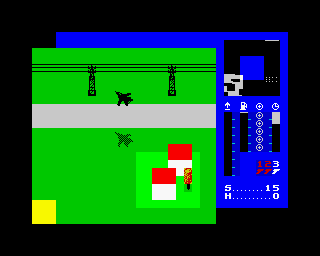
The pseudo-3D display in TLL is an impressive feat for its era. Buildings, trees, and enemy installations are drawn with clever use of scaling and shading to create depth as you swoop low over the landscape. While the overall color palette can feel somewhat muted by today’s standards, it evokes the gritty atmosphere of an urban warzone effectively.
Sprite work for both the Tornado aircraft and various enemy units is crisp and readable. Motion is smooth as you traverse city streets and open fields, and the vertical scroll rate adjusts dynamically to match your altitude, enhancing the sensation of speed. Explosions and smoke effects are satisfyingly punchy, lending weight to each successful hit on an enemy stronghold.
One highlight is the mini-map display on the side panel. It not only shows the position of all six discs but also reveals enemy patrols and terrain hazards. This real-time tactical overlay helps you plan your approach runs and escape routes, integrating seamlessly with the main playfield without cluttering the screen.
Despite its age, TLL’s art direction remains coherent and functional. Textures on building roofs, treetops, and carrier decks are distinct enough to allow quick recognition, even when flying at breakneck speed. While hardcore graphics enthusiasts may lament the absence of true 3D models or high-resolution textures, the game’s aesthetic still holds up thanks to its clear visual language and purposeful design.
Story
At its core, Tornado Low Level offers a straightforward narrative: you are an elite pilot tasked with disabling six enemy strongholds disguised as disc structures. There’s no elaborate cutscene or branching dialogue, but the premise is vividly conveyed through mission briefings and the in-game HUD. This simplicity works in the game’s favor, keeping the action front and center without unnecessary exposition.
Each disc you destroy brings you one step closer to crippling the enemy’s urban defense network. Though the story remains constant across your sorties, the sense of progression comes from the varied environments—industrial zones, suburban layouts, and open fields—all designed to reflect different levels of difficulty and strategic challenge.
The lack of deep character development or narrative twists might leave players craving more context, but TLL’s emphasis is squarely on arcade-style action. For many fans of the genre, this is precisely the appeal: a pure, unbroken sequence of high-intensity missions that demand focus and quick reflexes rather than dialogue choices or narrative puzzles.
If you’re hoping for a rich cast of supporting characters or moral dilemmas, TLL may feel thin. However, if you appreciate old-school, goal-oriented design—where each mission objective is crystal clear and every success is tangible—the game’s lean storytelling remains an asset rather than a drawback.
Overall Experience
TLL: Tornado Low Level delivers a tight, adrenaline-fueled arcade experience that remains engaging decades after its initial release. Its core loop of altitude management, fuel strategy, and precision strikes strikes a satisfying balance between challenge and accessibility. Each mission feels meaningful, with the looming threat of fuel depletion and collision danger constantly at play.
While the absence of speed control and deeper narrative elements might leave simulation fans wanting more, these design decisions open the door for a broader audience. Casual players can dive straight in without wrestling with complex flight models, yet dedicated gamers will still find plenty of depth in the game’s risk-reward systems and level layouts.
The game’s replay value is high: you’ll find yourself returning to incomplete missions to shave seconds off your run time or to perfect a refueling landing. Leaderboard-driven competition—or even self-imposed challenges like no-bomb runs—can sustain interest long after the main objectives are cleared.
In summary, Tornado Low Level stands out as a finely tuned action shooter that puts you in the pilot’s seat without overcomplicating matters. Its clear visuals, responsive controls, and well-paced mission design make it a worthy addition to any retro gaming collection or a fascinating historical footnote for modern players curious about early pseudo-3D shooters.


Reviews
There are no reviews yet.