 Retro Replay Retro Gaming History, Reviews & Emulation


Retro Replay Review
Gameplay
Wu Lung starts with a straightforward promise: find two matching tiles and remove them from a stack built across five levels. The first few matches are satisfying in that clean Mahjong-solitaire way, as blocked pieces gradually become available and the board begins to loosen. Then the harder part clicks: a legal pair is not automatically the right pair. You are constantly weighing what a removal exposes against what it may leave trapped.
That makes the game more thoughtful than its basic rules initially suggest. You will spend time scanning for open tiles, tracing likely partners, and trying not to burn through a useful match too early. It can be a quietly tense rhythm, especially when the board has narrowed and every remaining option looks consequential. If you enjoy puzzles where patience and foresight matter more than speed, Wu Lung has a solid core.
Its quality-of-life options are unusually important rather than ornamental. Undoing mistakes lets you experiment instead of treating one bad read as a dead end, while viewing the levels individually helps untangle the stacked layout. The tile-search highlight is similarly useful when your eyes have gone over the board one too many times. These tools lower the irritation without removing the need to think.
The two-player tournament mode adds some welcome competitive purpose, but it does not transform Wu Lung into a frantic head-to-head game. The same careful matching puzzle remains at the center. Bring a friend if you want a little extra variety; play alone if what you really want is a measured board-clearing challenge with enough safety nets to make repeated attempts feel fair.

Graphics
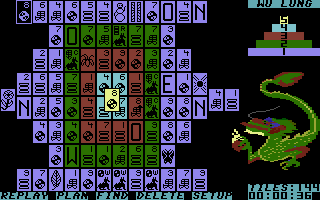
Wu Lung keeps the focus on its tile layout. The stack is arranged in distinct levels, and each level can use a different colour chosen by the player. That colour separation is helpful on a five-layer board, making it easier to see which tiles sit above or below others when planning a move.

Story
Wu Lung is built around the puzzle board, not an authored narrative. Your momentum comes from uncovering the next useful tile and working toward a cleared layout.
That bare structure suits the game. A Mahjong-solitaire puzzle does not need detours when the interesting part is deciding whether a tempting match will help or harm the rest of the board.
The closest thing to a story is the shape of an individual attempt: early openings, a promising middle game, then the uneasy final search for pairs that are still reachable. It is a small, repeatable arc, but a satisfying one when your plan holds together.
Overall Experience
Wu Lung is a focused 1988 puzzle game that understands the value of making a dense tile layout manageable. The five-level construction gives the matching rules enough bite, and the undo, layer-view, and search functions address the exact moments where Mahjong solitaire can become more exhausting than enjoyable.
Frustration can still set in if you dislike slow visual scanning or the feeling that an earlier choice has narrowed your path. This is not a puzzle that rewards impatient clicking. Take a moment to inspect the board before committing, use undo as a learning tool rather than a crutch, and the game’s decisions become much more satisfying.
For Commodore 64 puzzle fans, Wu Lung is worth a look as a practical, thoughtful variation on Mahjong solitaire. It is not trying to be anything larger than a tile-clearing game, but within that narrow lane it offers enough planning, flexibility, and competitive variation to hold your attention. The payoff is modest but real: a difficult board finally opening because you saw the right pair at the right time.


Reviews
There are no reviews yet.