 Retro Replay Retro Replay gaming reviews, news, emulation, geek stuff and more!
Retro Replay Review
Gameplay
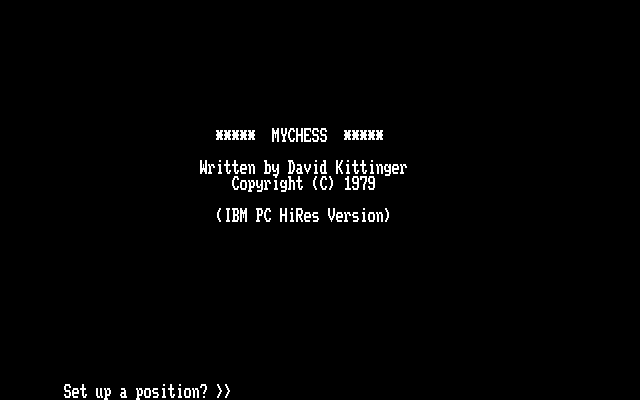
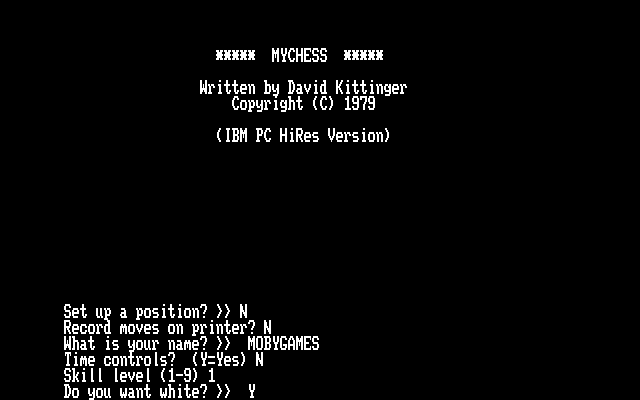
MYCHESS delivers a purist’s approach to chess, offering players a no-frills experience that harkens back to late-1970s computing. Developed by David Kittinger, the driving force behind the Chessmaster series, this title focuses squarely on the essentials: you versus the computer. There are nine difficulty levels, catering to everyone from absolute beginners to seasoned grandmasters looking for a sparring partner. Each level increases the AI’s look-ahead depth, forcing you to think several moves ahead or risk a swift defeat.
(HEY YOU!! We hope you enjoy! We try not to run ads. So basically, this is a very expensive hobby running this site. Please consider joining us for updates, forums, and more. Network w/ us to make some cash or friends while retro gaming, and you can win some free retro games for posting. Okay, carry on 👍)
Input is entirely keyboard-driven, with moves entered in standard algebraic notation. While the lack of mouse support may feel archaic today, it encourages precision and a deeper understanding of notation. You’ll quickly memorize how to write “Nf3” or “Qxe5,” making each move feel deliberate. For those unaccustomed to text commands, a brief learning curve awaits, but once you master it, the interface becomes second nature.
Beyond the standard play mode, MYCHESS provides board setup options that let you recreate famous positions or explore unique scenarios. You can’t save or load full games, but you can adjust piece placement at the start to practice endgames or tactics. Time controls are also built in, allowing for blitz or longer formats, and recordings of every match can be sent directly to a printer if you want a physical record of your battles. This feature is ideal for players who enjoy annotating their games by hand.
Graphics
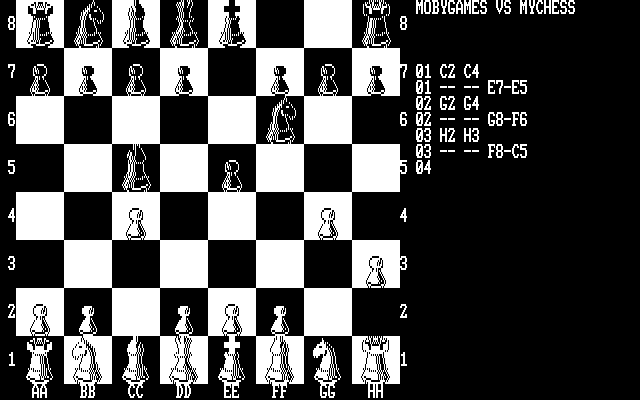
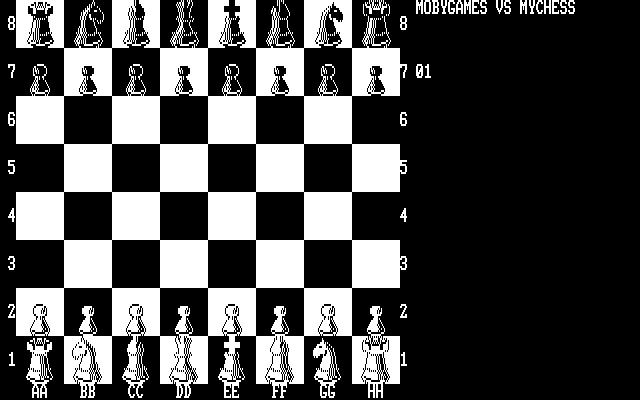
Graphically, MYCHESS is the epitome of late-1970s DOS aesthetics. The board is rendered entirely in text mode, using characters to represent pieces and grid lines. While there are no animated sprites or fancy 3D views, the minimalist presentation keeps the focus squarely on strategy rather than eye candy. Pieces are clear and distinct, ensuring you never mistake a bishop for a pawn.
Even by the standards of the early ’80s, the monochrome palette feels stark. Black and white squares alternate via ASCII shading characters, and each piece type—king, queen, rook, bishop, knight, pawn—has its own unique letter or symbol. This simplicity reduces visual clutter and makes it easy to spot threats and patterns at a glance, though modern players accustomed to mouse-driven GUIs may initially find it jarring.
One unexpected benefit of the text-only approach is performance. MYCHESS runs smoothly on virtually any hardware of its era, from early IBM PCs to homebrew XT clones. The absence of graphical overhead means near-instantaneous move rendering and quick AI calculations at lower levels. If you’re looking for a lightweight chess program that doesn’t demand cutting-edge graphics hardware, MYCHESS delivers.
Story
As a chess simulation, MYCHESS does not offer a traditional narrative or campaign. Instead, its “story” unfolds through each match you play, with victories and losses charting your progress. This open-ended structure appeals to players who prefer self-directed challenges and personal goal-setting—whether that means conquering the highest difficulty level or mastering complex endgame positions.
However, the title carries a rich pedigree in its development history. Created by David Kittinger, the mastermind behind the celebrated Chessmaster series, MYCHESS represents an important step in the evolution of computer chess. For aficionados of chess software, experiencing this program feels like reading an early chapter in the genre’s development—an artifact that paved the way for more elaborate successors.
Without cutscenes or voiceovers, the emotional stakes arise purely from your brainpower going head-to-head with the machine. Each triumph against higher difficulty levels becomes a personal milestone, and every blunder a lesson learned. In this way, the “story” is uniquely yours, shaped by individual tactics, strategic breakthroughs, and the timeless battle of wits on a checkered battlefield.
Overall Experience
MYCHESS remains a time capsule of early home computer gaming, offering a chess experience stripped to its fundamentals. Modern interfaces may have supplanted text-mode controls, yet this simplicity is precisely its charm: no distractions, no bells or whistles, just pure chess. If you’ve ever wished to test your skills against a classic AI opponent that challenges you on equal terms, MYCHESS is worth exploring.
On the downside, the lack of game saving and mouse support can feel restrictive. You must commit to matches in a single session, and entering moves by keyboard notation requires some patience. Yet for those who appreciate minimalism and speed over flash, these constraints fade away as you immerse yourself in the strategic depth.
Ultimately, MYCHESS is best suited for purists and retro enthusiasts. Its nine difficulty levels, printer-move logging, and configurable setups ensure plenty of replayability, while the legacy of David Kittinger lends it historical significance. Whether you’re curious about the roots of computer chess or simply seeking an efficient, no-nonsense opponent, MYCHESS delivers a rewarding, brain-teasing adventure.


Reviews
There are no reviews yet.