 Retro Replay Retro Replay gaming reviews, news, emulation, geek stuff and more!
Retro Replay Review
Gameplay
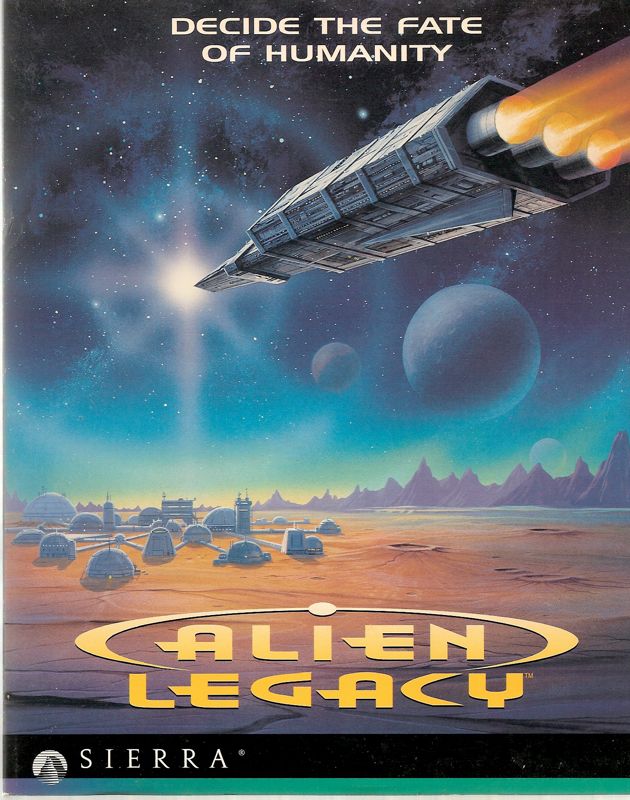
Alien Legacy unfolds across three distinctive modes—global strategy, colony management, and planetary exploration—each woven together to create a deep, multi-layered experience. At the heart of the game, you assume the role of Captain of the UNS Calypso, guiding roughly 5,000 colonists on a desperate mission to establish humanity’s foothold in the Beta Caeli star system. Every decision you make, from selecting sectors to explore to allocating research points, directly shapes the outcome of your fledgling civilization.
(HEY YOU!! We hope you enjoy! We try not to run ads. So basically, this is a very expensive hobby running this site. Please consider joining us for updates, forums, and more. Network w/ us to make some cash or friends while retro gaming, and you can win some free retro games for posting. Okay, carry on 👍)
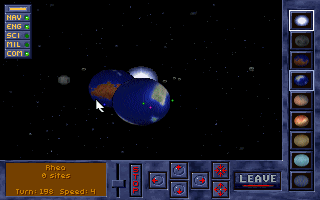
Planetary exploration takes place on a sector-by-sector basis, with the option to view each area in a detailed 3D or classic 2D perspective. By clicking on resource icons—such as ore veins or energy springs—you gain essential raw materials, while uncovering alien life forms and ancient ruins provides “research points” in specialized fields like biology and mathematics. This blend of puzzle-like searching and risk-reward scanning (which consumes fuel) adds tension and strategy before you even establish a foothold on a planet.
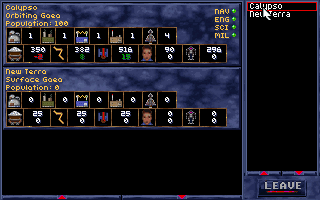
Once a viable sector is secured, colony management kicks in via a top-down, city-builder interface. You can construct up to sixteen buildings—mines, power generators, research labs, and shipyards—to sustain your people and maintain production. Every structure requires maintenance, human labor, and occasionally robots, creating an ongoing resource balancing act. Regular upgrades driven by your research tree keep your colonies on the cutting edge, but poor planning can quickly lead to shortages and stunted growth.
Meanwhile, the global strategy layer has you sending out starships to claim new worlds and forging a research agenda that unlocks fusion engines, advanced mining technologies, and eventually military hardware. Time advances in real time—even when you’re idle—so you’ll need to juggle exploration, expansion, and research efficiently. After roughly 2,000 rounds (about 83 months), the game shifts toward a final confrontation with an enigmatic enemy, pushing players to pivot from peaceful colonization to high-stakes conflict.
Graphics
For a mid-’90s release, Alien Legacy’s graphics strike a balance between functional clarity and visual flair. The planet map is rendered with clean, colorful icons that make tracking sectors and resources intuitive. Transitioning to the 3D exploration view reveals simple but effective low-polygon environments, with distinct symbols floating above resource sites and ruins to guide your clicks.
The 2D mode offers a more nostalgic, pixel-art style that some players may find charming, particularly those who appreciate classic strategy titles. While the terrain textures and structures won’t rival modern games, they convey essential information crisply: differences between deserts, forests, ice caps, and water are all immediately recognizable. Animations are minimal but purposeful, such as shimmering energy wells or rotating satellite dishes on communication arrays.
The colony management and shipyard interfaces feature detailed icons and grid-based layouts that keep the screen from feeling cluttered. Buildings have unique sprites that evolve slightly with each upgrade, giving you visual feedback on your progress. Cutscenes and event notifications use static illustrations accompanied by text—no voiceovers—but they inject personality into the narrative and guide players through critical story beats.
Overall, Alien Legacy’s graphics serve its strategic and exploratory gameplay admirably. They may look dated by today’s standards, but the art direction ensures that information is always presented clearly, and the alternating 2D/3D perspectives add variety to the visual experience.
Story
The narrative of Alien Legacy is compelling from the outset: following a devastating alien attack on Earth in 2043, humanity undergoes rapid technological advancement—and then wagers its entire future on massive seedships. You command the UNS Calypso, the slower of two arks destined for Beta Caeli, with the hope of surviving long enough to catch up with the leading ship, the UNS Tantalus.
As you survey each new planet, you uncover traces of a lost civilization and clues about “the awful events of the past.” These discoveries are woven into the research system, meaning your scientific investments not only improve gameplay mechanics but also gradually unspool a poignant backstory. Journal entries, archived transmissions, and adviser comments all flesh out the looming mystery of what befell the Tantalus—and how it ties to your precarious mission.
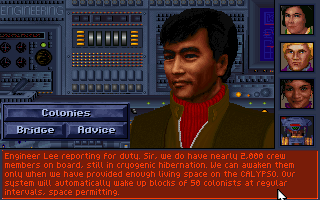
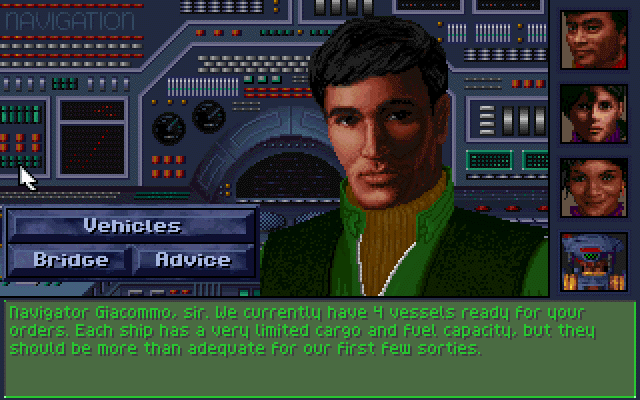
Character-driven elements are delivered through text-based dialogues with a handful of advisers, each specializing in tactical, scientific, or sociopolitical domains. Their input helps guide your decisions, though you ultimately chart your own course. The looming absence of the Tantalus builds a subtle tension that keeps you pressing forward, driven by hope, guilt, and the fear of repeating past mistakes.
In its latter stages, after about 2,000 rounds, the story shifts gears from exploration to outright warfare against an unknown foe. This narrative pivot transforms the game from a methodical colonization sim into a desperate struggle for survival, in which every piece of alien technology and every research breakthrough become crucial to victory.
Overall Experience
Alien Legacy delivers a rich, multi-layered strategy experience that challenges you to think on both grand and granular scales. The seamless interplay between global expansion, planetary exploration, and colony management provides depth without feeling disjointed. Even casual players will appreciate the adjustable time controls, which let you slow the clock when tasks become overwhelming.
The learning curve is moderate: early missions serve as tutorials in disguise, teaching you how to balance research, resource gathering, and infrastructure development. Once you grasp the core loop—search, research, build, expand—the gameplay opens up in creative ways. Veteran strategy fans will find enough complexity in fine-tuning colony layouts or optimizing scan patterns to stay engaged for dozens of hours.
Though the graphics and UI reflect the game’s mid-1990s origins, they remain functional and clear. The two viewing modes for planetary exploration add replay value and cater to different player preferences. Sound design is minimal but effective, with ambient space hums and alert tones that punctuate discoveries and crises.
Ultimately, Alien Legacy is a rewarding title for anyone who loves in-depth sci-fi strategy and doesn’t mind a text-heavy storyline. Its blend of mystery, management, and exploration creates a memorable journey that stands up remarkably well after decades. Whether you’re charting unknown worlds or unearthing secrets of a vanished civilization, Alien Legacy offers an engrossing challenge for strategic minds and sci-fi enthusiasts alike.


Reviews
There are no reviews yet.