 Retro Replay Retro Replay gaming reviews, news, emulation, geek stuff and more!
Retro Replay Review
Gameplay
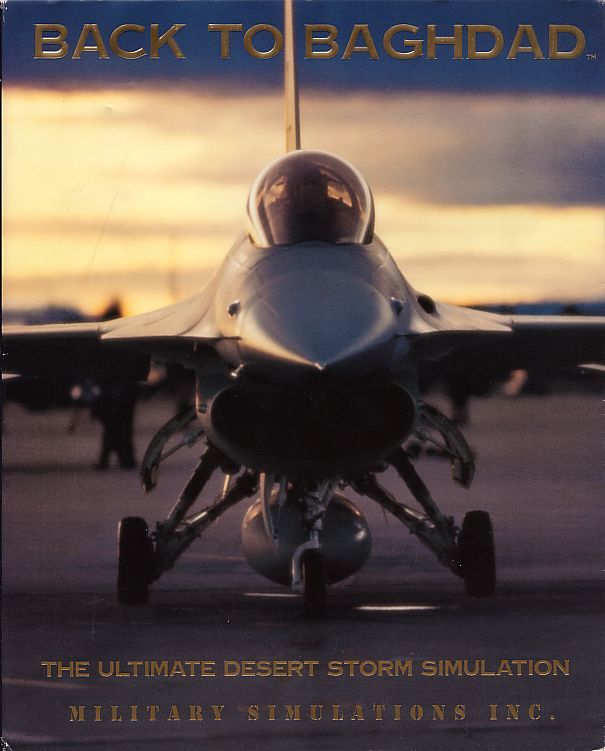
Back to Baghdad places you firmly in the cockpit of an F-16 Fighting Falcon, tasking you with a series of standalone missions over southern Iraq. From the moment you taxi to the runway, the game demands careful attention to your aircraft’s systems. Managing radar modes, weapons selection, and fuel reserves becomes second nature after a few sorties, giving the simulation a palpable sense of realism.
(HEY YOU!! We hope you enjoy! We try not to run ads. So basically, this is a very expensive hobby running this site. Please consider joining us for updates, forums, and more. Network w/ us to make some cash or friends while retro gaming, and you can win some free retro games for posting. Okay, carry on 👍)
The mission design is straightforward yet effective: each “one-off” sortie comes with a clear briefing that outlines primary objectives—whether it’s suppressing antiair installations, escorting friendly helicopters, or performing reconnaissance over hostile territory. There’s no overarching narrative campaign tying everything together, but the individual tasks feel varied enough to keep you invested. You’ll find yourself replaying missions to shave off seconds or improve weapon accuracy, driving a healthy level of replayability.
The flight model strikes a balance between authentic handling and accessibility. While hardcore simmers will appreciate the subtle nuances of G-forces, angle of attack, and energy management, newcomers can still enjoy the basic joys of flying by leaning on the helpful HUD indicators. Enemy AI reacts intelligently to your tactics, coordinating with surfacetoair batteries and flak positions, making each mission a tense game of cat and mouse.
Graphics
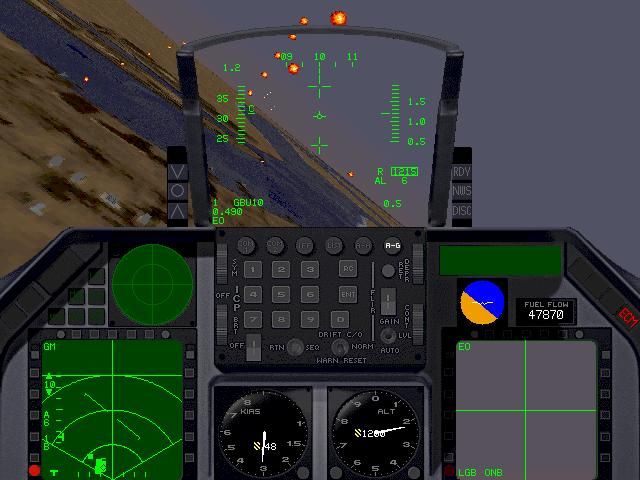
Using a purely softwarebased renderer, Back to Baghdad’s visuals may look dated by modern standards, but they were impressive at release. The game uses real satellite imagery to texture the terrain of southern Iraq, resulting in recognizable riverbeds, roads, and desert topography. Even with the absence of hardware acceleration, the draw distances remain solid, and you can spot distant mountain ridgelines or cityscapes peppered with antiaircraft emplacements.
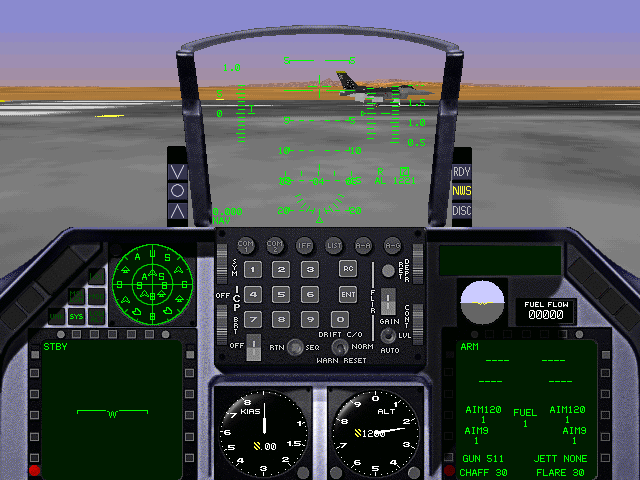
The F-16 cockpit is modeled with remarkable attention to detail. You’ll see individual switches, gauges, and warning lights rendered clearly in 3D, giving a strong impression of peering through the real aircraft’s canopy. Instrument readouts are crisp, and the HUD symbology remains legible under varying light conditions, ensuring you never lose track of your altitude, speed, or waypoint markers.
Environmental effects such as dust kicked up by jet wash and the glare of the sun on the instrument glass add to the immersive atmosphere. Although there’s minimal texture filtering and no dynamic shadows, the graphical presentation does a fine job of conveying scale and distance. This game proves that with clever use of satellite data and careful level design, a purely software engine can create a believable theater of operations.
Story
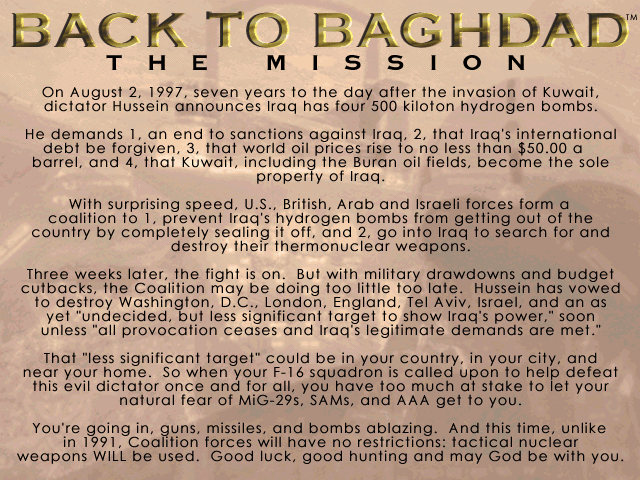
Back to Baghdad doesn’t offer a deep narrative or character development—its focus is squarely on tactical air operations in the aftermath of the Gulf War. Briefings come via text and maps, outlining the political tensions and strategic goals behind each sortie. While you won’t find cinematic cutscenes, the concise mission dossiers often hint at the broader struggle to maintain no fly zones and protect humanitarian corridors.
Within the limitations of its format, the game weaves enough background into its objectives to give you a sense of purpose. Escort missions emphasize civilian safety, SEAD (Suppression of Enemy Air Defenses) runs underline the need to keep allied forces airborne, and reconnaissance sorties remind you of the fragile peace that follows all conflicts. It’s a lean story approach, but it fits the bootcamp style training you’d expect of a working F-16 pilot.
Radio chatter and mission debriefs add flavor to the barebones presentation. Enemy SAM launches, friendor-foe calls, and air traffic controller instructions all contribute to an authentic atmosphere. Even without sprawling cutscenes or voiceovers, the snippets of dialog you overhear help ground each mission in the real world stakes of aerial warfare.
Overall Experience
Back to Baghdad delivers a tight, focused simulation experience that will appeal most to dedicated flight sim enthusiasts. Its steep learning curve and reliance on manual management of cockpit systems may intimidate casual players, but those willing to invest the time will find a richly detailed and rewarding challenge. Each successful mission brings a genuine sense of accomplishment.
The game’s period accurate terrain and realistic aircraft model make it a valuable snapshot of late ’90s flight simulation technology. Though it lacks modern conveniences like dynamic weather or advanced lighting, it more than compensates with its authentic satellitedriven maps and convincing software rendering. Performance is surprisingly smooth on modest hardware, allowing you to concentrate on tactics rather than frame rates.
In the end, Back to Baghdad offers an immersive window into post-Gulf War air operations. It’s not a storydriven blockbuster but a lean, missioncentric sim that nails the feeling of being a front-line F-16 pilot. If you’re looking for a challenging, historically grounded flight experience that emphasizes authenticity over spectacle, this title remains a worthy choice.



Reviews
There are no reviews yet.