 Retro Replay Retro Replay gaming reviews, news, emulation, geek stuff and more!




Retro Replay Review
Gameplay
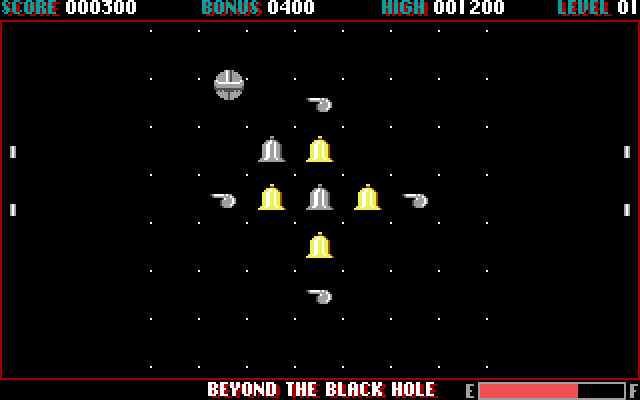
Beyond the Black Hole places you in the pilot’s seat of a futuristic orb, using classic paddle controls to navigate an asteroid-strewn sector in search of Vern Grenington and his missing service station on Vicinity NAW-911. The controls remain true to the era of late-20th-century arcade gaming, with a responsive left-right paddle for lateral movement and a single button to engage your orb’s primary targeting system. Though simple in concept, the controls deliver a satisfying learning curve that rewards precision and timing.
(HEY YOU!! We hope you enjoy! We try not to run ads. So basically, this is a very expensive hobby running this site. Please consider joining us for updates, forums, and more. Network w/ us to make some cash or friends while retro gaming, and you can win some free retro games for posting. Okay, carry on 👍)
Each level unfolds as a gauntlet of floating debris, automated defense drones, and subtle environmental hazards that must be eliminated or avoided to progress. In early stages, you’ll find yourself blitzing through straightforward target waves, honing your aim and getting accustomed to the orb’s inertia. Later levels require a more tactical approach—bypassing stealth sensors, hacking automated turrets, or using gravitational eddies to slingshot around massive objects.
The game’s unique twist is its “center-screen targeting” mechanic. An on-screen reticle automatically hones in on the nearest threat, letting you focus on navigation while firing off precision shots. This hybrid of auto-aim and manual steering keeps the tension high: move too quickly, and shots scatter; move too slowly, and incoming obstacles close the distance rapidly. Subtle levels may demand you deactivate security grids or collect energy nodes rather than simply blasting everything in sight.
Progression is marked by increasingly complex orbital puzzles and environmental anomalies that hint at the immense gravitational pull of the notorious black hole ahead. Periodic upgrades to your orb’s shields, thrust module, and targeting systems are earned by completing side objectives, encouraging exploration of hidden pathways and off-shoot caverns. This balance of arcade mechanics with light RPG-style progression helps maintain momentum throughout the roughly eight-hour campaign.
Graphics
Visually, Beyond the Black Hole captures the aesthetic of early 3D polygonal space shooters while delivering a surprisingly polished experience for its time. Triangular asteroids and wireframe obstacles evoke nostalgia for vector graphics, but they’re accented by dynamic lighting, particle effects, and textured backdrops that give each level a distinct atmosphere. Bright neon markers highlight interactive objects, ensuring you never lose track of your next objective amid a field of spinning debris.
Special attention has been paid to the black hole itself: as you near the event horizon, swirling accretion disks glow with shifting blues and purples, casting eerie light on nearby objects. Distortion shaders simulate gravitational lensing, subtly bending the visuals around the singularity. While the engine may feel dated compared to modern standards, these atmospheric touches elevate key moments and reward players who push further into the game’s closing stages.
The orb’s design is simple but effective: a sleek metallic sphere with illuminated control fins that pulse when your shields take damage. Camera angles shift dynamically during boss encounters or puzzle sequences, providing cinematic flair without compromising control. Cutscenes blend in-engine footage with stylized diagram overlays, offering background on Grenington’s disappearance and the ill-fated service station known to harbor the black hole.
Performance remains rock-solid even when dozens of objects swarm your field of view. Frame rates stay consistently high, ensuring paddle inputs feel immediate and responsive. On higher-end hardware, optional antialiasing and anisotropic filtering can be toggled to smooth jagged edges, while lower-spec systems can benefit from simplified shaders to maintain fluidity.
Story
At its core, Beyond the Black Hole weaves a mysterious narrative around the abrupt vanishing of Vern Grenington and his entire vehicle service station on Vicinity NAW-911. A seasoned space mechanic, Grenington had long been fascinated by the local black hole, which he believed could unlock new energy sources or warp-drive breakthroughs. When all contact ceased, you are dispatched to uncover the truth behind his disappearance—and to confirm whether the singularity held more secrets than any agency bargained for.
The manual sets the tone early, explaining why modern pilots, steeped in video game culture, are uniquely qualified to navigate this perilous domain. This tongue-in-cheek acknowledgment of retro gaming sensibilities injects a sense of camaraderie and lightheartedness into what could otherwise be a purely technical mission. Briefings blend corporate jargon with in-universe references to late-20th-century titles, forging a connection between your real-world pastime and the game’s diegetic controls.
Throughout the campaign, data logs and transmission snippets flesh out the backstory: encrypted voice recordings from Grenington’s crew, maintenance readouts from his modular station, and cryptic messages that suggest an otherworldly intelligence lurking beyond the event horizon. These narrative fragments are optional discoveries, often hidden in side corridors or behind encrypted locks, rewarding players who take the time to explore every cavern and research node.
The climax converges on a haunting revelation: the black hole’s singularity may be more than a cosmic anomaly—it could represent a conduit to alternate realities or sentient quantum fields. By the finale, you’re left questioning whether the mission was ever about rescue or if it was simply a test of how far humanity would go to harness the unknown. It’s a thought-provoking finish that lingers long after the credits roll.
Overall Experience
Beyond the Black Hole strikes a delicate balance between arcade-style action and atmospheric exploration, offering a satisfying adventure for fans of both fast-paced shooters and narrative-driven space dramas. The paddle control scheme is immediately accessible yet provides depth through inertia and targeting mechanics that keep each level fresh. Whether you’re blasting through asteroid belts or delicately maneuvering around gravitational anomalies, the sense of momentum and risk is ever present.
The game’s strengths lie in its nostalgic presentation and creative level design. Subtle set pieces—like navigating a derelict repair bay while avoiding automated turrets or slipping through a plasma-charged nebula—elevate routine target waves into memorable challenges. Replay value is high thanks to branching side objectives, hidden logs, and time-attack modes that unlock new orb upgrades for speed-runners.
While the graphics engine is a product of its era, the art direction and atmospheric effects more than compensate for any technical limitations. Combined with a pulsing electronic soundtrack and precisely timed audio cues, the game cultivates a sense of isolation and wonder that underscores the narrative’s themes of curiosity and cosmic peril.
Ultimately, Beyond the Black Hole is a must-play for anyone intrigued by retro-inspired space shooters with layered storytelling. It delivers hours of polished gameplay, unexpected narrative twists, and a satisfying progression of upgrades and challenges. For players who relish uncovering every data log, mastering paddle controls, and chasing down a mystery at the edge of oblivion, it’s an experience that keeps you coming back for one more orbit.


Reviews
There are no reviews yet.