 Retro Replay Retro Replay gaming reviews, news, emulation, geek stuff and more!

Retro Replay Review
Gameplay
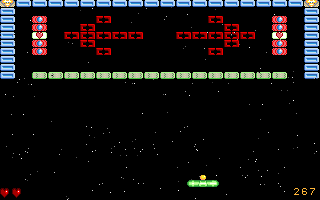
Blockage presents itself as a faithful breakout clone, delivering classic paddle-and-ball mechanics with a few clever twists. Players maneuver a simple horizontal paddle along the bottom of the screen, bouncing a single ball upward to shatter rows of colored bricks. The basic premise—keep the ball in play and clear the stage—remains intact, ensuring instant familiarity for fans of the genre.
(HEY YOU!! We hope you enjoy! We try not to run ads. So basically, this is a very expensive hobby running this site. Please consider joining us for updates, forums, and more. Network w/ us to make some cash or friends while retro gaming, and you can win some free retro games for posting. Okay, carry on 👍)
What sets Blockage apart are the “explosion blocks,” special bricks you must hit to advance. Striking one early in a level triggers a chain reaction, blowing away every brick on-screen and awarding you all available points in one satisfying burst. Alternatively, if you save the explosion block for last, the stage clears automatically once you’ve collected all other bricks. This design choice adds a layer of strategy: decide whether to go for an immediate clean sweep or carefully chip away at every piece.
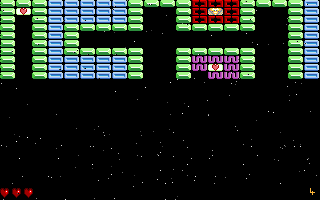
Collectible heart icons sporadically float through the debris field, granting extra lives for skilled catchers. However, there are no traditional power-ups—no multi-balls, no catch-the-ball paddles, no lasers—only the raw arcade challenge of paddle control and split-second reactions. Every shattered brick unleashes a swarm of pixel fragments, and if you lose sight of your ball amidst the chaos, a frantic recovery becomes your next test.
While the controls are responsive and the learning curve is gentle, the absence of a high score table and any additional modes means that Blockage is best enjoyed in short bursts. There’s no tower of leaderboards to climb, no endless marathon mode, just one straightforward progression through increasingly complex brick layouts. If you crave a no-frills, pure-breakout experience with a handful of tactical choices, Blockage nails the fundamentals.
Graphics
Visually, Blockage opts for a minimalist, retro-inspired palette that pays homage to the 8-bit era. Each brick is rendered in vibrant, solid colors against a plain black background, ensuring clear visibility even when debris fills the screen. There’s an undeniable charm in its simplicity—no distracting animations or flashy shaders, just clean lines and bright hues.
The real show-stopper is the particle effect produced when bricks explode. Tiny fragments scatter in random trajectories, fading gradually as they fall. This pixelated debris not only looks pleasing but also serves as a gameplay element, forcing players to track their ball through a shower of fragments. It’s a clever way to add visual drama without resorting to over-the-top graphics engines.
On higher resolutions, the blocks maintain crisp edges and the paddle moves smoothly with zero tearing or lag. Even on lower-end hardware, Blockage runs flawlessly, thanks to its lightweight design. The trade-off for this fluid performance is a lack of background detail or parallax layers; the playing field remains static and utilitarian throughout.
Ultimately, the graphical approach aligns perfectly with the game’s purpose: focus on core mechanics over visual spectacle. If you’re seeking dazzling effects or intricate environments, you may be underwhelmed. But for purists who appreciate a disciplined, distraction-free interface, Blockage delivers a clean and effective presentation.
Story
Blockage does not attempt to weave a narrative tapestry; there is no hero, no villain, and certainly no sprawling universe. Each level exists solely as a challenge chamber for your paddle skills. This absence of story might feel austere to those expecting a plot-driven experience, but it’s entirely consistent with the game’s arcade DNA.
In place of cutscenes or lore, the game conveys progression through level numbering and incremental difficulty. As you advance, you’ll encounter varied brick layouts—angled formations, narrow corridors, and tight clusters around the explosion block. These design shifts serve as your “story beats,” telling a wordless tale of escalating challenge rather than a scripted saga.
For players who prize narrative immersion, Blockage’s story section may come across as a blank page. Yet for many arcade enthusiasts, the pure feedback loop of ball-on-brick collisions is drama enough. Each smash and scatter becomes its own little moment of triumph, a tiny victory with no backstory required.
Overall Experience
Blockage excels at embracing the core tenets of breakout-style games: simple controls, immediate feedback, and a clear objective. Its strength lies in its refusal to overcomplicate—there are no extra modes, no loot drops, no tutorials beyond a brief on-screen prompt. What you see is what you get, and what you get is a polished, minimalist arcade blast.
The strategic twist of explosion blocks elevates the formula without bloating it. Deciding when to trigger a level-reset explosion introduces risk-versus-reward tension, encouraging players to hone both precision and timing. Meanwhile, the sporadic hearts for extra lives reward those who can read the falling debris and swoop in for a timely catch.
However, the lack of audio feedback and absence of a high score table may leave competitive players wanting. There’s no cheering crowd, no tense soundtrack to heighten adrenaline, nor a leaderboard to memorialize your achievements. If you prefer a well-accompanied or socially connected experience, Blockage’s bare-bones approach can feel isolating.
In sum, Blockage offers a focused, no-frills breakout experience that will appeal most to retro purists and arcade minimalists. Its graphics are clean, its mechanics are tight, and its strategic explosion feature adds a welcome twist. Just don’t expect bells, whistles, or a narrative—this is pure paddling bliss in its simplest form.


Reviews
There are no reviews yet.