 Retro Replay Retro Replay gaming reviews, news, emulation, geek stuff and more!




Retro Replay Review
Gameplay
Castle Wolfenstein delivers a tense and pioneering stealth experience that still holds up as a foundational design in modern gaming. From the very first moments, you awaken in a dank prison cell, aware that every footstep could betray you. Instead of running and gunning, you learn early on that patience and careful planning are your greatest assets. You must listen for the steady patrols of guards, peek around corners, and choose the right moment to move.
(HEY YOU!! We hope you enjoy! We try not to run ads. So basically, this is a very expensive hobby running this site. Please consider joining us for updates, forums, and more. Network w/ us to make some cash or friends while retro gaming, and you can win some free retro games for posting. Okay, carry on 👍)
The scarcity of ammunition and the relative toughness of enemy soldiers force you into nonviolent solutions whenever possible. Drawing your weapon at a careless guard can lead to instant surrender, allowing you to search him for valuable items like keys, bullets, or intel. Alternatively, you can slip past enemies in plain sight by donning stolen uniforms—though impersonating an SS officer brings its own risks when you encounter higher-ranking personnel.
Exploration is just as critical as evasion. The sprawling maze of corridors and rooms hides chests full of war plans, grenades, bulletproof vests, and occasional food or drink. Opening a chest might give you the crucial documents needed to complete your mission, but there’s also a chance you’ll find alcohol that temporarily impairs your aim and balance. Every decision—shoot or spare, search or bypass—carries consequences that ripple throughout your escape attempt.
Graphics
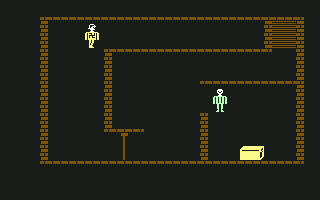
On its debut platform, Castle Wolfenstein’s graphics were stark yet functional, using a monochromatic palette that emphasized clarity over flash. Each soldier, wall, and item is rendered in sharp, simple shapes, making it easy to spot a guard’s helmet at a glance or identify a chest tucked away in the shadows. While the visuals lack modern polish, they effectively convey tension in every pixel.
Rooms and corridors are laid out in a top-down view that maximizes your situational awareness. The consistent tile set means you quickly learn to recognize dead ends, guard chokepoints, and hiding spots. Though there are no sweeping camera angles or dynamic lighting effects, the minimalist presentation focuses your attention on the core stealth mechanics rather than on visual spectacle.
Minimal animations—guards turning, weapons firing, doors opening—are complemented by early digital sound samples that punctuate your actions. When a guard yells in German or a shot rings out, the game world suddenly feels more visceral, despite the limited graphical fidelity. This blend of simple visuals and punchy audio cues is emblematic of an era when gameplay innovation outweighed graphical ambition.
Story
Castle Wolfenstein opens with a straightforward premise: you are a lone Allied operative imprisoned in a Nazi stronghold. Your initial goal is to escape your cell, but the stakes quickly rise once you learn about stolen war plans hidden inside the castle. This minimal narrative framework drops you into the action without exposition, reinforcing the sense of urgency and isolation.
As you navigate the fortress, the scattered documents and officer uniforms you collect piece together a larger picture of the Nazi war machine. There are no lengthy cutscenes or voice-acted dialogues; instead, the story unfolds organically through environmental clues and your actions. Each surrendered guard or discovered chest gives you a fragment of intelligence, deepening your investment in the mission.
While the plot is lean by modern standards, the simplicity works in its favor, keeping focus on the suspenseful infiltration and daring escapes. You feel like a resourceful spy rather than a scripted hero, turning each successful evasion into a personal triumph. The story’s tension is woven directly into gameplay, ensuring that every step through the castle carries weight.
Overall Experience
Castle Wolfenstein remains a fascinating window into gaming history, showcasing the birth of stealth mechanics that have since become a genre cornerstone. Despite its age, the game’s core loop of sneaking, surprising guards, and hunting for critical documents still feels rewarding. The tension is real—one wrong move can send alarms ringing throughout the castle.
For modern players, the game offers both a challenge and a lesson in design economy. There are no health bars or waypoint markers, so you must rely on sound cues and memory of the castle’s layout. This can lead to a steep learning curve but also to deeply satisfying “aha” moments when you master a patrol pattern or uncover a hidden stash of ammo.
Castle Wolfenstein’s legacy is undeniable. It laid the groundwork for later classics in the series and influenced countless stealth titles thereafter. As a standalone experience, it remains an engaging and thought-provoking adventure—one that reminds us how powerful minimalist design can be in crafting immersive gameplay.


Reviews
There are no reviews yet.