 Retro Replay Retro Replay gaming reviews, news, emulation, geek stuff and more!




Retro Replay Review
Gameplay
Chess Player 2150 stands out in its era for offering a remarkably strong opponent, having clinched the 1989 British Open Personal Computer Chess Championship. The program’s built-in performance menu allows you to compare match results against contemporaries like Chessmaster 2000, Chessmaster 2100 and Colossus X. Watching your own results stack up against those 10-game mini-matches gives a transparent benchmark of where you stand.
(HEY YOU!! We hope you enjoy! We try not to run ads. So basically, this is a very expensive hobby running this site. Please consider joining us for updates, forums, and more. Network w/ us to make some cash or friends while retro gaming, and you can win some free retro games for posting. Okay, carry on 👍)
A signature feature is its adaptive learning engine: each move you play feeds an internal “experience” counter. Over successive games, the AI refines its positional evaluation and tactical sharpness. Even beginners will notice a steep learning curve as the program “grows” smarter, making every rematch more challenging. Importantly, you can save that learned intelligence to disk, so you’ll never lose months of strategic progress.
Beyond pure strength, Chess Player 2150 offers adjustable difficulty settings and board orientations. You can choose between clocked blitz games or leisurely untimed matches, tailoring the challenge to your schedule. Whether you’re drilling openings, experimenting with unorthodox defenses or simply enjoying casual play, the interface keeps things straightforward. Submenus walk you through setting time controls, piece sets and analysis depth with minimal fuss.
Graphics
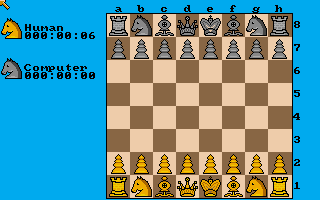
Visually, Chess Player 2150 strikes a nice balance between clarity and charm. Its default 2D board presents crisp, easily distinguishable squares and pieces—even on lower-resolution Amiga or PC screens. If you prefer a more modern feel, the optional 3D view rotates the board in perspective, adding depth without sacrificing readability.
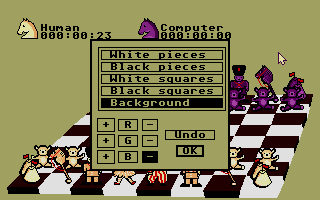
A standout graphical touch is the inclusion of whimsical piece sets. One farm‐themed skin replaces standard pawns with sheep and bishops with chickens, injecting a light-hearted vibe into serious encounters. The Science Fiction set swaps in little alien figures, pleasing fans of futuristic aesthetics. Toggling between themes is instantaneous via the pull-down menu, so you can experiment with styles mid-game.
While digitized speech on the Amiga version is technically audio, it complements the visuals by announcing moves and menu choices with clear, pleasant voices. The combination of distinctive piece artwork, animated cursor highlights and occasional sound cues makes even repetitive analysis sessions more engaging. Overall, the graphics satisfy both functional and decorative needs.
Story
Though Chess Player 2150 isn’t a narrative-driven title, its “story” emerges through its development pedigree and competitive pedigree. Created by an ambitious programmer who proudly showcased tournament victories in the ST Report International Online Magazine back in 1992, this program represents a milestone in home-computer chess software. The championship win lends a sense of pedigree and credibility.
The underlying tale is one of continual self‐improvement. From its first launch, the AI begins as a competent opponent; after every match, its internal algorithms refine their understanding of key positional patterns. This evolutionary arc mirrors the journey of a human player advancing from novice to expert over months of practice, giving your encounters a satisfying progression narrative.
On a lighter note, the inclusion of creature-themed and sci-fi pieces hints at the author’s desire to keep the game from feeling overly academic. These fun design choices speak to the program’s dual identity: a serious competition-grade engine wrapped in a playful, engaging shell. The lack of a story campaign is more than compensated by the emergent narrative of your own growth.
Overall Experience
Chess Player 2150 delivers a polished, flexible chess experience that remains noteworthy even decades after its release. Serious players will appreciate the championship-proven AI and adaptive learning mechanism, while casual users can delight in quirky graphics and straightforward controls. The ability to save and resume both games and the engine’s evolving “knowledge” ensures long-term value.
While modern interfaces may feel sleeker, and contemporary engines far surpass the 2150 rating, this title still offers an accurate window into the evolution of chess software. It’s particularly worthwhile for aficionados interested in the history of computer chess or collectors of classic Amiga/PC titles. The blend of competitive depth and playful presentation makes it accessible to a broad audience.
Ultimately, Chess Player 2150 is more than a relic; it’s a testament to the ingenuity of late-80s programming and a fun, challenging opponent in its own right. Whether you’re honing tactics, experimenting with unconventional piece sets or simply enjoying the satisfaction of outwitting a digital rival, this program delivers a memorable chess experience.


Reviews
There are no reviews yet.