 Retro Replay Retro Replay gaming reviews, news, emulation, geek stuff and more!
Retro Replay Review
Gameplay
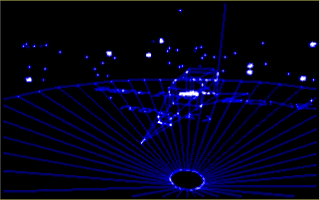
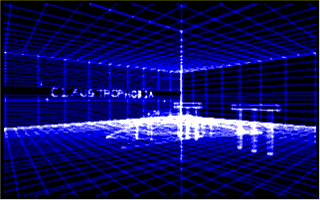
Crystal Pixels presents itself not as a traditional game with levels or missions, but as a pure, freeform simulation. Upon loading into the void, players are greeted by a constellation of floating rooms—each a “pixel” in a larger cosmic mosaic. You pilot your explorer craft from one room to another, interacting with objects or empty spaces, rearranging, adding, or removing elements at will. This tactile freedom makes every session unique: you might build complex assemblies one moment, or simply drift between voids the next.
(HEY YOU!! We hope you enjoy! We try not to run ads. So basically, this is a very expensive hobby running this site. Please consider joining us for updates, forums, and more. Network w/ us to make some cash or friends while retro gaming, and you can win some free retro games for posting. Okay, carry on 👍)
There is no set objective or narrative guidance to follow. Instead, Crystal Pixels encourages intrinsic motivation: you decide what counts as “progress.” Want to stack platforms into a spiraling tower around the central star? Go for it. Prefer to clear every object and let the silence of the void settle in? That’s equally valid. This open‐ended approach feels daring even by modern standards, harking back to an era when experimentation was the reward itself.
The recently completed translation from Italian to English broadens accessibility, making menus and object labels clear for newcomers. Although the interface retains its mid-’90s simplicity, the control scheme remains intuitive: point, click, and drag to manipulate, with keyboard shortcuts for quick mode changes. While it may take a few minutes to get accustomed to the pacing and layout, the low entry barrier means you can start constructing—or deconstructing—your own spatial puzzles almost immediately.
Graphics
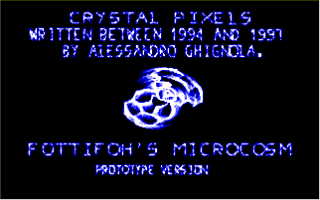
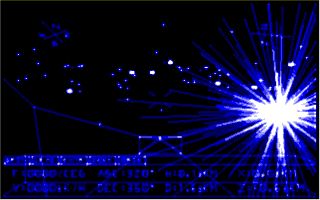
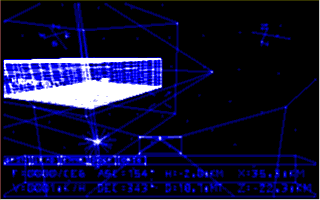
Graphically, Crystal Pixels is unapologetically retro. Its blue wireframe visuals at a 320×200 resolution exude a distinctive ’90s charm. Every room, platform, and object is rendered in clean lines against the black canvas of space, evoking the minimalism of early polygonal titles. While modern eyes might find the aesthetic sparse, this design choice actually serves the simulation ethos: you focus on form and function rather than textures or shading.
The wireframe style also delivers surprisingly smooth performance, even on contemporary machines or emulators. There’s no stuttering or slowdown as you shuttle between pixels, no draw-distance pop-ins to break immersion. The constant frame rate allows you to zip around the central star, spinning your creations and examining structures from every angle. In a way, the lack of graphical frills frees your imagination to supply color and detail.
For players interested in game-design history, the graphics themselves are a lesson in efficiency. Alessandro Ghignola managed to convey depth, spatial relationships, and object identity with just lines and nodes. The result is less about photo-realism and more about clarity—the clean silhouette of a platform or the outline of a cargo crate immediately tells you how you can interact with it, leaving you to ponder your next move.
Story
Unlike narrative-driven titles, Crystal Pixels offers no prewritten storyline to follow. There are no protagonists, no cutscenes, and no dialogue. Instead, the “story” arises from your actions and experiments. Build a sprawling structure around the star, then watch as flickering geometrics cast shifting patterns across the wireframe void. That emergent visual poetry becomes your tale—one of creativity, discovery, or even frustration, depending on how wildly you choose to manipulate your space.
This absence of a formal plot is deliberate. Ghignola’s design philosophy treats the game world as a sandbox: players carve stories out of its geometry rather than consuming a predefined tale. If you seek narrative hooks or comedic relief, you won’t find them here. Instead, the game rewards you with a pure simulation playground where personal goals—architectural marvels, engineering challenges, or abstract art pieces—become your guiding narrative.
While some may view the lack of storyline as a drawback, it’s worth considering the vintage context. In the mid-1990s, many developers were experimenting with emergent gameplay. Crystal Pixels stands as a testament to that spirit, offering a blank canvas where your decisions are both the plot and the resolution. For players craving a story of their own making, this odd little simulation is a rare gem.
Overall Experience
Playing Crystal Pixels feels like uncovering a digital time capsule. Its mid-’90s heritage shines through in every polygonal corner, yet the sandbox philosophy remains timeless. Whether you’re a retro-gaming enthusiast, a curious simulation buff, or a designer seeking inspiration, the title rewards patience and experimentation. There’s genuine satisfaction in finding unintended uses for simple wireframe objects or in crafting a personal layout that tells your own visual tale.
The English conversion breathes new life into the experience, opening the door for a broader audience to explore Ghignola’s early work. While modern games often bombard you with achievements, tutorials, and in-game prompts, Crystal Pixels trusts you to chart your own path. That freedom can be liberating or overwhelming, depending on your tolerance for ambiguity. Fans of structured goals may feel adrift, but those who relish creative autonomy will find this simulation endlessly engaging.
Ultimately, Crystal Pixels is a niche experience—an art piece disguised as software. It won’t hold your hand, and it won’t spell out a grand quest. But for players willing to embrace its wireframe void, it offers a playground of infinite possibility. If you’re intrigued by the roots of 3D simulation, or if you simply want to decorate a virtual constellation of rooms with your own imagination, this title is a captivating detour from the usual gaming fare.


Reviews
There are no reviews yet.