 Retro Replay Retro Replay gaming reviews, news, emulation, geek stuff and more!



Retro Replay Review
Gameplay
Dino-Sorcerer’s core gameplay revolves around a simple yet endlessly appealing mix-and-match mechanic. Children (and adults) can choose from a selection of dinosaur heads, bodies, tails, and legs, then rearrange these parts to form entirely new prehistoric creatures. Each change automatically updates the dinosaur’s name, blending Latin-sounding prefixes and suffixes to create labels that feel semi-authentic and often hilarious. This playful naming system adds an element of surprise and delight every time you swap out a limb or horn.
(HEY YOU!! We hope you enjoy! We try not to run ads. So basically, this is a very expensive hobby running this site. Please consider joining us for updates, forums, and more. Network w/ us to make some cash or friends while retro gaming, and you can win some free retro games for posting. Okay, carry on 👍)
Beyond the creative assembly process, Dino-Sorcerer offers the satisfying option to save and print your unique creations. After spending time perfecting a fanciful beast or a faithful recreation of a Velociraptor, you can export the design to disk or send it directly to a printer. For classrooms or home use, this functionality transforms the game into a hands-on arts-and-crafts activity, bridging digital play with tangible keepsakes.
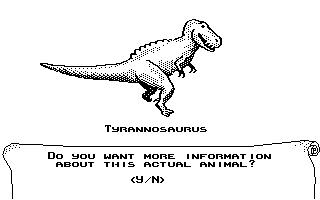
Perhaps the most rewarding aspect of Dino-Sorcerer is its subtle educational twist. If a player’s custom dinosaur matches a known species—say, a Tyrannosaurus rex or a Triceratops—the game recognizes the achievement and provides a short informational blurb about that real creature. This reward loop not only reinforces correct body-part identification but also encourages kids to experiment more, trying to discover all the hidden “true” dinosaurs in the mix.
Graphics
Given its origins as an early John Romero project on the SoftDisk platform, Dino-Sorcerer’s visuals remain charmingly rudimentary by modern standards. The game uses crisp, monochrome line art, ensuring each dinosaur part is clearly distinguishable. While there’s no texture shading or 3D rendering, the simplicity of the graphics contributes to its accessibility—young players immediately understand which limb goes where without visual clutter.
The user interface is equally straightforward: menus and icons are large, labeled, and intuitive. Even a child encountering a mouse for the first time can click and drag parts around the screen with minimal instruction. This no-frills approach to design means there’s virtually zero learning curve, and no distracting animations or flashy effects to slow down the creative flow.
Despite the lack of modern visual polish, the clean, cartoon-like outlines foster imagination. In many respects, the minimal aesthetic serves the game’s goal of fueling creative play rather than simulating realistic dinosaurs. The end result is a playful, almost “storybook” feel that complements the game’s playful tone.
Story
Unlike many contemporary titles, Dino-Sorcerer doesn’t weave a dramatic narrative or present a sequence of quests. Instead, the “story” emerges organically from the player’s own creative process. Each hybrid dinosaur you design becomes the protagonist of your personal dino-tale, whether it’s a spiky-footed “Dracorapi” or a long-necked “Velocisaurus.” The game trusts its audience to invent their own adventures, and that freedom is a refreshing change of pace.
Where educational games of the era often resorted to dry facts presented in a linear way, Dino-Sorcerer embeds learning within the act of play. The occasional pop-up fact on successfully recreating a genuine dinosaur species functions as an Easter egg rather than a didactic lecture. This subtlety encourages players to dig deeper if they’re curious, without breaking the flow of their imaginative creations.
In this sense, the story of Dino-Sorcerer is co-authored by the player. Each session is a distinct chapter in a larger saga of dinosaur discovery. Whether you’re cataloging your own “authentic” finds or just giggling at the absurd combinations you can dream up, the narrative remains entirely in your hands.
Overall Experience
Dino-Sorcerer stands out as a charming relic from the early days of PC gaming—a period when experimentation and ingenuity often trumped high-fidelity graphics or sprawling worlds. For families, educators, and nostalgic gamers alike, it offers a compact toolkit for creativity and discovery. Young players can learn basic taxonomy and anatomy, while older fans might appreciate the historical significance of this being one of John Romero’s first post-SoftDisk efforts.
Though it lacks multiplayer modes, achievements, or progression systems common in modern edutainment titles, its open-ended design is precisely what gives it lasting appeal. You won’t find boss fights or timed challenges here—just a blank canvas and a mechanical zoo of dinosaur parts waiting to be assembled. The memorable naming algorithm injects humor at every turn, making each creation feel like a mini reward in itself.
For anyone seeking a bite-sized, creativity-focused experience—or for parents looking to blend screen time with an off-screen art project—Dino-Sorcerer delivers in spades. It may not boast the bells and whistles of today’s apps, but its heart lies in pure imaginative play, and there’s something timeless about that. If you’re in the market for a simple yet endlessly replayable dinosaur-creation toy, Dino-Sorcerer is still worth dusting off and rediscovering.



Reviews
There are no reviews yet.