 Retro Replay Retro Replay gaming reviews, news, emulation, geek stuff and more!

Retro Replay Review
Gameplay
DOSMINE takes the classic Minesweeper formula and thrusts it back into the era of monochrome monitors and text‐based adventure screens. At its core, the objective remains straightforward: clear a grid of concealed cells without detonating hidden mines. Each safe cell you uncover either reveals a number—indicating how many mines lie in adjacent cells—or triggers a chain reaction that clears all connected non‐mine cells until the nearest numbered boundary. The fundamental mechanics are pure Minesweeper, yet the retro DOS ambiance lends a strange new tension to every mouse‐free keystroke.
(HEY YOU!! We hope you enjoy! We try not to run ads. So basically, this is a very expensive hobby running this site. Please consider joining us for updates, forums, and more. Network w/ us to make some cash or friends while retro gaming, and you can win some free retro games for posting. Okay, carry on 👍)
Players navigate the grid using intuitive keyboard controls—arrow keys to move, the spacebar to reveal a cell, and an optional flagging key to mark suspected mines. Without the luxury of a point‐and‐click interface, every move feels slightly more deliberate, as if you’re tiptoeing across an actual minefield rather than merely clicking squares. The game supports adjustable difficulty settings, from beginner grids where a lucky initial click often guarantees survival, to expansive expert boards where one wrong keystroke can obliterate hours of careful progress.
Despite its simplicity, DOSMINE demands both patience and pattern recognition. Seasoned puzzle‐game veterans will recognize classic strategies—probability counting, double‐chording and corner play—but must execute them in a purely textual environment. There are no flashy power‐ups or alternative game modes: the challenge is distilled down to logic, memory, and occasionally, a daring risk when two equally plausible cells remain.
Graphics
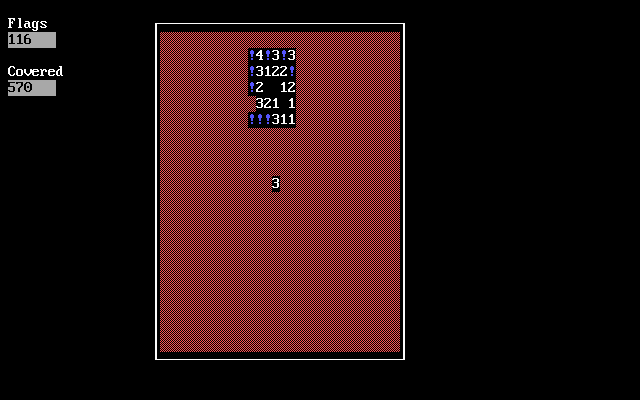
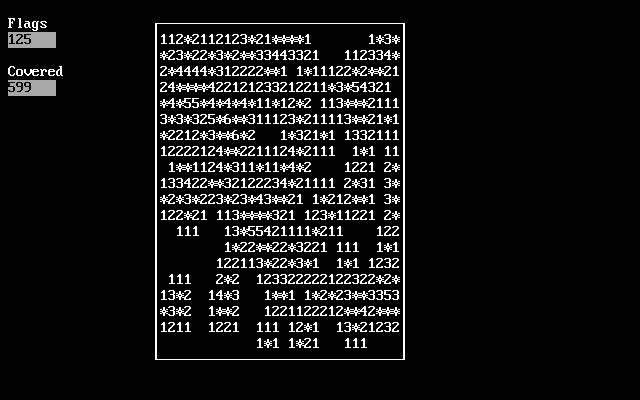
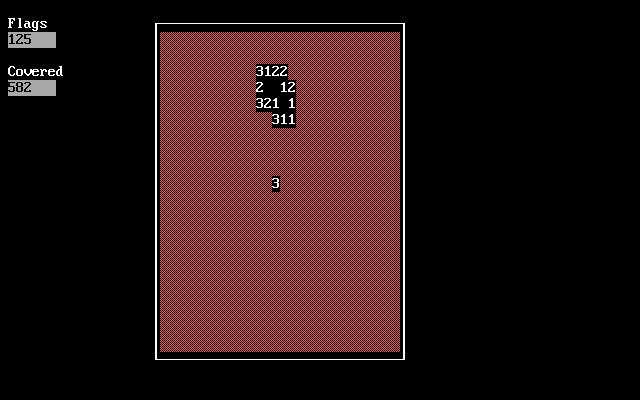
Visual fidelity in DOSMINE embraces the raw charm of textmode graphics. There are no sprites, no high‐resolution tilesets, and certainly no 3D rendering—just ASCII characters and the occasional shading block to denote flags and mines. The grid is crisp and unambiguous, with each cell represented by a single character. When a mine is revealed, a stylized “*” pops into place, alerting you to disaster in a manner that is striking in its starkness.
Color usage is minimal but effective: classic DOS palette options allow for contrasting hues between covered cells, uncovered numbers, and flags. The result is both functional and nostalgically evocative. If you grew up tinkering with config.sys and autoexec.bat, the sight of these color registers flickering on your screen may prompt a smile—or at least a sense of deja vu.
Of course, modern gamers accustomed to particle effects and dynamic lighting might find the presentation underwhelming. Yet that’s precisely the point. DOSMINE trades visual spectacle for a stripped‐down experience that puts pure gameplay first. In that respect, its graphics feel intentionally utilitarian rather than outdated—and they deliver on the promise of a true DOS revival.
Story
In the strictest sense, DOSMINE has no story beyond: “Don’t step on a mine.” There is no narrative arc, character development, or branching dialogue. The game assumes you’re here for the puzzle, not a sprawling plot or cinematic cutscenes. Each session is its own microcosm of suspense, with the only backstory being the legend of Minesweeper itself.
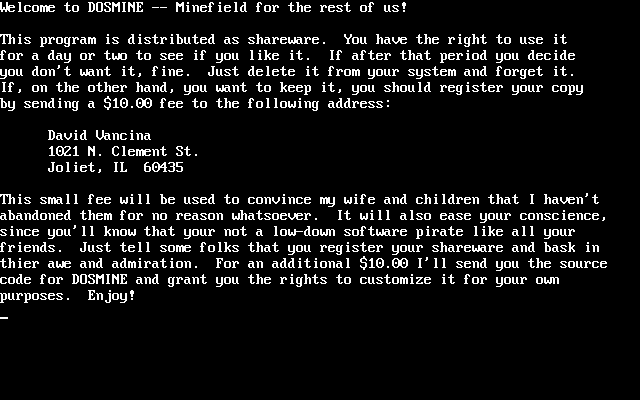
That said, there’s an implicit tale of DIY computing embedded in the experience. By porting a Windows stalwart back to MS-DOS, DOSMINE invites players to imagine the origins of PC gaming—boot disks swapped at LAN parties, the thrill of configuring a boot-optimization tweak mid-game, and the anticipation of a cursor moving on a green‐screen CRT. In a way, the real narrative is one of nostalgia and technical ingenuity.
For fans of pure logic puzzles, the lack of a traditional storyline won’t feel like a gap. Instead, DOSMINE’s “plot” is yours to craft each time you play: every cleared field, every flagged mine, and every nail‐biting guess becomes a personal anecdote. If you relish sharing tales of improbable lucky clicks or heart‐stopping near misses, this game offers fertile ground for storytelling among fellow puzzle enthusiasts.
Overall Experience
DOSMINE is both a tribute and a curiosity. By stripping Minesweeper down to its DOS roots, the developer has created an experience that feels both familiar and novel. While it lacks the bells and whistles of modern puzzle titles—no achievements, no music, no mouse input—it compensates with unadulterated logic gameplay that never outstays its welcome. Sessions are quick to start, brutally fair in design, and endlessly replayable.
If you’re seeking a deep narrative or glossy production values, look elsewhere. But if you appreciate minimalist design, enjoy classic puzzle mechanics, or simply want a window into the early days of PC gaming, DOSMINE delivers in spades. It’s a niche offering, sure, but one that caters perfectly to retro aficionados and Minesweeper diehards alike.
Ultimately, DOSMINE challenges you to find beauty in simplicity. Its textmode interface and absence of modern frills are not shortcomings but deliberate design choices, aimed at recapturing the tension and charm of early computing eras. For players willing to embrace the old‐school aesthetic, DOSMINE proves that great puzzles require little more than a grid, a goal, and the courage to take a leap of faith.



Reviews
There are no reviews yet.