 Retro Replay Retro Replay gaming reviews, news, emulation, geek stuff and more!


Retro Replay Review
Gameplay
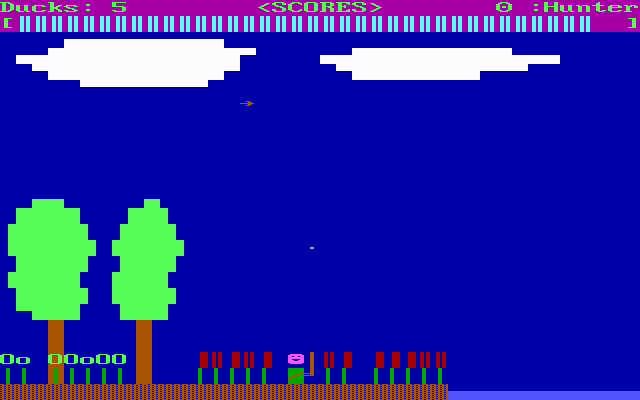
Duck Hunt’s gameplay distills the classic hunt into a streamlined ASCII experience, demanding nothing more than a keen eye and an itchy finger on the space bar. You control a small, armed ASCII-man stationed at the bottom center of your terminal window, waiting for a formation of rude, taunting birds to swoop overhead. Unlike its NES predecessor, where a light gun did the work for you, here timing and prediction replace hardware—anticipate exactly when a duck will align with your crosshair and press space to send your bullet skyward.
(HEY YOU!! We hope you enjoy! We try not to run ads. So basically, this is a very expensive hobby running this site. Please consider joining us for updates, forums, and more. Network w/ us to make some cash or friends while retro gaming, and you can win some free retro games for posting. Okay, carry on 👍)
The core loop is deceptively simple: watch for the birds, judge their speed and trajectory, and fire at the precise moment so your shot arrives at their altitude. Miss the timing by a fraction, and the duck will mercilessly insult your poor marksmanship before flapping away unharmed. This challenge injects a playful tension into every round—each second can feel like an eternity as you calculate bullet travel time versus the flyer’s constant descent.
Rounds continue until you exhaust your limited supply of bullets, which ups the stakes considerably. One stray shot can waste precious ammo, and soon you’re agonizing over every press of the space bar. This adds a surprisingly strategic layer to what might initially seem like a pure reflex test: do you fire early in hopes of an easy hit, or wait for the perfect alignment and risk losing the duck altogether?
Graphics
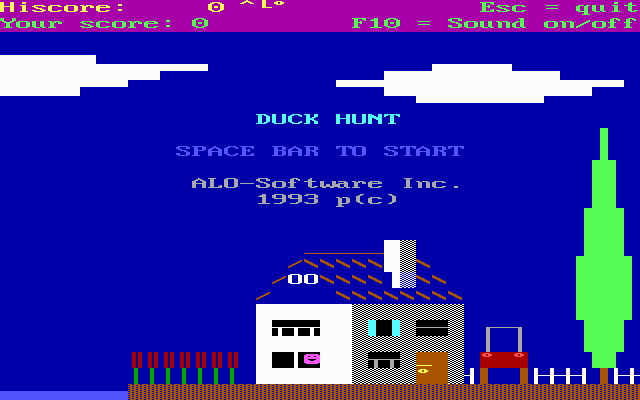
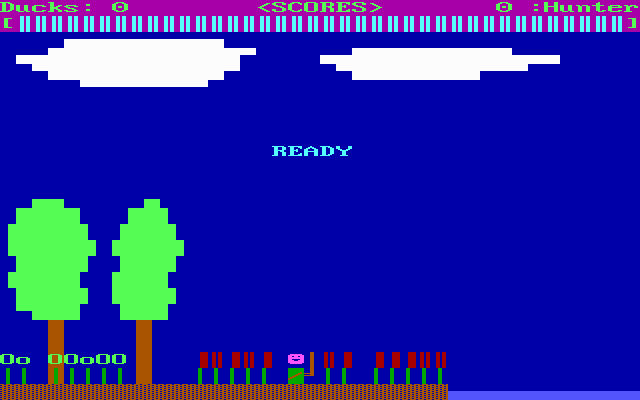
Visually, Duck Hunt embraces a minimalist aesthetic, rendering every element in crisp ASCII characters. The hunter, bullets, and flapping birds are all formed with simple symbols, yet the design conveys motion clearly—ducks appear in various wing positions as they traverse the screen, and your bullet ascends in a bold, unmissable line. This stripped-down look is charming in its throwback to early computing games.
The stark contrast between the monochrome background and the white ASCII sprites keeps the action legible, even when multiple birds swarm simultaneously. While modern gamers may be accustomed to photo-realistic textures, Duck Hunt’s retro palette and grid-like playfield offer a refreshing departure, evoking nostalgia for text‐based adventures and DOS-era shooters.
Despite its simplicity, the game manages to communicate important visual cues—when you’re low on ammo, when a duck is about to insult you, or when a perfect shot lands dead-on. Subtle animations, like the hunter’s recoil or the bird’s sarcastic shake upon escaping, bring personality to an otherwise minimal interface. Overall, the graphics are a clever nod to vintage design philosophy that still feels accessible and purposeful today.
Story
Duck Hunt doesn’t offer a sprawling narrative or deep lore; instead, it spins its own lighthearted yarn through clever text and situational humor. The “story” is essentially you versus the flock of rude birds, with each miss accompanied by snarky remarks that egg you on to improve. It’s a minimalist plot—hunt, miss, endure jeers, and try again—all designed to keep you engaged through comedic taunts rather than cutscenes or dialogue trees.
The absence of a traditional story arc is intentional, focusing player attention on the hunt itself. Yet there is an implicit progression: as your skills sharpen and you learn to predict flight patterns, the insults sting less and the victories feel sweeter. Those small moments of triumph become your personal narrative, giving the otherwise bare-bones structure a surprising sense of achievement.
By replacing exposition with in-game banter, Duck Hunt crafts its own charm. The rude birds serve as both adversaries and comic relief, turning every successful shot into a small victory over a digital foe that once jeered at your incompetence. This unique approach to storytelling—relying entirely on gameplay feedback—keeps the experience brisk, witty, and wholly focused on the core mechanics.
Overall Experience
For players seeking a quick, addictive time-killer, Duck Hunt delivers. Its blend of precise timing, limited ammunition, and cheeky insults creates a loop that’s easy to learn yet hard to master. Sessions are short enough to fit into coffee breaks, but the urge to best your high score can easily extend play far longer than intended.
The game’s minimalist ASCII presentation and lack of sprawling menus ensure there’s no barrier to entry—launch, play, repeat. Newcomers will appreciate the straightforward controls and clear objectives, while retro enthusiasts will grin at the homage to early gaming days. The modest system requirements mean it runs on virtually any platform capable of displaying text, making it an ideal pick for low-spec setups or coding hobbyists exploring terminal-based projects.
Overall, Duck Hunt stands out as a clever reinterpretation of a beloved classic. By replacing light-gun action with space-bar precision and swapping colorful sprites for ASCII art, it offers a fresh, challenging experience that respects its roots while forging its own identity. Whether you’re chasing nostalgia or simply looking for a fun test of reflexes and prediction, this little terminal shooter is well worth the hunt.


Reviews
There are no reviews yet.