 Retro Replay Retro Replay gaming reviews, news, emulation, geek stuff and more!



Retro Replay Review
Gameplay
Global Effect’s core loop revolves around building a thriving economy before unleashing your military might on rival nations. You begin by laying down the essential infrastructure: housing complexes to accommodate workers, farms or fisheries to feed your population, and power plants to keep everything running. This balancing act rewards careful planning, as any gap in resource production can bring your entire city to a standstill.
(HEY YOU!! We hope you enjoy! We try not to run ads. So basically, this is a very expensive hobby running this site. Please consider joining us for updates, forums, and more. Network w/ us to make some cash or friends while retro gaming, and you can win some free retro games for posting. Okay, carry on 👍)
What really sets Global Effect apart is its environmental customization system. Much like in Civilization, you select your world’s climate—whether it’s an icy tundra or a radiation-scarred wasteland. These choices drastically alter the difficulty, making you rethink standard strategies. On a frozen map, you’ll prioritize geothermal or nuclear power earlier, whereas in a post-apocalyptic setting you must scavenge for usable land and salvage construction materials.
Power management itself evolves into a mini-game. You start with a very limited energy supply and must expand your output through “green” solutions. Planting forests becomes both a strategic and aesthetic choice, since trees are the most efficient early-game carbon sinks. Later, you can upgrade to wind farms, solar arrays, or even experimental fusion reactors to support larger industrial zones.
Once your civilian economy hums along smoothly, you unlock the ability to train and deploy military units. Armies can be given preplanned flight paths to strike enemy cities or defend key territories; you can override these orders on-the-fly if you spot an opening. While pathfinding occasionally leads to quirky troop movements, the real-time strategic layer—combined with the satisfaction of seeing your battle plan executed—remains undeniably compelling.
Finally, Global Effect includes a two-player mode via null-modem cable, even allowing you to link different operating systems. This old-school LAN feel may seem quaint today, but it delivers a no-latency head-to-head challenge. Facing a human opponent forces you to adapt your economic and military strategies in real time, lending the game impressive replay value.
Graphics
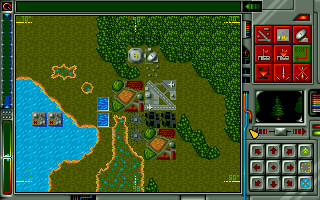
On the visual front, Global Effect opts for a clean, isometric perspective reminiscent of classic city-builders like The Settlers. Each building type is distinct and color-coded—residential blocks feature warm hues, industrial facilities have a more muted palette, and power plants glow with neon accents. This clarity makes it easy to monitor your cityscape at a glance.
Terrain and environment settings not only affect gameplay but also dramatically alter the look of your world. Snowy levels are blanketed in white, with steam rising off factory chimneys in bitter cold. Post-apocalyptic maps showcase cracked earth, skeletal trees, and ruined highways, giving a sense of desolation that keeps every decision feeling weighty.
Animation is functional rather than flashy. Citizens walk along paths, harvesters swing their tools, and military transports taxi across runways with satisfying mechanical motion. Though individual animations can be repetitive, they are charming in their simplicity and never obscure gameplay clarity.
Unit models in battle are modest in polygon count but are easy to distinguish when you’re commanding large formations. Explosions, smoke plumes, and tracer fire add necessary drama to combat without dragging down performance. Even on moderate hardware, Global Effect maintains a steady frame rate, making large-scale wars a visual treat rather than a slideshow.
Story
Global Effect doesn’t offer a deep, character-driven narrative—its focus is squarely on sandbox-style empire building. That said, each environmental setting implies its own backstory. Perhaps your civilization is one of the few survivors on an irradiated Earth, or a pioneering colony on a frozen world far from home.
Scenarios occasionally provide brief mission briefs that set objectives and context: “Secure a nearby oil reserve before the enemy does,” or “Reforest the eastern valley to stabilize your power grid.” These short vignettes give a sense of urgency, though the overarching plot is left to your imagination.
The emergent storytelling comes from your own successes and failures. A power shortage that cripples your economy becomes part of your campaign lore. Retaking a lost city after a surprise invasion creates a triumphant comeback moment. In this way, Global Effect encourages players to craft their own narratives rather than follow a scripted storyline.
Overall Experience
Global Effect excels at blending city-building depth with real-time strategy combat. Its layered power and environmental systems require thoughtful planning, and conquering a hostile landscape feels all the more rewarding when you’ve optimized your entire supply chain. The satisfaction of watching your economy hum along—and then diverting that surplus into war machines—is at the heart of the experience.
While the graphics are not cutting-edge, their clarity and thematic variety ensure that each environment feels unique. The interface is intuitive, letting you drill down into resource flows or zoom out to survey your empire in seconds. Occasional pathfinding quirks and the absence of a scripted narrative may disappoint some, but these are minor trade-offs for the game’s strategic depth.
Multiplayer via null-modem cable might strike modern players as archaic, but it offers a pristine low-latency environment for tactical showdowns. If you can wrangle the technical setup, you’ll find head-to-head matches every bit as engaging as the solo sandbox. For fans of The Settlers or classic RTS titles, Global Effect represents a potent combination of economic simulation and battlefield command.
Overall, Global Effect is a richly detailed city-builder that evolves into a full-fledged war simulator. Its emphasis on environmental factors and energy management gives it a unique twist among strategy games. Whether you’re a meticulous planner who loves optimizing production chains or a tactician eager to test your armies in battle, this game delivers a compelling blend of challenges and rewards.


Reviews
There are no reviews yet.