 Retro Replay Retro Replay gaming reviews, news, emulation, geek stuff and more!

Retro Replay Review
Gameplay
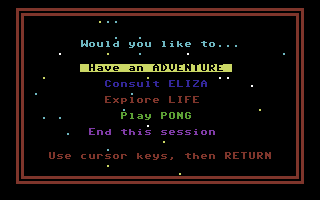
Golden Oldies: Volume 1 delivers a quartet of foundational titles that, together, span the earliest experiments in interactive entertainment. Each mini-game is its own distinct experience: Eliza’s conversational algorithm simulates basic therapy sessions, Conway’s Life invites you to sculpt evolving patterns on a grid, Adventure tests your wits in a text-only treasure hunt, and Pong pits you against a simple AI or a friend in ASCII paddle warfare. This variety packs a surprising amount of playtime into one budget package.
(HEY YOU!! We hope you enjoy! We try not to run ads. So basically, this is a very expensive hobby running this site. Please consider joining us for updates, forums, and more. Network w/ us to make some cash or friends while retro gaming, and you can win some free retro games for posting. Okay, carry on 👍)
The loose adaptations can feel both charming and rough around the edges. Eliza’s dialogue tree is serviceable but pared down compared to more modern ports—responses loop quickly, and the script occasionally stumbles over unrecognized inputs. By contrast, Life offers the most robust interaction: you can choose from preset configurations like the famous glider gun, explore random seeds, or even nudge cells yourself to see emergent behavior in real time.
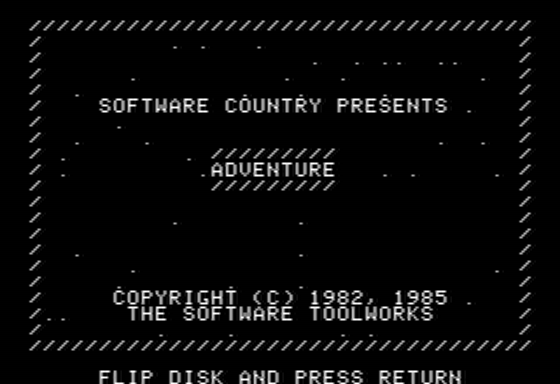
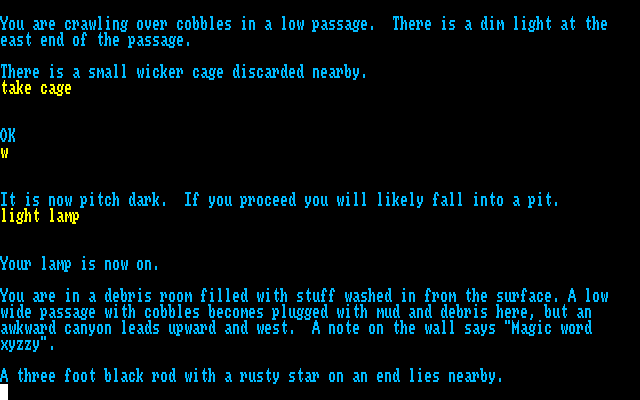
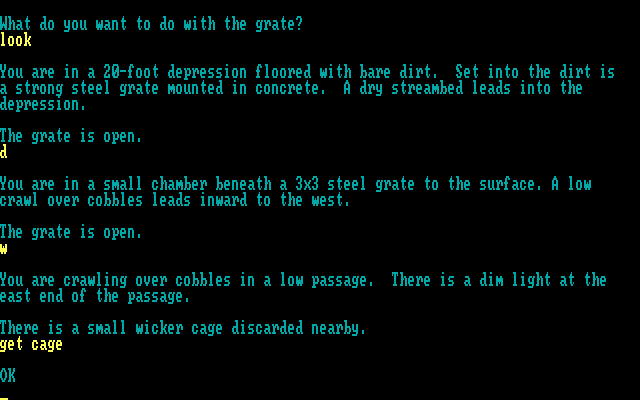
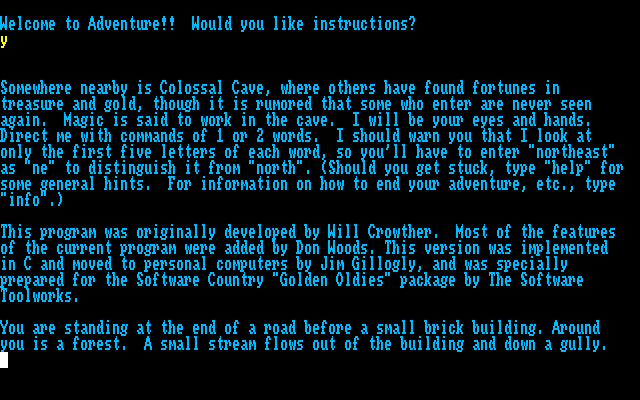
Adventure preserves the pulse of Crowther’s original cave exploration, complete with inventory puzzles and cryptic clues. It may frustrate newcomers with its terse text prompts, but for veterans of the 1970s era, it hits all the right nostalgic notes. Pong is the briskest diversion, relying on retro ASCII graphics and simple physics. Its colorized variant adds a splash of vibrancy, though the core gameplay remains a matter of precise timing and reflexes.
Overall, the gameplay suite acts less as a polished modern collection and more as a curated museum exhibit. You won’t find hand-holding tutorials or fancy achievements here—just bare-bones interfaces that let you experience digital history firsthand. For players seeking quick, bite-sized sessions or an appreciation for gaming’s roots, Golden Oldies succeeds admirably.
Graphics
Graphical fidelity in Golden Oldies is necessarily primitive, since these are text and character-based programs at heart. Pong’s ASCII court evokes its arcade ancestor in stark monochrome blocks, while the optional color mode adds red and green highlights that make each rally a bit more eye-catching. There’s a nostalgic pleasure in squinting at characters on a dark background, recalling the days when pixel precision was an art form.
Conway’s Life uses simple symbols—dots, Xs, or shaded blocks—to represent living cells. Despite the minimal palette, the animations of patterns emerging, colliding, and dissolving hold a captivating beauty. Watching a glider gun steadily produce gliders is almost meditative, and the presets display several of Life’s most elegant formations. Though there are no high-res sprites or shaders, the satisfaction lies in pure algorithmic motion.
Adventure and Eliza lean entirely on text. Adventure’s black-and-white terminal style feels authentic, but some modern players may yearn for color or graphical maps to aid navigation. Eliza’s interface mimics early computer chat logs: user inputs appear on one line, followed by the simulated therapist’s response. The aesthetics are undeniably sparse, yet they reinforce the pioneering spirit of the era.
While there’s no modern graphical overhaul or optional skinning, the collection’s visuals underscore its authenticity. Golden Oldies isn’t about eye candy; it’s a time capsule that shows how far digital display technology has come. For enthusiasts of retro computing, this stark presentation is part of the appeal.
Story
In Golden Oldies, narrative depth varies wildly between titles. Adventure remains the only entry with an explicit plot: you descend into a network of caverns in search of treasure, solve riddles, avoid hazards, and gradually piece together a map of a sprawling underground world. Its storytelling is minimalist—pure text descriptions—but every “You are in a maze of twisty passages” moment sparks the imagination.
Eliza doesn’t tell a story in the conventional sense. Instead, it prompts you to project your own thoughts and emotions into a simulated therapy session. Its loosely branching dialogue offers the illusion of empathy, yet the lack of context or memory retention can feel jarringly mechanical. You won’t be swept up in a narrative arc here, but you may find it amusing or uncanny to watch the program mirror your inputs.
Conway’s Life and Pong are essentially story-less experiences, each defined by its rules rather than by characters or plot. Life unfolds as a zero-player game: you set the initial conditions and then watch geometric patterns ebb and flow according to simple automaton laws. Pong reduces interaction to a single goal—prevent the ball from passing your paddle—leaving no room for narrative beyond the thrill of competition.
As a collection, Golden Oldies reads more like an anthology of interactive concepts than a unified saga. If you’re seeking epic storytelling or richly drawn characters, you’ll find little to satisfy that craving here. Instead, these titles invite you to appreciate the raw mechanics and thought experiments that laid the groundwork for modern game narratives.
Overall Experience
Golden Oldies: Volume 1 is an essential piece of gaming archaeology. As probably the first retro-collection offered to the public, it captures a moment when enthusiasts began curating and preserving the earliest interactive software. Playing these four programs back-to-back provides a palpable sense of how far design philosophies and technology have evolved over the decades.
The collection’s strengths lie in its historical significance and educational value. Students of game design will recognize fundamental principles at work—dialog trees in Eliza, emergent systems in Life, text parsing in Adventure, and physics simulation in Pong. Even with their rough edges, these titles showcase the elegant simplicity that pioneering developers achieved under severe hardware constraints.
However, modern gamers may find the package too austere for extended play. The lack of modern conveniences—no save states for Adventure, no advanced AI options for Pong, limited command help in Eliza—can lead to frustration. Casual players expecting a polished compilation might be put off by the bare-bones presentation and steep learning curve of text interfaces.
Ultimately, Golden Oldies: Volume 1 is best suited for retro enthusiasts, history buffs, and curious newcomers willing to embrace its unvarnished approach. It offers a direct line to the conceptual roots of the medium, and for that alone, it remains a fascinating, if somewhat rough, tribute to gaming’s early days. If you value authenticity and want to experience seminal works firsthand, this collection is well worth exploring.


Reviews
There are no reviews yet.