 Retro Replay Retro Replay gaming reviews, news, emulation, geek stuff and more!


Retro Replay Review
Gameplay
Jill Goes Underground builds on the classic side-scrolling, platform-style action that made the original Jill of the Jungle titles memorable. Players guide Jill through a series of meticulously designed underground chambers, each packed with treacherous traps like fire-breathing statues, deadly spikes, and patrolling monsters. The game balances precision platforming with exploration, encouraging you to probe every corridor for hidden power-ups and secret passages.
(HEY YOU!! We hope you enjoy! We try not to run ads. So basically, this is a very expensive hobby running this site. Please consider joining us for updates, forums, and more. Network w/ us to make some cash or friends while retro gaming, and you can win some free retro games for posting. Okay, carry on 👍)
One of the standout features of the gameplay is Jill’s ability to transform into different creatures, each with its own unique abilities. Whether slipping through narrow tunnels as a nimble insect or barreling through obstacles as a sturdy beast, these transformations add a strategic layer to the platforming action. In human form, Jill wields a trusty knife, suitable for dispatching weaker enemies and triggering switches, but you’ll often find yourself relying on creature forms to tackle more complex hazards.
The difficulty curve is well-paced, with early levels serving as a tutorial for basic moves and transformations, then gradually ramping up in complexity and intensity. Occasional respawn points and generous life counts help mitigate frustration, while secret areas reward thorough exploration. Overall, the gameplay loop is engaging and offers a satisfying blend of challenge, puzzle-solving, and combat that should appeal to both veteran platformer fans and newcomers alike.
Graphics
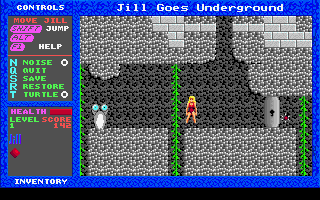
For a mid-’90s DOS title, Jill Goes Underground impresses with its vibrant color palette and finely drawn sprites. The jungle-themed levels from earlier entries give way to a darker, more foreboding atmosphere as Jill delves into Montezuma’s underground castle. Background tiles are richly detailed, featuring weathered stone walls, dripping lava pits, and moss-covered ruins that enhance the sense of ancient mystery.
Character animations have seen a noticeable upgrade compared to the first game in the trilogy. Jill’s running, jumping, and transformation sequences are smoothly animated, giving each movement a satisfying fluidity. Enemy designs range from simple critters to menacing fire-breathers, and each is rendered with enough distinctiveness to keep encounters visually interesting. Even the smaller environmental hazards, like rotating spikes and collapsing platforms, are clear and well-animated, reducing the chance of unfair deaths.
The musical soundtrack complements the visuals perfectly, layering atmospheric percussion and ambient chords to underscore the subterranean setting. While the tunes may loop after a few minutes, they never become annoyingly repetitive, and each level introduces subtle variations to keep the audio fresh. Sound effects—sword slashes, creature roars, and echoing footsteps—are crisp and help immerse you in Jill’s perilous journey.
Story
Plot in Jill Goes Underground remains straightforward yet effective: after exploring the jungle depths, Jill ventures into Montezuma’s castle with the singular goal of rescuing her Prince. There’s little in the way of elaborate cutscenes or dialogue, but the premise provides a clear motivation that ties each level together. The underground castle setting feels suitably ominous and rewards forward momentum with occasional visual nods to the broader jungle trilogy lore.
Storytelling here relies on environmental cues rather than text-heavy exposition. Ancient murals on the walls hint at past civilizations, and scattered treasure chests suggest that Montezuma’s downfall may hold unexpected secrets. While purists might long for more narrative depth, the minimalist approach allows the gameplay to take center stage and keeps the pace brisk.
Jill’s character remains a silent protagonist, but her determination comes through in her rapid movements and fearless dives into danger. This classic action-hero archetype works well within the game’s framework: you know exactly what she’s fighting for, and the castle’s oppressive ambiance makes each rescue attempt feel more urgent. The result is a modest yet fitting continuation of the Jill of the Jungle saga.
Overall Experience
Jill Goes Underground offers a polished platforming experience that successfully builds upon its predecessors. The combination of refined controls, varied transformations, and intricately designed levels results in a game that feels both fresh and familiar. Even decades after its release, the core mechanics hold up, delivering satisfying precision and rewarding exploration.
While the lack of a deep narrative or voiceovers may leave players seeking a more cinematic journey wanting, the game never pretends to be anything more than a tight, action-oriented platformer. Its charm lies in crisp level design, fluid animation, and a soundtrack that enhances rather than distracts. Hidden areas and optional challenges provide substantial replay value for completionists and speed-runners alike.
Whether you’re revisiting a childhood favorite or discovering Jill’s underground exploits for the first time, this entry in the Jill of the Jungle trilogy remains a testament to early ’90s platforming ingenuity. It’s easy to recommend to fans of the genre and anyone looking for a challenging yet fair adventure through ancient ruins and dark catacombs.


Reviews
There are no reviews yet.