 Retro Replay Retro Replay gaming reviews, news, emulation, geek stuff and more!


Retro Replay Review
Gameplay
LineWars II puts you in the cockpit of a sleek space fighter as you tackle ten distinct scenarios, each packed with ten objectives that span asteroid blasting, pirate elimination, patrols, and ship escorts. The mission structure is straightforward yet demanding, requiring careful planning and quick reflexes. From the moment you launch into space, you’ll find yourself juggling multiple goals—protecting convoys, clearing asteroid fields, or hunting down elusive pirate vessels—all while managing your ship’s limited resources.
(HEY YOU!! We hope you enjoy! We try not to run ads. So basically, this is a very expensive hobby running this site. Please consider joining us for updates, forums, and more. Network w/ us to make some cash or friends while retro gaming, and you can win some free retro games for posting. Okay, carry on 👍)
What sets LineWars II apart from more dogfight-focused shooters is its emphasis on a hunting-like rhythm. Instead of endless circles around a target, you’ll navigate shadowed asteroid belts and pinpoint enemy hideouts by scanning for faint glimmers on your HUD. The lack of traditional lock-on systems and the radical light-sourcing of the engine create tense, methodical engagements. Every shot must count, and every maneuver can expose you to ambushes lurking in the darkness.
The shareware model gives players a taste of the demo mission, while registered users unlock nine additional single-player missions and multiplayer support over modem and LAN. This scalable approach allows newcomers to sample the core mechanics before committing, and veteran pilots to hone their skills in increasingly difficult environments. The variety of objectives ensures that no two missions feel the same, fostering a satisfying sense of progression as you adapt to new challenges and threats.
Graphics
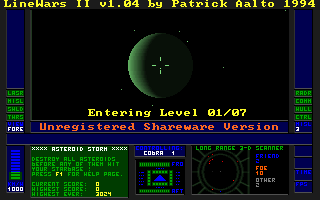
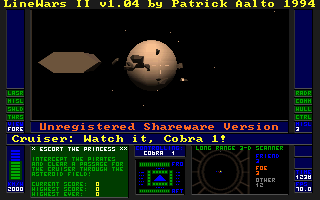
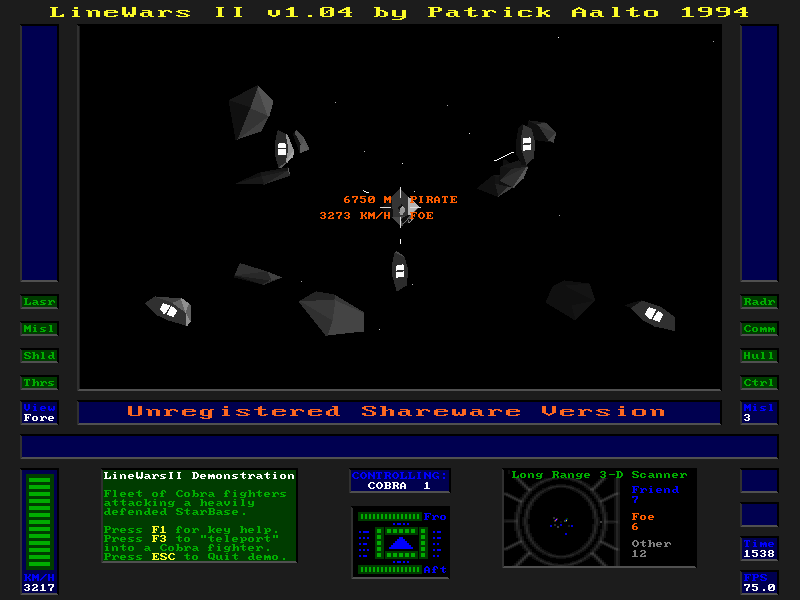
LineWars II’s polygon-based engine focuses on line-drawing and bold lighting effects to create a believable—and often disorienting—space environment. By emphasizing stark contrasts between illuminated ship hulls and jet-black voids, the game conveys the perilous nature of space travel without relying on texture maps or pre-rendered backgrounds. Each asteroid casts long, shifting shadows, making simple navigation an exercise in spatial awareness.
Despite its minimalist aesthetic, the visuals hold up well for a mid-’90s shareware title. Enemy fighters are rendered with crisp wireframe outlines that pulse under your weapon fire, while explosions bloom into clusters of glowing lines that dissipate realistically. This lightweight approach keeps frame rates steady, even during large-scale engagements, ensuring that gameplay remains responsive when the action heats up.
Lighting serves a dual purpose: enhancing atmosphere and influencing gameplay. Asteroids and derelict ships block ambient light, plunging sections of space into near-total darkness. This design choice forces you to rely on your radar and brief illumination bursts, heightening tension every time you lose visual contact with your target. By turning darkness into both an ally and an adversary, LineWars II transforms each mission into a suspenseful hunt rather than a straightforward dogfight.
Story
The narrative in LineWars II is simple but effective: as a freshly licensed space fighter pilot, you’re posted to a remote outpost in the Deneb star system that has seen no action for years. Your only colleagues are an old cyborg pilot whose metal limbs have more battle history than most fleets, and the stoic starbase captain overseeing operations. At first glance, it seems like a desk job—until an unexpected asteroid storm barrels toward the station, triggering a chain reaction of pirate activity and lurking dangers.
Each mission unfolds against this backdrop of escalating tension. Between asteroid waves and pirate raids, you’ll piece together hints of a larger conspiracy threatening the sector. The dialogue is sparse but purposeful, delivered through mission briefings and radio chatter that lend a cinematic feel without bogging down the pace. Though the characters are archetypal, their terse exchanges and the mounting stakes drive home the isolation and urgency of your assignment.
LineWars II strikes a balance between classic space shooter simplicity and a narrative that keeps you invested. There are no sprawling cutscenes or overly complex lore dumps—just a steady drip of information that propels you from one mission to the next. By the time you face the final scenario, you’ll feel the weight of every past engagement, making the climax a true culmination of your efforts as Deneb’s last line of defense.
Overall Experience
LineWars II combines tight, hunt-oriented gameplay with a distinctive visual style and an engaging, if straightforward, story. The shareware demo offers a generous glimpse into the first mission, while registered players gain access to nine more single-player scenarios and competitive or cooperative play over modem and LAN. This flexibility makes it appealing to both solo pilots and groups looking for retro space combat.
Performance is reliably smooth, even on modest hardware, thanks to the game’s efficient polygon-and-line architecture. While you won’t see photo-realistic textures or modern shader effects, the stark environments and dynamic lighting create an immersive atmosphere that few contemporary shareware titles can match. LineWars II’s strength lies in its ability to turn visual simplicity into a feature—encouraging strategic thinking and rewarding careful observation.
For fans of classic 3-D space shooters like Wing Commander, LineWars II delivers a satisfying blend of challenge, variety, and atmosphere. Its incremental difficulty, mission diversity, and hidden narrative layers provide hours of gameplay, and the network options extend replay value long after the single-player campaign ends. If you’re looking for a shareware-era title that balances nostalgia with innovative design decisions, LineWars II is a solid choice that still stands out decades after its release.
Reviews
There are no reviews yet.