 Retro Replay Retro Replay gaming reviews, news, emulation, geek stuff and more!

Retro Replay Review
Gameplay
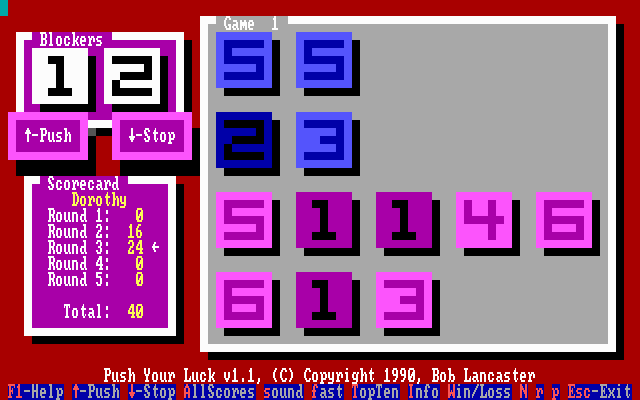
MicroLink Push Your Luck translates the timeless thrill of dice rolling into a straightforward yet deeply strategic computer game. Each of the five rounds begins with you rolling two “blocker” dice, which set the numbers you must avoid on subsequent rolls. Then, with up to five dice in hand, you choose how far to push your luck—accumulating points while hoping not to roll a blocker number.
(HEY YOU!! We hope you enjoy! We try not to run ads. So basically, this is a very expensive hobby running this site. Please consider joining us for updates, forums, and more. Network w/ us to make some cash or friends while retro gaming, and you can win some free retro games for posting. Okay, carry on 👍)
The tension is immediate: every extra roll can deliver valuable points or abruptly end your turn. If a die shows a blocker value, that die is immediately removed from play and yields no points. Push your luck too far and you risk losing access to all your dice, potentially scoring zero for the entire round. The decision to bank early or gamble on an extra roll becomes a pulse-pounding choice that will resonate with fans of risk-reward gameplay.
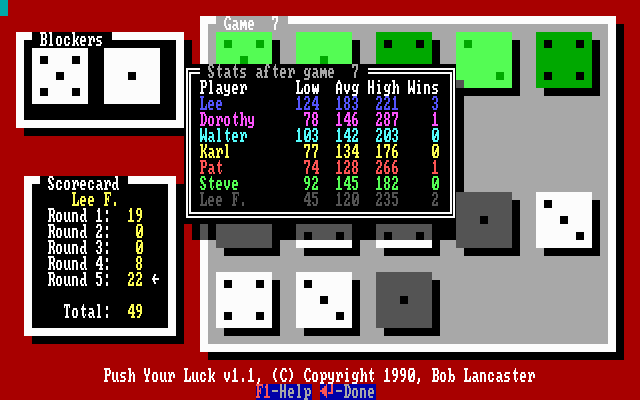
Over five rounds, you’ll refine your instincts. Early missteps can be recovered with bold moves in later rounds, but consistency wins out. The simple ruleset belies a wealth of tactics, from knowing when to quit a hot streak to calculating odds based on remaining dice. As each round concludes, you tally your score and compare it to your best friends—or your own previous high score—striving for mastery of this digital dice festival.
Graphics
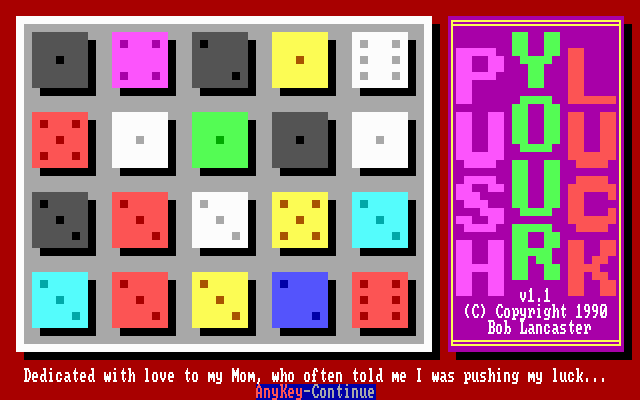
While MicroLink Push Your Luck was built for PC/XT/AT hardware in the DOS era, its visuals feel surprisingly vibrant thanks to ANSI character art. Rather than drab text or rudimentary CGA palettes, the game uses extended character sets and a broader color range to delineate dice faces, scoreboards, and notifications, lending a more polished aura to the screen.
Dice are depicted as clusters of colored blocks and symbols, making each roll instantly legible. Blocker values flash in a contrasting hue whenever they appear, helping players quickly gauge danger. Animations are minimal—dice “roll” by briefly alternating patterns—but the pacing strikes an excellent balance between responsiveness and the satisfying illusion of randomness.
Audio is delivered through the PC speaker, which means bleeps, beeps, and simple chimes accompany your rolls and round conclusions. It’s basic by modern standards, yet endearing in its retro charm. Fans of vintage PC gaming will appreciate how sound cues reinforce the tension of each dice release.
Story
Push Your Luck doesn’t attempt to spin a grand narrative or weave elaborate characters into its framework. Instead, it embraces the purity of classic tabletop gameplay, presenting a minimalist setting where luck, timing, and decision-making take center stage. This bare-bones approach encourages players to craft their own stories around each dramatic dice roll.
The absence of a traditional storyline allows for endless replayability. Every session writes its own arc—epic comebacks, nail-biting gambles, and heart-stopping busts become the tales you recount after the final tally. The game’s “narrative” is thus generated by you and your opponents as dice tumble and fortunes change.
Though there is no hero’s journey or sprawling lore, Push Your Luck evokes a shared social experience. It captures the atmosphere of gathering around a table with friends, passing dice from hand to hand, and cheering or groaning at every twist of fate. In that sense, the story lives in the reactions it provokes.
Overall Experience
MicroLink Push Your Luck offers a compelling blend of simplicity and depth. It excels as a pick-up-and-play title, inviting newcomers with an easy-to-understand rule set, while offering seasoned players enough strategic nuance to keep sessions fresh. The five-round structure provides a quick yet satisfying playtime, perfect for short breaks or friendly competitions.
The retro presentation—ANSI graphics and PC speaker sound—adds nostalgic flair rather than feeling outdated. It’s a reminder of an era when gameplay innovation often outpaced hardware limits. For those curious about DOS-era design or fans of light strategic challenges, the title remains both accessible and engaging.
Ultimately, Push Your Luck stands on its core mechanic: the exhilarating risk-versus-reward dance of rolling dice. If you enjoy games that put your nerve and number-crunching skills to the test, this classic adaptation is worth exploring. Its straightforward interface, quick rounds, and nail-biting decision points deliver an experience that’s as entertaining today as it was on the original PC/XT/AT platforms.


Reviews
There are no reviews yet.