 Retro Replay Retro Replay gaming reviews, news, emulation, geek stuff and more!


Retro Replay Review
Gameplay
The Tandy 1000 adaptation of Monopoly remains remarkably faithful to the Parker Brothers’ original board game, capturing the strategic depth and player interactions that have made its tabletop predecessor a perennial favorite. Gibson’s menu-driven interface simplifies the process of property auctions, rent determination, and chance/community chest draws, allowing 2 to 4 players to seamlessly navigate each turn without the need for cumbersome rule lookups. The inclusion of all official rules means newcomers and seasoned Monopoly enthusiasts alike can dive into the full experience, negotiating trades, building houses and hotels, and feeling the tension of bank runs just as they would around a physical board.
(HEY YOU!! We hope you enjoy! We try not to run ads. So basically, this is a very expensive hobby running this site. Please consider joining us for updates, forums, and more. Network w/ us to make some cash or friends while retro gaming, and you can win some free retro games for posting. Okay, carry on 👍)
One standout feature in this shareware release is the Save Game option, a godsend for those marathon sessions that often stretch for hours. Whether you’re midway through a cutthroat property bidding war or locked in a dice-driven race to Boardwalk, simply hit the save command and pick up right where you left off later. This flexibility elevates the experience beyond what most early ’80s PC titles offered, turning an otherwise single-sitting affair into a campaign you can revisit over days or even weeks.
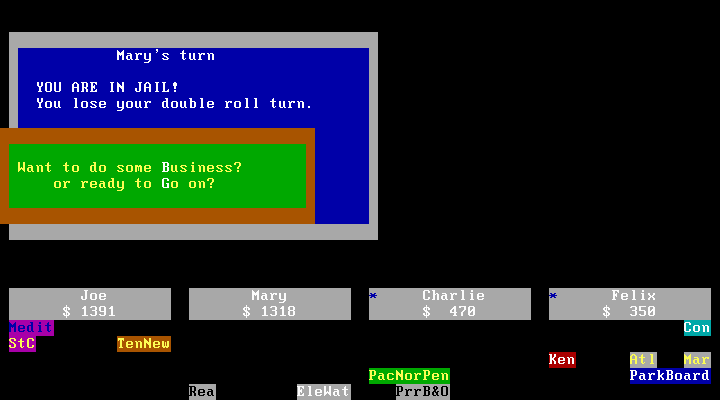
Interactivity shines through the clever use of pop-up menus, each rendered in a distinctive colored “window” that harkens back to early graphical shells such as Norton’s Batch Enhancer. Selecting options by typing the corresponding letter keeps gameplay snappy, with nested menus guiding you from general actions—like rolling the dice or managing your assets—to more specific transactions, such as mortgaging properties or engaging in player-to-player deals. This layered approach may have a slight learning curve, but once mastered it provides a fluid, keyboard-centric experience that rarely feels clunky or confusing.
Despite its text-based nature, the game doesn’t skimp on atmosphere. When it’s your turn to roll, the dice animate across the CGA board and emit an authentic rattling noise—the kind of auditory feedback that makes even a simple text-mode title feel surprisingly tactile. Between these animations and the occasional beep cues for important events, each turn feels alive, giving players subtle reminders of the stakes involved in every decision.
Graphics
Visually, Gibson’s Monopoly is unapologetically minimalist. The entire board is rendered in CGA text mode, composed of colored ASCII characters rather than bitmapped sprites. While this may sound limiting, the clever use of foreground and background hues delineates property groups, railroads, utilities, and corner spaces with effective clarity. It’s a far cry from modern standards, but for its era, it delivers exactly what players need: a clear, legible representation of the famous Monopoly board.
The menu windows further enhance readability, each framed with characters that simulate borders and shaded backgrounds that help differentiate active selections. This “windowing” system not only organizes information neatly but also gives the interface a pseudo-graphical feel, removing the flatness sometimes associated with pure text-mode applications. There are no scrolling playfields or zoomed-in property views, but the design makes efficient use of limited screen real estate to keep everything in view.
Given the constraints of the Tandy 1000 hardware and CGA output, the subdued color palette is actually an asset. Bright blues, reds, greens, and yellows pop against a dark background, making property names and menu options instantly recognizable. The simplicity of the visuals means loading times are almost nonexistent, and the board refreshes instantly after each dice roll or property transaction, keeping the pace brisk.
Audio cues, though sparse, integrate well with the textual graphics. The signature dice-rattling effect injects a surprising degree of polish, while other beeps signal bankruptcy, property purchases, and special card draws. These sounds lend character to the game without overwhelming the system’s limited sound capabilities, creating a balanced audiovisual package that remains engaging even decades later.
Story
While traditional narrative arcs are naturally absent in a digital board game adaptation, Monopoly’s enduring theme of capitalist competition provides its own form of emergent storytelling. Each match becomes a unique saga of real-estate rivalry, where fortunes can rise or collapse in a single dice roll. Players craft their own mini-thrillers—striking deals behind the scenes, forging alliances to thwart a runaway leader, or risking it all in hopes of a lucky Chance card.
This Tandy 1000 version doesn’t attempt to shoehorn in a backstory or cutscenes; instead, it honors the social tale inherent in Monopoly’s gameplay. The story unfolds dynamically around the table, shaped by your negotiation tactics and risk tolerance. Will you gamble on expensive hotels early on, or play it safe by collecting railroads? Every decision spins its own narrative thread, and the game’s strict adherence to the Parker Brothers rules ensures that no house-ruled shortcuts dilute the dramatic tension.
Those familiar with Monopoly lore will appreciate the consistency: the distinctly colored properties evoke memories of family game nights, while the familiar layout of Community Chest and Chance spaces sparks anticipation each time you pass “Go.” The absence of a guided storyline might feel austere to players seeking a more cinematic experience, but for purists, this digital rendition preserves the pure strategic storytelling that defines Monopoly’s rich heritage.
In sum, the narrative appeal lies in the unpredictable interplay among players rather than any scripted events. The sense of rivalry, camaraderie, and high-stakes finance is woven directly into the mechanics, allowing you and your opponents to become co-authors of each game’s unfolding drama.
Overall Experience
Playing Gibson’s shareware version of Monopoly on a Tandy 1000 is like time-traveling to the dawn of home computing, yet the experience remains surprisingly accessible and entertaining. Despite its age, the game’s faithful rule implementation, robust menu-driven interface, and clever use of text-mode visuals deliver a satisfying digital translation of the classic board game. The inclusion of a Save Game feature notably extends its appeal, letting you tackle sprawling sessions without fear of losing progress.
Fans of retro gaming will find joy in the interface’s nods to early PC utilities, while newcomers might be pleasantly surprised by how playable and engaging a text-mode board game can be. The crisp CGA graphics and minimal sound design won’t compete with modern video games, but they carry a nostalgic charm that underscores the title’s historical significance. More importantly, the gameplay holds up: strategy, negotiation, and a dash of luck still make each round compelling.
For those on a budget or collectors of vintage software, Gibson’s Monopoly offers an affordable entry point into classic computer gaming. As shareware, it invites you to try before you buy, ensuring you understand both its limitations and its strengths. If you crave a faithful, no-frills adaptation of Monopoly that emphasizes substance over spectacle, this is a worthwhile addition to your digital library.
Ultimately, Monopoly on the Tandy 1000 is a testament to what one dedicated programmer could achieve with Turbo Pascal and a handful of CGA colors. It doesn’t reinvent the wheel, but it faithfully preserves the core elements that make Monopoly a lasting favorite. Whether you’re reliving childhood memories or discovering the digital board game for the first time, Gibson’s adaptation offers a robust and charming experience that stands the test of time.


Reviews
There are no reviews yet.