 Retro Replay Retro Replay gaming reviews, news, emulation, geek stuff and more!



Retro Replay Review
Gameplay
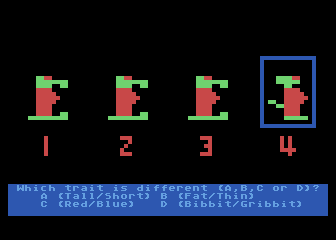
Moptown Parade’s core mechanic is delightfully straightforward: players select a series of colorful “Moppet” creatures and line them up in a queue, obeying a numeric rule that dictates how many traits must differ between consecutive creatures. At its simplest setting (one trait), children learn to spot single attribute changes—color, size or pattern—while at the maximum setting (four traits), the challenge encourages them to juggle multiple changes at once. This sliding scale of difficulty makes the learning curve gentle yet adaptable, catering to a wide age range within the target group of 4–7 years old.
(HEY YOU!! We hope you enjoy! We try not to run ads. So basically, this is a very expensive hobby running this site. Please consider joining us for updates, forums, and more. Network w/ us to make some cash or friends while retro gaming, and you can win some free retro games for posting. Okay, carry on 👍)
The interface is designed with young users in mind: large, clickable icons for each Moppet trait appear at the bottom of the screen, and on-screen prompts clearly state the current rule (“2 traits must differ,” for example). As each Moppet hops into place, the game provides immediate feedback—either a cheerful bell for a correct choice or a brief “oops” sound effect for a mismatch—reinforcing both right and wrong answers through simple audiovisual cues. This instant response loop keeps kids engaged and helps them internalize pattern-recognition concepts quickly.
Beyond individual levels, Moptown Parade offers an open-ended “parade builder” mode where learners can mix and match rules, colors, and shapes in free play. This sandbox environment encourages experimentation, letting children test hypotheses (“What happens if I swap the stripe for the polka dot?”) without penalty. The overall pace is unhurried, allowing beginners to take breaks, and more advanced kids to zip through sequences using higher trait counts, turning the experience into both a study tool and a playful diversion.
Graphics
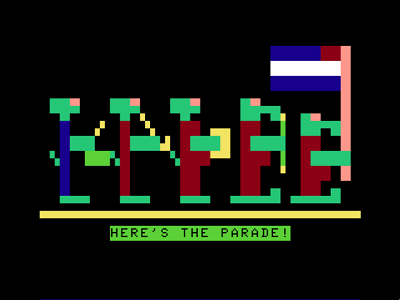
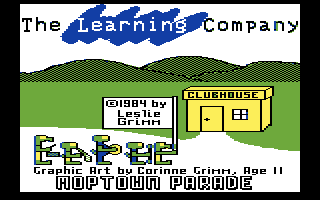
Visually, Moptown Parade is a charming time capsule of early ’90s educational software. The Moppets themselves are drawn with bold outlines and flat, cheerful colors—blue, red, yellow and green—ensuring each creature is instantly distinguishable. While animations are limited to hopping motions and simple flashes upon correct answers, they’re just lively enough to hold a young child’s attention without overwhelming them with visual complexity.
The backgrounds alternate between pastel-hued plazas, festive parade routes and blank boards designed purely for focus. Decorative elements—balloons, banners and confetti—add a celebratory feel to each round, subtly reinforcing the idea of a parade in progress. The user interface frames the action with clearly labeled buttons for adjusting difficulty, pausing the game and seeking help, all in a size and style that’s easy for small fingers to navigate.
Though by modern standards the graphics lack high-resolution textures or intricate shading, they serve their purpose superbly: the design prioritizes clarity of shapes and colors over flashiness. This aesthetic choice aligns perfectly with the game’s educational goals, ensuring that young players can concentrate on pattern rules rather than be distracted by extraneous details.
Story
Being an edutainment title, Moptown Parade doesn’t offer a deep narrative or branching plotlines. Instead, it sets up a simple premise: Moppets wish to march in a grand parade, but they must line up correctly to keep the crowd delighted. This light framing gives context to the pattern puzzles, turning abstract logic exercises into a playful procession where each correct match brings the next creature closer to the parade stage.
Though there’s no character development or dialogue, the implied “story” emerges through player actions. Every time a child completes a sequence, they witness a mini-celebration—balloons rise, music plays a short fanfare and the lineup advances. This scaffolding of cause-and-effect creates a sense of progression and achievement, suggesting a narrative arc of preparation and performance without requiring complex storytelling mechanics.
For parents and educators, this minimalist approach can be an advantage: children supply their own imaginative flavor, inventing backstories for each Moppet or imagining cheering crowds along the parade route. The game’s flexible setup allows for off-screen storytelling, making it easy to integrate role-play activities or thematic lessons—whether about colors, animals or community events—around the core puzzle action.
Overall Experience
Moptown Parade remains a solid choice for introducing young learners to the fundamentals of pattern recognition and logical reasoning. Its adjustable difficulty, immediate feedback and uncluttered interface make for a stress-free environment where success feels attainable and mistakes simply become opportunities to learn. Even decades after its initial release, the game’s design philosophy—simplicity paired with subtle encouragement—holds up well for its intended audience.
Parents will appreciate the game’s open-ended nature, which fosters both guided learning sessions and independent play. While advanced players might notice the lack of deeper mechanics beyond trait-count variation, most preschoolers and early elementary children will find the progression satisfying. The game also complements classroom activities, allowing teachers to link digital levels with hands-on exercises in sorting, classifying and sequencing physical objects.
In an age of flashy edutainment titles, Moptown Parade’s unassuming approach can feel refreshingly focused. It doesn’t rely on constant reinvention or complex narratives; instead, it hones in on one learning objective—pattern recognition—and refines it through incremental challenges. For families and educators seeking a straightforward, time-tested tool to develop early logic skills, Moptown Parade is a parade worth joining.


Reviews
There are no reviews yet.