 Retro Replay Retro Replay gaming reviews, news, emulation, geek stuff and more!
Retro Replay Review
Gameplay
Noctis offers an expansive sandbox of interstellar exploration that places the player firmly in the command seat of a lone scout ship. Unlike traditional space sims that focus on combat and trading, Noctis emphasizes discovery. You chart courses to any of the galaxy’s millions of star systems, provided you manage your fuel reserves carefully, much like the classic Frontier titles.
(HEY YOU!! We hope you enjoy! We try not to run ads. So basically, this is a very expensive hobby running this site. Please consider joining us for updates, forums, and more. Network w/ us to make some cash or friends while retro gaming, and you can win some free retro games for posting. Okay, carry on 👍)
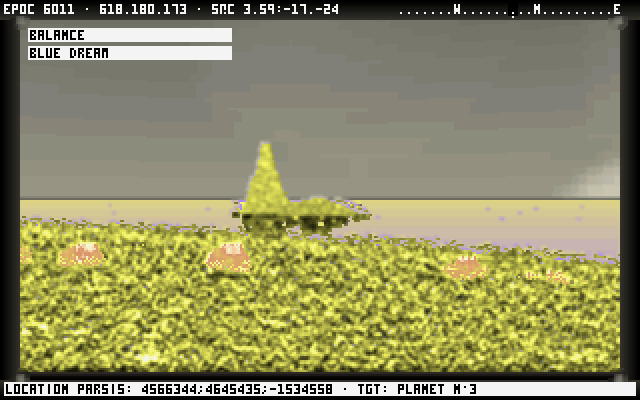
The procedure for landing on planets and moons feels intuitive yet challenging, drawing inspiration from the landing mechanics of Starflight. Each celestial body you approach may host unique terrain or environmental hazards, and successfully touching down often requires careful alignment and speed control. The thrill of descending through an atmosphere–or skirting the edge of a pulsar’s deadly radiation–becomes a highlight of each session.
One of the most compelling aspects of Noctis is its persistent universe. When you name a newly discovered star or planet and upload your findings, those labels persist for other players to see. Likewise, your game integrates discoveries made by the community, so every jump to hyperspace can reveal new data logged by fellow explorers. This social layer adds a surprising level of dynamism to what might otherwise feel like a solitary voyage.
The interface is straightforward, with cockpit instruments laid out in a functional wireframe design. Although some modern players may find the visuals simplistic, the clarity of the HUD makes navigation, resource management, and data logging quick and accessible. If you enjoy methodical planning, route plotting, and the sense of genuine frontier exploration, Noctis delivers a highly satisfying gameplay loop.
Graphics
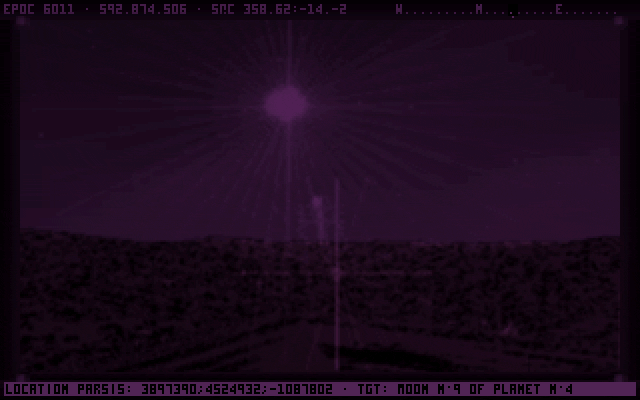
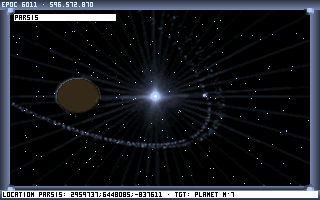
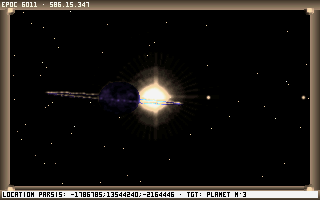
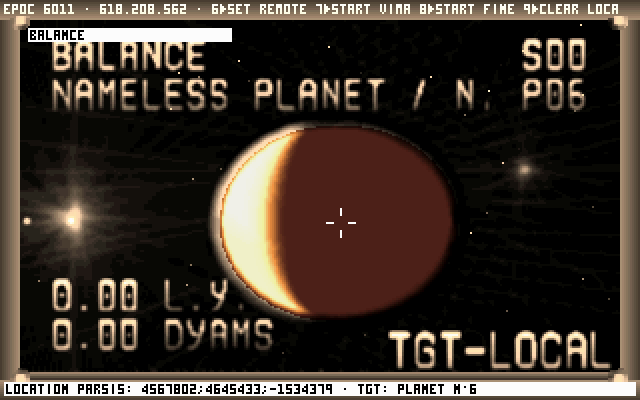
Noctis employs a retro-inspired aesthetic that leans heavily on vector starfields and color-coded wireframes. While it may lack the texture-heavy environments of contemporary sims, its minimalistic approach communicates crucial information at a glance. Star classes are distinguished by hue and intensity, making it easy to spot an S11 pulsar or an S00 sun from a distance.
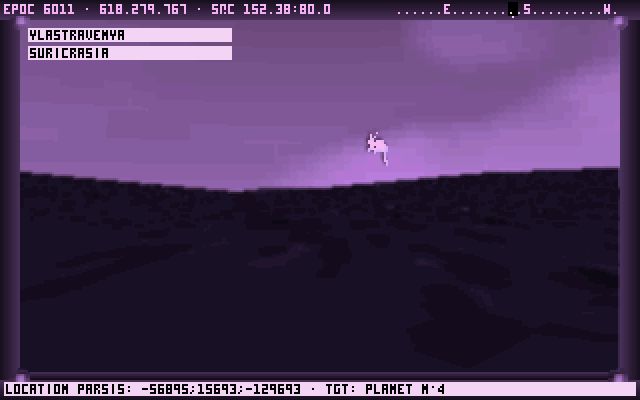
Planetary surfaces are rendered in basic shading schemes, but this simplicity belies the richness of each world’s procedural detail. Crater patterns, mountain ridges, and polar ice caps all receive unique topographies, ensuring that every landing zone feels distinct. The lack of high-resolution terrain meshes may disappoint some, but the procedural variety compensates by encouraging exploration.
The cockpit view remains uncluttered, prioritizing essential gauges such as fuel levels, scanner readouts, and gravity readings. Noctis forgoes photorealism in favor of practicality; you always know where to look when initiating a hyperspace jump or engaging precision landing protocols. This clear presentation is especially welcome during longer play sessions where information overload can become a concern.
Subtle ambient effects—distant nebula glows, pulsing star coronas, and dynamic starfield parallax—enhance immersion without taxing system resources. If you appreciate a nostalgic visual style that supports, rather than overshadows, the core experience of exploration, Noctis nails the aesthetic balance between function and atmosphere.
Story
Noctis doesn’t offer a traditional narrative with plot twists or character arcs; instead, it delivers an emergent story driven by the player’s own discoveries. Humanity’s sentient species has vanished, leaving behind only a fleet of scout vessels tasked with cataloging the galaxy. You become the chronicler, piecing together a silent saga through the names and notes you record.
The absence of NPC dialogue or scripted encounters might initially feel sparse, but the lore you uncover—whether it’s a strangely metallic moon or an ice world with fractal frost patterns—invites creative speculation. Each star system is a blank canvas, and your personal logs serve as the brush strokes of an overarching, user-generated chronicle.
Community-shared annotations further enrich the story. When you download others’ field notes, you might stumble across theories about vanished civilizations or wild geology that you would never have spotted on your own. This collaborative storytelling framework turns the galaxy into a living journal where the narrative evolves as more explorers contribute.
While some gamers yearn for cutscenes or voiced character interactions, Noctis appeals to those who find narrative meaning in pure discovery. Here, the story is the sum of countless personal logs—your own and everyone else’s—woven together into a tapestry of cosmic mystery.
Overall Experience
Noctis stands as a remarkable achievement, especially given its solo-development roots. The game’s ambition to recreate the awe of true galactic exploration shines through every jump, every landing, and every new system you catalog. There’s a tangible sense of scale and wonder that few modern titles attempt, much less accomplish.
Its blend of procedural generation, persistent universe mechanics, and community data sharing gives Noctis an enduring appeal. Even after dozens of hours, the prospect of finding an undiscovered star or naming your own moon keeps the experience fresh. The real-time simulation ensures that every decision—fuel management, travel route, landing approach—carries genuine weight.
Admittedly, Noctis may not satisfy those seeking fast-paced dogfights or intricate economic simulations. Its strengths lie in solitude, patience, and the joy of mapping the uncharted. For players who yearn for quiet reflection and the thrill of pioneering the unknown, Noctis is an essential journey.
In the end, Noctis succeeds by doing something different. It forgoes the usual tropes of space combat or trade pyramids and instead invites you to become the ultimate interstellar cartographer. If exploring the silent depths of a procedurally generated galaxy sounds like your idea of adventure, Noctis delivers an experience that’s as vast and mysterious as the cosmos itself.


Reviews
There are no reviews yet.