 Retro Replay Retro Replay gaming reviews, news, emulation, geek stuff and more!
Retro Replay Review
Gameplay
Paladin delivers a classic overhead turn-based strategy experience that excels in tactical depth and resource management. Players command their lone hero through a series of tile-based maps, carefully weighing each move against their limited Movement Points (MP). Every action—be it moving, opening doors, picking up loot, or casting a spell—eats into that character’s precious MP, forcing you to think several turns ahead to avoid costly mistakes.
(HEY YOU!! We hope you enjoy! We try not to run ads. So basically, this is a very expensive hobby running this site. Please consider joining us for updates, forums, and more. Network w/ us to make some cash or friends while retro gaming, and you can win some free retro games for posting. Okay, carry on 👍)
The turn structure is simple yet engaging: you act, your enemies respond, and the battlefield evolves accordingly. With spells, melee attacks, and utility actions all costing MP, the game strikes a satisfying balance between risk and reward. High-stakes scenarios like capturing strategic objectives or rescuing NPCs underscore the importance of conserving resources and positioning your Paladin effectively.
Adding to the replay value is the built-in level editor, which empowers you to design custom quests from the ground up. Whether you’re crafting elaborate mazes of traps or straightforward skirmishes against bandits, the editor’s intuitive interface ensures you can jump right into mission design. The fact that new Paladins can be created here—each with unique stats and growth paths—further extends the game’s strategic possibilities.
Graphics
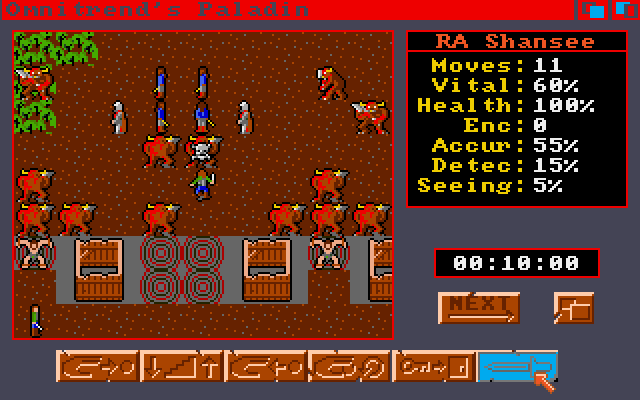
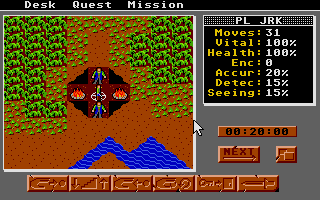
Visually, Paladin opts for a functional, tile-based aesthetic that pays homage to early ’90s strategy titles. The grid is clearly delineated, with distinct tile art for terrain, walls, and interactive objects such as doors or treasure chests. These clear visuals facilitate quick decision-making, as you can immediately discern chokepoints, cover, and enemy locations without hunting for subtle visual cues.
Character sprites are simple yet expressive, with the Paladin’s armor gleaming in metallic hues and enemy units color-coded by faction. Spell effects—like flaming missiles or healing auras—are rendered with straightforward animations, offering enough flair to feel impactful without overwhelming the screen. While the graphics may not break any modern benchmarks, they serve the gameplay superbly, keeping your focus firmly on tactical planning rather than flashy distractions.
The user interface is clean and unobtrusive. MP bars, health indicators, and action menus appear contextually, disappearing when not needed to leave the battlefield uncluttered. Even when you’re in the thick of a multi-map quest, the heads-up display remains consistent, so you’re always aware of your Paladin’s stats and available inventory without navigating through convoluted menus.
Story
At the heart of Paladin’s narrative is the journey from fledgling trainee to battlefield commander. You step into the boots of a would-be knight whose prowess in swordsmanship and leadership isn’t a birthright but a hard-won achievement. Each quest serves as a trial: repelling invaders, recovering holy artifacts, or escorting vulnerable villagers to safety.
While the overarching plot is modest, its episodic structure gives each mission its own mini-story arc. One map might pit you against a band of marauders in rolling hills, while another thrusts you into the dim corridors of a corrupt temple. These self-contained tales reinforce the theme of continuous growth and refinement as you hone your skills under pressure.
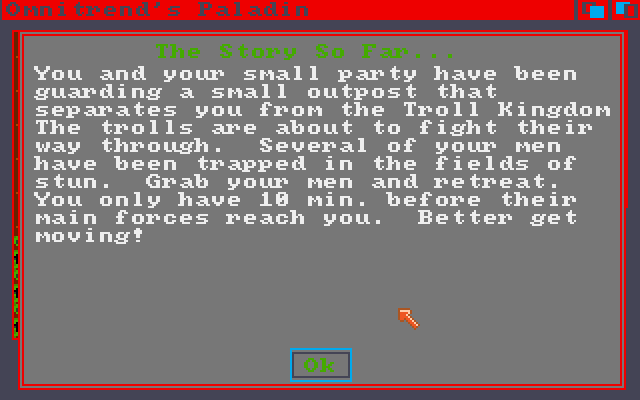
Between missions, brief text vignettes provide context—introducing new allies, revealing rival commanders, or hinting at an encroaching evil. Though the narrative never aspires to epic complexity, it offers just enough motivation to keep you invested in your Paladin’s rise to knighthood. The promise of unlocking new abilities and seeing your hero’s legend grow is a compelling carrot that consistently drives you onward.
Overall Experience
Paladin strikes a satisfying chord for fans of strategic, methodical gameplay. Its streamlined mechanics and clear visuals ensure that focus remains on tactical decision-making. The gradual progression system—where only your Paladin gains experience and new powers—provides a tangible sense of evolution, making each victory feel truly earned.
The inclusion of a level editor elevates the game from a fixed series of ten quests to a potentially endless library of custom challenges. Whether you’re experimenting with dungeon crawls, fortress sieges, or purely defensive scenarios, the editor’s flexibility breathes life into the title long after you’ve completed the built-in campaigns.
Though it leans into nostalgia rather than cutting-edge presentation, Paladin’s solid design, varied mission types, and customizable content make it a standout choice for players seeking a thoughtful strategy game. If you relish planning every move, adapting on the fly, and guiding a lone warrior to knighthood, Paladin offers a rewarding—and replayable—adventure.



Reviews
There are no reviews yet.