 Retro Replay Retro Replay gaming reviews, news, emulation, geek stuff and more!



Retro Replay Review
Gameplay
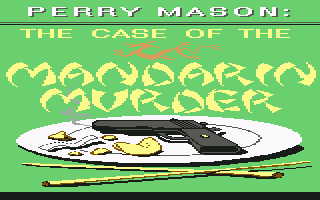
Perry Mason: The Case of the Mandarin Murder places you firmly in the role of the famed defense attorney, navigating a text-driven world that blends narrative description with graphic vignettes. Drawing inspiration from Infocom’s classics, the game challenges you to parse concise commands—EXAMINE, TALK TO, GO TO—as you explore rooms, collect clues, and interrogate witnesses. While the parser occasionally trips over unusual phrasing, it remains responsive enough to preserve the immersion, rewarding thoughtful input with richly detailed responses.
(HEY YOU!! We hope you enjoy! We try not to run ads. So basically, this is a very expensive hobby running this site. Please consider joining us for updates, forums, and more. Network w/ us to make some cash or friends while retro gaming, and you can win some free retro games for posting. Okay, carry on 👍)
Puzzles are at the heart of the experience. Whether you’re deducing the significance of a cryptic note or piecing together a timeline of events, each puzzle demands logical reasoning and patience. The game never holds your hand; instead, it expects you to cross-reference testimony, map out locations, and theorize about motive. This cerebral approach can feel slow to newcomers, yet it offers tremendous satisfaction when you finally corner a suspect with indisputable evidence.
Interactivity extends beyond simple item management. Dialogue sequences allow you to press suspects on inconsistencies, and the order in which you present evidence influences how the narrative unfolds. Some branches may lock you out of key testimonies if you push too hard or too soon, so meticulous record-keeping is essential. For dedicated players who appreciate methodical investigation, this level of depth elevates the gameplay from a mere puzzle hunt to a true legal drama.
Graphics
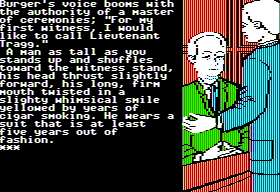
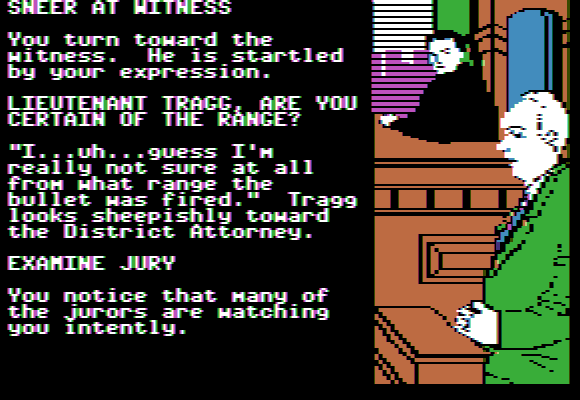
For a text adventure released in the late 1980s, the game’s graphics are surprisingly evocative. Each location—whether it’s the somber jail cell, the opulent mansion parlor, or the shadowy alleyway—features a static illustration that sets the tone without overshadowing the text. These black-and-white or limited-color stills serve as atmospheric anchors, helping to visualize the environment described in the prose.
While the pixel art lacks animation or dynamic lighting, it captures key details: the anxious expression on the defendant’s face, the pattern of brocade on an antique vase, or the distinct layout of the crime scene. These visuals are not mere window dressing; they reinforce narrative beats and occasionally hide subtle clues—such as a hidden compartment in a desk or a bloodstain on a floorboard—that you might otherwise overlook.
Compared to Infocom’s entirely text-based offerings, the graphical elements here feel like a welcome enhancement. They break up long passages of narrative, provide clear visual reference points, and contribute to an overall sense of place. Though primitive by modern standards, the graphics still succeed in immersing you in the smoky offices and mahogany-lined corridors of 20th-century Los Angeles.
Story
The plot of The Case of the Mandarin Murder is lifted straight from an Erle Stanley Gardner novel, with Perry Mason defending a woman accused of killing her wealthy husband. From the moment you enter the jail cell, the narrative unfolds with the signature twists and courtroom theatrics that made the original books so compelling. A cast of colorful suspects—including a scheming business partner, a secretive mistress, and a slippery butler—keeps you guessing until the final revelation.
Dialogue and descriptive passages are written in crisp, period-appropriate prose. You’ll encounter terse police reports, lawyerly cross-examinations, and vivid scene-setters that ground you in the grittier side of Los Angeles society. The writing balances exposition with suspense, revealing just enough backstory to motivate your inquiries without bogging down the investigation with extraneous detail.
What truly distinguishes the story is its legal edge. Unlike generic murder mysteries, you must think like a defense attorney: identify reasonable doubt, anticipate the prosecution’s moves, and craft an airtight case. This focus on courtroom strategy gives the narrative a unique flavor—one where the triumph of logic and rhetoric can feel as thrilling as a midnight chase sequence in other games.
Overall Experience
Perry Mason: The Case of the Mandarin Murder stands as a solid exemplar of late-era text adventures, marrying challenging puzzles with a rich detective drama. Its deliberate pace and emphasis on careful reasoning may deter players seeking nonstop action, but for aficionados of interactive fiction, it offers a depth that few contemporary titles can match. The occasional parser hiccup and lack of animation do little to undermine the core experience.
The game’s strengths lie in its faithful adaptation of Gardner’s world and its commitment to the analytical rigor of legal work. Whether you’re a fan of classic detective stories or simply curious about the origins of graphical text adventures, you’ll find plenty to admire. The sense of discovery—unraveling motives, uncovering hidden evidence, and outwitting the prosecution—remains as rewarding today as it was upon release.
For potential buyers, this title represents both a historical artifact and a genuinely engaging mystery. If you appreciate old-school gameplay, intricate puzzle design, and the chance to step into the polished shoes of Perry Mason, The Case of the Mandarin Murder is well worth investigating. Just be prepared to take meticulous notes, revisit locations frequently, and savor every moment of the legal battle ahead.



Reviews
There are no reviews yet.