 Retro Replay Retro Replay gaming reviews, news, emulation, geek stuff and more!
Retro Replay Review
Gameplay
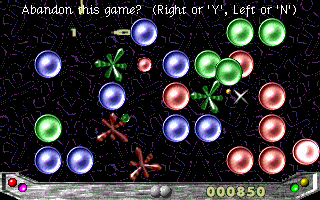
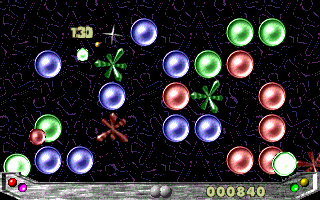
Pulse delivers a fresh twist on the traditional tile‐matching genre by replacing static blocks with freely roaming colored disks. Instead of dropping pieces into place, you use an attraction mechanic to pull scattered disks toward a focal point, creating clusters of four or more to clear them. This core loop feels immediately intuitive yet offers surprising depth as the difficulty ramps up.
(HEY YOU!! We hope you enjoy! We try not to run ads. So basically, this is a very expensive hobby running this site. Please consider joining us for updates, forums, and more. Network w/ us to make some cash or friends while retro gaming, and you can win some free retro games for posting. Okay, carry on 👍)
Once you clear a set of disks, you’re rewarded with a spiky piece of that same color. These spiky pieces introduce a multi‐stage combo system: gathering and clearing them yields triangles, and clearing triangles yields stars. Each stage adds complexity and encourages you to plan several moves ahead, balancing the need for quick clears against setting up bigger chain reactions.
As you advance through Pulse’s levels, power-ups and special events periodically shift the pace. You might earn a magnet burst that swallows nearby disks or trigger a “Pulse Storm” that shuffles all pieces on screen. These elements inject variety and keep the gameplay from feeling repetitive, though they also ratchet up the pressure as the playfield becomes increasingly crowded.
Graphics
Graphically, Pulse embraces a clean, neon-infused aesthetic that complements its fast-paced action. Each disk, spike, triangle, and star is rendered in vibrant colors against a dark background, ensuring that you can always distinguish individual elements even in the heat of a high-speed combo. The glowing edges and particle effects add flair without becoming visually overwhelming.
The user interface is equally polished: score tallies, level indicators, and power-up icons are neatly arranged around the playfield, never obscuring the action. Animations are smooth, and the transition from one level to the next is punctuated by dynamic visual cues that maintain momentum and keep you focused on the puzzle at hand.
Performance remains rock-solid even when dozens of pieces are swirling on screen. There’s no noticeable slowdown or stutter, which is crucial for a game that relies on split-second decisions. Whether you’re playing on a high-end PC or a midrange device, Pulse’s graphical presentation feels both responsive and stylish.
Story
Pulse opts for a minimalist narrative, presenting its puzzle challenges as stages in an abstract cosmic journey. Rather than a deep lore or character‐driven plot, the game conveys a sense of progression through its level design and evolving color motifs. Each “world” introduces new hues and background patterns, subtly suggesting forward movement without overwhelming you with exposition.
Ambient music and sound effects further reinforce the game’s atmosphere. A steady electronic beat underlies the action, punctuated by rising chimes whenever you complete a big combo. Though there are no voiced cutscenes, these audio cues create a mood that feels both energizing and slightly mysterious—ideal for players who prefer a puzzle game that keeps its story elements spare yet evocative.
For those who do enjoy a narrative hook, Pulse offers just enough thematic framing to make each level feel like part of a larger challenge. You’re not merely matching shapes; you’re stabilizing and harmonizing an ever-shifting energy field. It’s a light backdrop, but it gives purpose to the mechanics without detracting from the core puzzle experience.
Overall Experience
Pulse strikes an excellent balance between accessibility and depth. New players can immediately grasp the attraction mechanic and start clearing disks, while seasoned puzzlers will appreciate the multi-tiered clearing system and the strategic potential of power-ups. The gradual difficulty curve ensures that you’re never slammed with impossible challenges too early, yet veteran players will find plenty of room to improve their high-score runs.
The game’s pacing is one of its strongest assets. Early levels feel meditative and rewarding, but as disks proliferate, the action becomes a thrilling scramble. This ebb and flow keeps sessions dynamic, whether you’re tackling a single level or trying to beat your personal best in a marathon run.
In terms of replay value, Pulse excels. Daily challenges, unlockable color themes, and leaderboard integration encourage repeated play, and the simple premise means you can jump in for a quick five-minute session or immerse yourself for hours. For anyone seeking a fast-paced, visually striking puzzle game with a clever twist on familiar mechanics, Pulse is well worth exploring.


Reviews
There are no reviews yet.