 Retro Replay Retro Replay gaming reviews, news, emulation, geek stuff and more!
Retro Replay Review
Gameplay
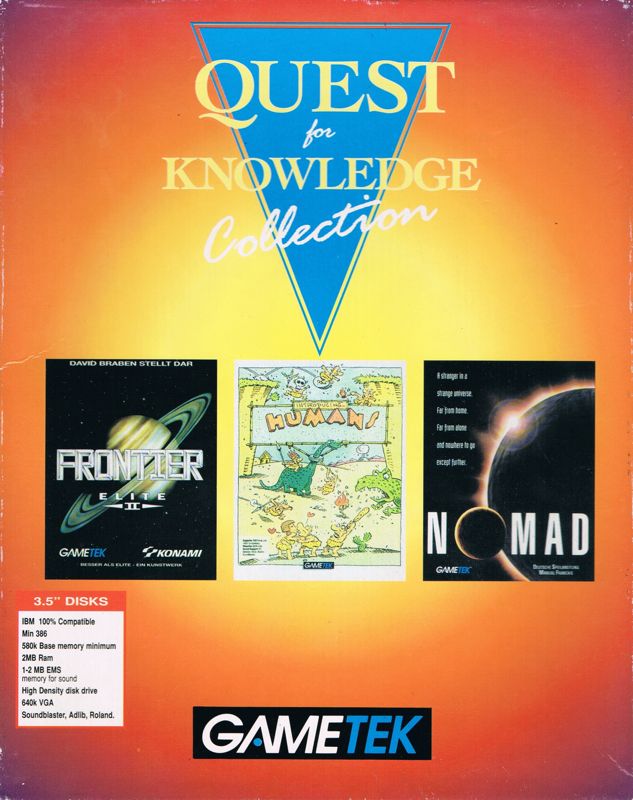
The “Quest for Knowledge Collection” delivers a remarkably diverse gameplay experience by packaging three distinct classics—Frontier: Elite II, Nomad, and Humans—onto one disc. In Frontier: Elite II, players are thrust into the vastness of space with an open-ended simulation that encourages exploration, trade, and combat under realistic Newtonian physics. The steep learning curve may intimidate newcomers, but those who embrace the challenge will find themselves immersed in a living galaxy where every decision carries weight.
(HEY YOU!! We hope you enjoy! We try not to run ads. So basically, this is a very expensive hobby running this site. Please consider joining us for updates, forums, and more. Network w/ us to make some cash or friends while retro gaming, and you can win some free retro games for posting. Okay, carry on 👍)
Nomad shifts gears entirely, offering an isometric puzzle-adventure that leans heavily on logic and environmental interaction. Here, you guide a lone explorer through a series of interconnected chambers, solving riddles and avoiding hazards. The puzzles ramp up in complexity at a steady pace, keeping the adrenaline high as you manipulate levers, move blocks, and decipher cryptic clues to unlock new areas.
Rounding out the trio, Humans delivers a side-scrolling platformer with a prehistoric twist. Rather than simply running and jumping, you command a tribe of cavemen to overcome obstacles by stacking, bridging gaps, and working together. Each level feels like a microcosm of cooperative strategy, demanding that you think several steps ahead to position your cavemen correctly and avoid pitfalls. Together, these three titles create a gameplay tapestry that caters to simulation enthusiasts, puzzle solvers, and platforming fans alike.
Graphics
Given their original release eras, the visuals in Frontier: Elite II are deceptively minimalist. Utilizing wireframe and rudimentary polygon models, the game conveys the immensity of space in a way that modern filters and scaling can only partially enhance. Starfields, planetary bodies, and the occasional enemy ship remain stark yet evocative, leaving much to the player’s imagination.
Nomad’s graphics adopt a colorful, pixel-art aesthetic that still holds charm decades later. The isometric viewpoint is crisply rendered, with each tile and sprite defined clearly enough to make puzzle elements stand out. Animations are simple but fluid, ensuring that objects react predictably to your input—a crucial feature for a puzzle-based title where precision is key.
Humans employs a more cartoonish palette, with larger sprites and expressive animations that emphasize the goofy antics of its caveman cast. Background backdrops are richly detailed for the genre, from lush jungles to volcanic lairs, and each level’s visual theme reinforces the unique challenges you’ll face. While none of these games compete with modern HD titles, their retro graphics are lovingly preserved and enhanced by running smoothly on contemporary hardware.
Story
Frontier: Elite II doesn’t hand you a scripted narrative but instead offers a sandbox epic. Your “story” emerges from the goals you set—be it mastering trade routes, carving out a bounty-hunting empire, or daring first contact with alien species. The absence of a fixed plot gives players the freedom to author their own spacefaring saga.
Nomad presents a more traditional storyline. You awaken stranded in an ancient labyrinth, with only fragmented journal entries to guide your progress. As you collect artifacts and decipher clues, a subtle backstory unfolds, hinting at lost civilizations and hidden technologies. The narrative thrust is never overbearing, allowing puzzle-solving to remain at the forefront.
Humans weaves a lighthearted tale of prehistoric survival. Each level offers playful context—recover lost eggs, fend off rival tribes, or escort elder cavemen to safety. The story serves chiefly as a backdrop for clever level design, but its tongue-in-cheek humor and charming characters make every victory feel worthwhile.
Overall Experience
One of the greatest strengths of the “Quest for Knowledge Collection” lies in its presentation: all three games arrive on a single CD, complete with scanned manuals and full documentation. The package replicates the authentic feel of 90s game ownership, from reading through strategy guides to consulting star maps and puzzle flowcharts. For retro enthusiasts and newcomers alike, this is a genuine time capsule.
The variety on offer ensures that you’re never bored. Whether you spend an afternoon charting uninhabited star systems, puzzling your way through intricate dungeons, or orchestrating prehistoric teamwork, each session feels fresh. The compilation also demonstrates the evolution of game design—transitioning from the open-ended ambition of Frontier, through the cerebral puzzles of Nomad, to the cooperative platforming of Humans.
Overall, this collection stands as both a nostalgic tribute and an educational glimpse into gaming’s past. While the graphics and interface may show their age, the core gameplay in each title remains compelling. For players eager to explore different genres and appreciate the roots of modern gaming, “Quest for Knowledge Collection” is an essential addition to the library.


Reviews
There are no reviews yet.