 Retro Replay Retro Replay gaming reviews, news, emulation, geek stuff and more!



Retro Replay Review
Gameplay
Rock-Slide nails the core appeal of classic digging-and-collecting puzzle games by leaning heavily into the Boulder Dash formula. You guide your character through nine carefully crafted caverns, digging through soft soil while avoiding the inevitable tumble of heavy rocks overhead. The simple rule—remove the ground beneath a rock, and it will fall—becomes the foundation for a variety of brain-teasing scenarios that escalate in complexity as you progress.
(HEY YOU!! We hope you enjoy! We try not to run ads. So basically, this is a very expensive hobby running this site. Please consider joining us for updates, forums, and more. Network w/ us to make some cash or friends while retro gaming, and you can win some free retro games for posting. Okay, carry on 👍)
The absence of enemies and a time limit might sound like it dilutes the challenge, but it actually adds a methodical layer of planning to each level. Without the pressure of racing against a clock or dodging creatures, Rock-Slide invites you to pause, survey the layout, and devise the safest route to claim all the prizes. Each of the nine levels forces you to think two steps ahead: one wrong move, and you risk burying your path or crushing your character under a cascading heap of boulders.
Prize collection in Rock-Slide isn’t just a simple grab-and-go affair. Because prizes don’t obey gravity, you can manipulate their positions by triggering rockfalls in the right sequence, creating momentary bridges or clearing new branches of dirt. This mechanic elevates the experience from a straightforward digger into a spatial logic puzzle, where timing and precision are just as critical as quick reflexes. For fans of cerebral gameplay, this one-two punch of gravity-based mechanics and careful plotting makes every level a satisfyingly tense exercise in problem solving.
Graphics
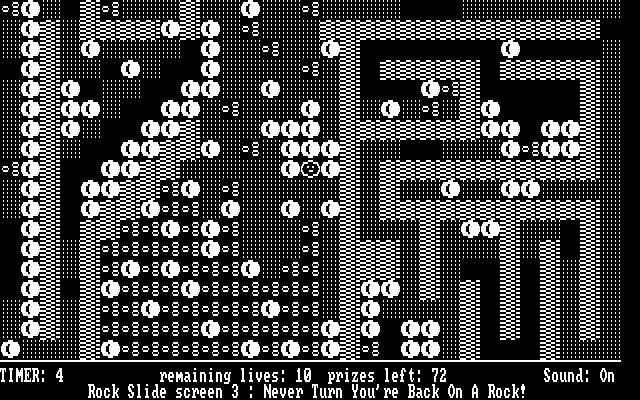
Visually, Rock-Slide opts for a bare-bones, retro pixel art style that feels right at home in the era of its inspiration. The cavern walls are rendered in earthy browns, the soil shifts in shades of tan, and the glint of each prize is immediately recognizable against the subdued backdrop. While the palette is limited, the overall consistency lends a charming authenticity to the throwback design.
Animations are kept to a minimum, but the way rocks tumble and settle feels weighty and believable. This subtle sense of physicality gives every move a satisfying heft: when you clear a tile beneath a stone, you can almost hear the thunk as it lands. The character sprite is small but expressive enough to signal walking, digging, and the unfortunate moment of getting squashed—a grim but useful bit of feedback for when your puzzle plans go awry.
The user interface remains unobtrusive, leaving the bulk of the screen dedicated to the action. A simple counter tracks how many prizes you’ve collected, and a level indicator shows your progression through the nine-stage gauntlet. It’s not flashy, and it doesn’t have the polished sheen of modern indie titles, but its clarity and straightforward design keep the focus on solving the puzzles rather than being distracted by bells and whistles.
Story
Rock-Slide doesn’t offer a deep narrative or a cast of memorable characters—nor does it really need to. Your objective is clear from the outset: penetrate the subterranean maze, gather all the treasures, and emerge victorious. What the game lacks in lore it makes up for in atmosphere, letting the distinctive chime of each successfully extracted prize and the danger of misjudged rockfalls tell their own tale.
If you’re craving a sweeping epic or rich character arcs, Rock-Slide will feel stark. However, many players will appreciate this stripped-down approach. By removing distracting side plots and cutscenes, the game creates a laser focus on pure puzzle engagement. You become the intrepid spelunker whose only companions are the earthy cavern walls, your trusty pickaxe, and the ever-present threat of gravity.
That said, there’s a certain romanticism in bending a minimalist plot to your imagination. You can envision yourself as a fearless treasure hunter, delving deeper into uncharted caverns for glory. The lack of explicit storytelling encourages players to craft their own adventures, which can be more compelling than any prefab script. In this way, Rock-Slide proves that a game can be narratively satisfying even when its story is written between the lines.
Overall Experience
Rock-Slide delivers a concise but robust puzzle experience that will resonate most with fans of retro gaming and methodical problem solvers. With its nine tightly designed levels, each challenge feels fair but never trivial, striking a sweet spot between nostalgic simplicity and modern puzzle depth. The absence of enemies and time constraints may initially seem like a downside, but it instead fosters a more cerebral, contemplative pace that sets it apart from more frenetic dig-and-dodge titles.
The aesthetic may be raw, and the story nearly non-existent, but these minimalistic choices are intentional design strengths rather than shortcomings. They place every ounce of attention on the interplay between you, the rocks, the prizes, and the dirt you carve away. If you appreciate games that reward careful planning over button-mashing reflexes, you’ll find Rock-Slide both challenging and immensely satisfying.
While it may not reinvent the wheel for puzzle-platformers, Rock-Slide stands as a polished homage to a classic formula. Its combination of weighty rock physics, gravity-defying prize mechanics, and unhurried strategic play creates a focused and replayable package. For anyone searching for a no-frills, deeply engaging puzzle game that harkens back to the golden age of digging adventures, Rock-Slide is well worth the dig.


Reviews
There are no reviews yet.