 Retro Replay Retro Replay gaming reviews, news, emulation, geek stuff and more!



Retro Replay Review
Gameplay
Sandstorm’s core gameplay loop revolves around three distinct mission types—Scud Defense, Jet Defense, and Tomahawk Offensive—each offering a different strategic challenge. In Scud and Jet Defense missions, you’re placed at a fixed battery point on the map, equipped with an arsenal of surface-to-air missiles. Enemies appear in waves from the horizon, and you must use the mouse to aim and fire, timing shots carefully to intercept incoming threats before they breach your city’s defenses.
(HEY YOU!! We hope you enjoy! We try not to run ads. So basically, this is a very expensive hobby running this site. Please consider joining us for updates, forums, and more. Network w/ us to make some cash or friends while retro gaming, and you can win some free retro games for posting. Okay, carry on 👍)
The Tomahawk Offensive missions flip the paradigm. Here, you’re in control of a cruise missile that must weave through enemy flak to reach a ground target. You plot the missile’s path with the mouse, avoiding anti-aircraft fire and obstacles, then lock on and release your ordnance only when perfectly aligned. This dynamic creates a thrilling cat-and-mouse feel, as you must balance patience—waiting for the right trajectory—with urgency—striking before flak density overwhelms you.
Across its twenty missions, Sandstorm steadily ramps up difficulty by increasing enemy numbers, introducing faster jets, denser missile salvos, and more complex terrain features. Early levels serve as a gentle tutorial, while later scenarios demand precise cursor control, split-second decision-making, and resource conservation. The game’s mix of defensive and offensive play keeps sessions fresh, preventing monotony even on repeat plays.
Controls are simple and responsive, with the mouse handling both pointing and firing functions. For purists, the single-button scheme echoes classic arcade simplicity; for modern players, it’s an intuitive bridge between retro design and today’s ergonomic expectations. One click fires a surface-to-air interceptor in defense missions or selects waypoints in missile runs, making for a smooth learning curve and minimal menu navigation.
Replay value stems from score-chasing and mission mastery. Each level tracks how many enemy units you destroy, so dedicated players can challenge themselves to clear waves flawlessly or shave seconds off Tomahawk runs by optimizing flight paths. Though there’s no online leaderboard, the in-game scoring system provides ample incentive to revisit conquered terrain and perfect your tactics.
Graphics
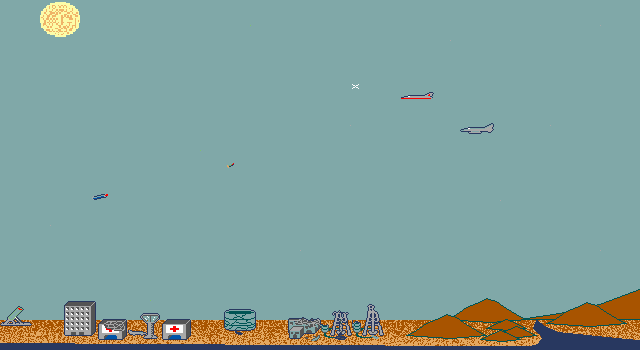
Sandstorm’s visuals embrace a retro 2D aesthetic that feels instantly familiar to fans of early ’90s PC strategy and action hybrids. The color palette is dominated by sandy tans, deep blues, and muted grays—evoking the stark deserts and twilight skies of the Gulf War theater. Despite its age, the game’s art style uses clean lines and contrasting hues to maintain clarity even when dozens of objects crowd the screen.
Enemy jets and missiles are represented by small but distinct sprites, each with simple yet effective animation frames. You’ll recognize incoming Scud missiles by their long white trails, while hostile aircraft flash in metallic gray as they streak overhead. Explosions burst into pixelated blooms of orange and red, offering pleasing visual feedback when you intercept threats or smash targets with your Tomahawk strike.
Map backgrounds vary subtly to break visual monotony: urban clusters of blocky buildings, winding roadways, and oil rig silhouettes appear beneath the action. Although there are no fully scrolling landscapes, parallax-style shifts in the horizon line during missile runs add depth to otherwise static scenes. These touches enhance immersion without taxing system resources.
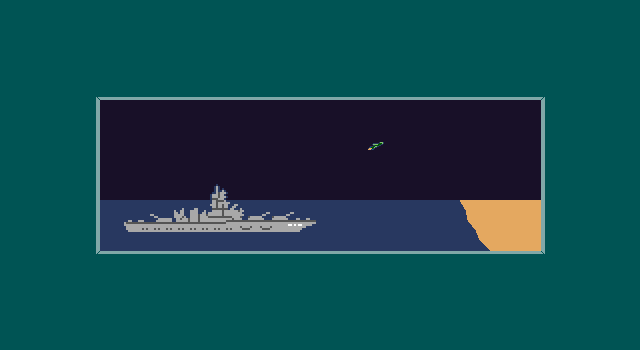
Cutscenes and transitions between missions are sparse but atmospheric. A simple text overlay outlines each objective, occasionally accompanied by a dated but serviceable map graphic showing your next destination. While there’s no voiceover, the minimal presentation leaves room for your imagination, letting you project the gravity of real-world events onto the pixelated tableau.
Overall, Sandstorm’s graphics may not rival modern 3D simulators, but its straightforward style delivers all the visual information you need. The clarity of sprites, the purposeful use of color, and the occasional background detail coalesce into an experience that’s both nostalgic and functionally effective in conveying battlefield stakes.
Story
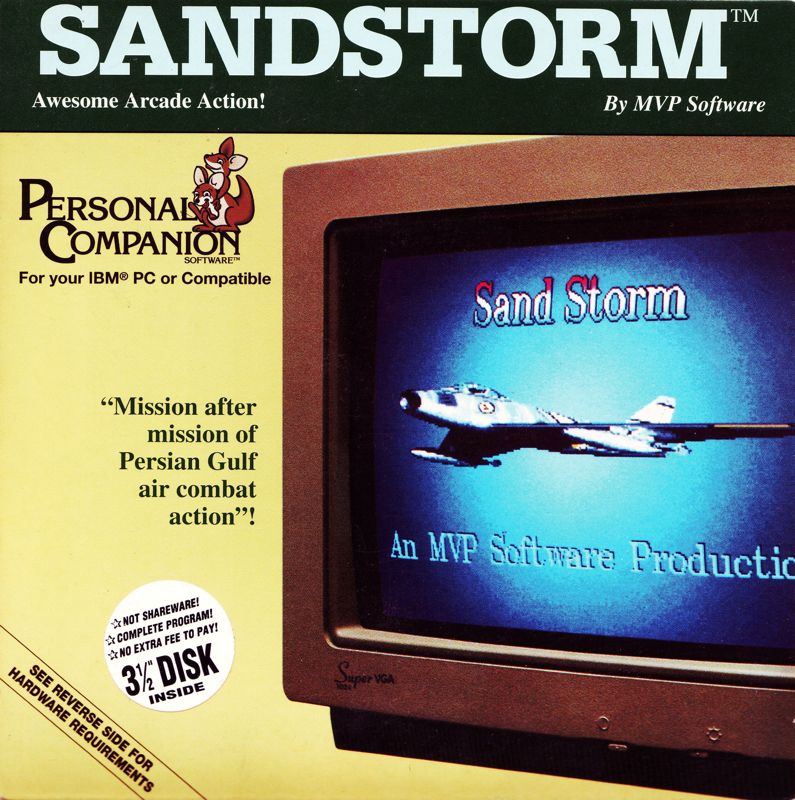
Sandstorm situates you in the heart of the Gulf War, tapping into the real-world tension of missile exchanges and aerial dogfights. The narrative is told through mission briefings rather than cutscenes, each summarizing the geopolitical stakes: protecting allied cities from Scud bombardment, defending airbases against attack, or disrupting enemy supply lines with a decisive Tomahawk campaign.
Although the story doesn’t delve into character arcs or moral quandaries, it captures the strategic pulse of modern conflict. You’re never just pushing buttons; you’re portrayed as a front-line operator whose split-second decisions have life-or-death consequences. The terse briefing texts—complete with target coordinates and intel on enemy defenses—serve as your mission dossier, grounding each level in plausible military objectives.
The game’s historical context is conveyed with enough detail to feel authentic without bogging down gameplay. Each mission briefing mentions real-world locations—oil fields, desert highways, urban centers—invoking the broader scope of the Gulf War. The lack of elaborate storytelling keeps focus on action, but players seeking a deeper narrative may find the minimalist approach leaves character development wanting.
Nonetheless, Sandstorm’s understated storytelling has a certain old-school charm. By prioritizing gameplay over cutscenes, it respects players’ desire for immediate engagement. The bare-bones plot serves its purpose: just enough context to make you care about stopping missiles and delivering precision strikes, without lengthy exposition or fantasy embellishments.
For history buffs or war game enthusiasts, the setting alone provides narrative weight. You’re not just playing whack-a-missile; you’re reenacting a pivotal moment in late 20th-century military history. That realistic backdrop gives each successful defense salvo or perfectly timed cruise missile launch a satisfying sense of achievement.
Overall Experience
Sandstorm offers a compact yet compelling package for anyone drawn to strategy-action hybrids or retro military simulations. Its balanced mix of defensive and offensive missions ensures that you’re never doing the same thing twice in a row, while the steady difficulty curve keeps both newcomers and veterans engaged. Mastery of the mouse-based controls is rewarded with higher scores and briefer mission times.
While some modern players may yearn for richer visuals or a deeper story, Sandstorm’s strengths lie in its focused design and pick-up-and-play accessibility. Sessions can be as short as ten minutes—perfect for quick bursts of adrenaline—yet also support extended play as you chase leaderboard-worthy performances. The simple UI and clear visual cues make it approachable, even if you’ve never touched a game from this era.
In terms of sound design, sparse beeps and alert tones punctuate each incoming threat, complemented by occasional voiceover prompts in mission briefings. The minimalist audio keeps you dialed into the action without overwhelming your senses, though an optional soundtrack might have heightened immersion for some players.
Ultimately, Sandstorm shines as a nostalgic throwback that still provides a solid challenge. Its reliance on tried-and-true gameplay mechanics—think Missile Command meets guided-missile puzzle—means it doesn’t reinvent the wheel, but it executes its concept with precision. For fans of military-themed arcade strategy or anyone seeking a palate cleanser between blockbuster shooters, Sandstorm remains a worthy diversion.
If you’re looking for a veteran-level bite-sized war game that rewards quick thinking and precise control, Sandstorm delivers an engaging, historically flavored experience. Its clear graphics, straightforward storytelling, and varied mission types combine into an overall package that’s both educational and entertaining, making it a worthwhile addition to any retro gaming library.

Reviews
There are no reviews yet.