 Retro Replay Retro Replay gaming reviews, news, emulation, geek stuff and more!
Retro Replay Review
Gameplay
Scroller delivers a pure, unfiltered side-scrolling platform experience that epitomizes early proof-of-concept game design. You guide a small, nimble character across flat terrain, using only the left and right arrow keys for movement. Jumping is deceptively simple—once airborne, your character continues in the last horizontal direction without further input, adding a subtle layer of inertia-driven challenge to each leap.
(HEY YOU!! We hope you enjoy! We try not to run ads. So basically, this is a very expensive hobby running this site. Please consider joining us for updates, forums, and more. Network w/ us to make some cash or friends while retro gaming, and you can win some free retro games for posting. Okay, carry on 👍)
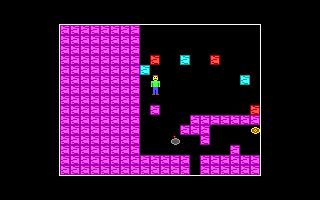
The primary objective in each level is twofold: dodge the slowly descending bombs and collect all 39 gold coins scattered throughout the stage. The bombs fall at predictably slow speeds, giving you time to plan your jumps, but their constant presence demands unwavering focus. As you rush to grab the final coins, the temptation to take riskier routes grows, creating an addictive tension that belies the game’s minimalist premise.
Though the controls are limited, the tightness of your inputs and the satisfaction of narrowly avoiding explosions bring an unexpectedly engaging rhythm to the gameplay. Each jump and turn feels deliberate; even in this basic framework, you can’t help but appreciate how well-tuned the timing and responsiveness are. It’s a testament to the game’s design ethos that so much challenge and fun arise from such fundamental mechanics.
For players seeking a deep, multi-layered adventure, Scroller might feel sparse. But for those who relish pure platforming skill tests and want to experience a slice of gaming history in its raw form, it serves as a fascinating exercise. Its concise level design encourages repeated playthroughs, as mastering the precise timing and optimal coin routes becomes a rewarding pursuit.
Graphics
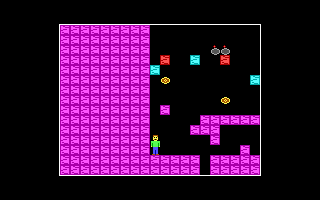
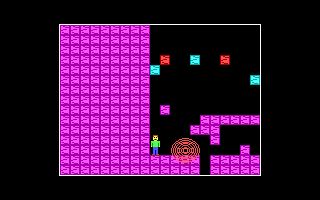
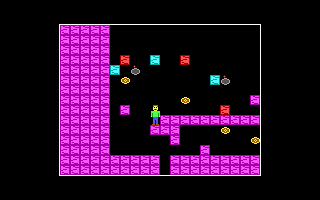
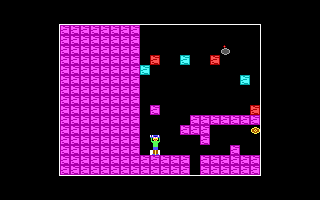
Visually, Scroller embraces a straightforward, retro pixel-art style that reflects its origins as an early development prototype. The color palette is limited but clean, with brightly colored coins standing out against neutral background tones. Characters and bombs are rendered in simple, blocky sprites that evoke the charm of classic 8-bit and 16-bit platformers.
While you won’t find lavish animations or parallax backgrounds here, the minimalism actually enhances the game’s clarity. Every visual element serves a purpose: the bombs are easy to spot from a distance, and the coins’ metallic sheen is instantly recognizable. There’s no visual clutter to distract you from the core challenge of timing your jumps and plotting your path.
The environments are similarly unadorned, featuring flat platforms and straightforward layouts that change subtly from one level to the next. This lack of visual extravagance can feel austere by modern standards, but it also underscores Scroller’s role as a developmental stepping stone rather than a fully polished retail product.
In short, Scroller’s graphics aren’t about pushing technical boundaries; they’re about functional design. If you appreciate nostalgia and can look past contemporary graphical expectations, you’ll find its pared-down aesthetic oddly compelling—each frame is a reminder of how gameplay can reign supreme when visuals march to the beat of simplicity.
Story
Scroller doesn’t boast a grand narrative or elaborate lore. There’s no antagonist issuing taunts, no epic quest to save a kingdom, and no branching dialogue trees. Instead, the “story” is distilled into a single, straightforward premise: dodge bombs, gather coins, and survive. This bare-bones approach harkens back to the earliest days of platform gaming, where challenges were defined by mechanics rather than plot.
That said, the game’s lack of narrative depth doesn’t feel like a flaw so much as a design choice. By eschewing cutscenes and backstory, Scroller keeps its focus laser-sharp on the act of play itself. You don’t spend time reading exposition; you spend time mastering jumps and refining your approach to each level’s coin layout and bomb pattern.
In a way, the absence of story invites players to project their own sense of purpose onto the experience. Are you a treasure hunter racing against time? An acrobat testing your reflexes? The simplicity allows your imagination to fill in the gaps, giving Scroller a surprisingly personal touch despite its utilitarian design.
For gamers accustomed to story-driven adventures, this title may feel more like a technical demo than a full-fledged narrative experience. However, its focus on pure mechanics leaves plenty of room for personal challenge narratives—every coin you snag and every near-miss with a bomb becomes part of your own highlight reel.
Overall Experience
As an early proof-of-concept, Scroller offers a glimpse into the development process of platform games, showcasing how core mechanics can stand on their own without the frills of modern production values. It’s a short, focused experience that tests your timing and precision, rewarding patience and practice more than narrative investment.
If you’re a retro gaming enthusiast or someone curious about the roots of side-scrolling platformers, this title is a small but informative piece of video game history. It’s succeeded by the more well-known Super Silverbrothers, but Scroller has its own unique charm, capturing a moment when game designers were experimenting with ideas that would later become genre staples.
That said, mainstream players seeking lengthy campaigns, varied worlds, and in-depth character progression might find Scroller’s scope limited. It’s best approached with tempered expectations, enjoyed as a concise trial of pure platform mechanics rather than a comprehensive entertainment package.
In the end, Scroller stands as both a nostalgic curiosity and a competent platformer in its own right. Whether you play it to appreciate its simplicity or to challenge your coordination, it delivers a straightforward, undiluted slice of side-scrolling action that remains engaging despite—or perhaps because of—its minimalist design.


Reviews
There are no reviews yet.