 Retro Replay Retro Replay gaming reviews, news, emulation, geek stuff and more!
Retro Replay Review
Gameplay
Shadow President places you in the Oval Office from day one, tasking you with steering the United States—and by extension, much of the globe—through a complex web of political, military, and humanitarian challenges. Rather than focusing on action-packed sequences, this title emphasizes careful decision-making. You’ll weigh the pros and cons of sending military aid to an unstable region, authorizing covert operations, or extending economic assistance to allies. Each choice ripples across international relations, domestic opinion, and your own approval rating.
(HEY YOU!! We hope you enjoy! We try not to run ads. So basically, this is a very expensive hobby running this site. Please consider joining us for updates, forums, and more. Network w/ us to make some cash or friends while retro gaming, and you can win some free retro games for posting. Okay, carry on 👍)
The depth of the simulation becomes apparent the moment you convene your cabinet meetings. Your advisors present conflicting viewpoints: the Defense Secretary pushes for a show of force, while the Secretary of State advocates diplomatic negotiations. Balancing these perspectives while monitoring real‐time newsfeeds and updating policies creates an immersive sense of presidential responsibility. Timely responses to crises—whether it’s a famine in East Africa or rising tensions in the Middle East—will define your tenure.
Controls are primarily menu-driven, relying on detailed reports, statistical charts, and resource allocations. It can feel daunting at first, but the interface rewards players willing to learn its intricacies. You allocate budgets to domestic programs like social welfare or scientific research, adjusting tax rates to appease voters without crippling the economy. The interplay between domestic approval and international influence encapsulates the “cause and effect” core of Shadow President’s design.
Throughout the campaign, special events—such as natural disasters, political scandals, and uprisings—will test your leadership style. Do you prioritize humanitarian aid over military intervention? Will you risk political capital to broker a peace deal or bide your time for a more opportune moment? These dynamic scenarios ensure that no two playthroughs feel alike, appealing strongly to strategy enthusiasts seeking high replay value.
Graphics
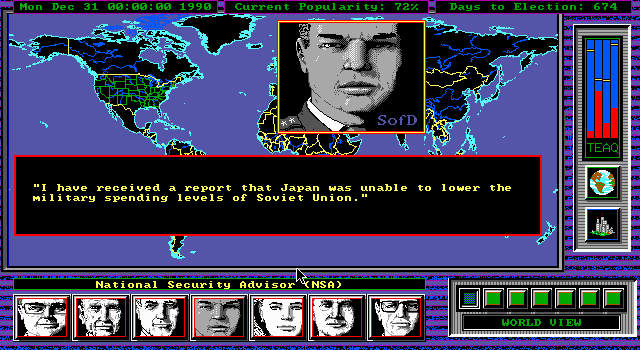
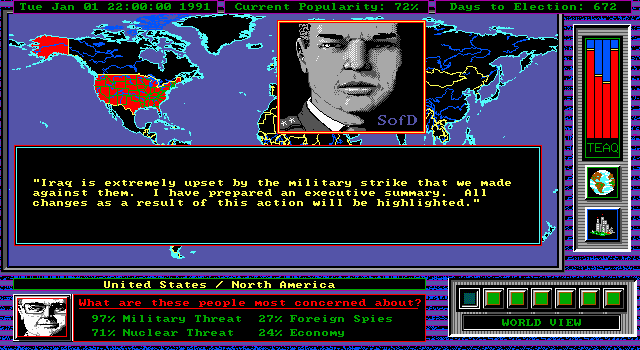
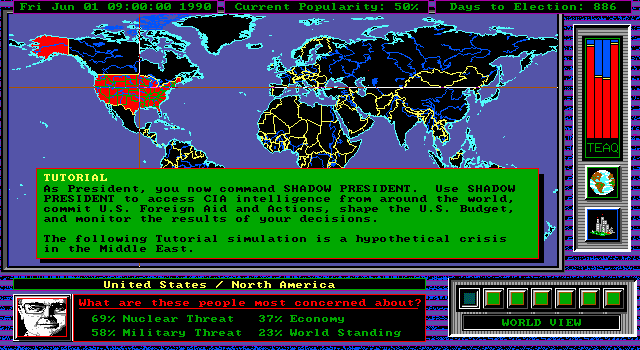
Visually, Shadow President opts for a functional, map-centric presentation rather than cinematic flair. The world map is laid out in muted earth tones, with clear geopolitical borders and icons representing conflict zones, natural disasters, or diplomatic missions. While textures and animations are minimalistic by modern standards, the interface conveys crucial information efficiently, ensuring you’re always aware of global hotspots.
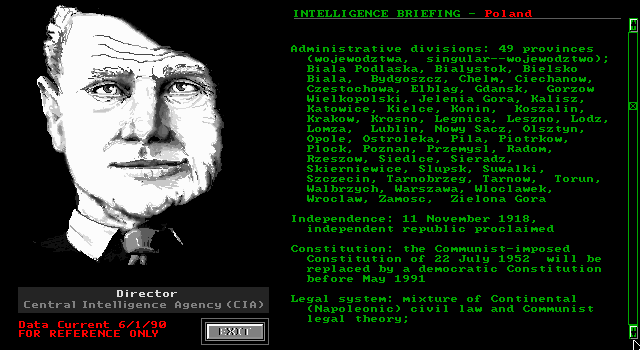
Portraits of world leaders and department heads appear during briefings, accompanied by succinct text boxes that outline their recommendations and concerns. The static nature of these character images might strike players seeking high-definition rendering or dynamic cutscenes as dated, yet this simplicity aligns with the game’s emphasis on policy over spectacle. The focus remains firmly on data and decision trees rather than graphical embellishments.
Charts and graphs display approval ratings, economic indicators, and military readiness, all rendered in crisp, legible formats. Customizable overlays let you track long-term trends—or zoom in on specific regions experiencing unrest. Though lacking flashy effects, the graphical design succeeds in keeping you engaged with the strategic flow of information, preventing unnecessary distractions from the core gameplay loop.
In today’s era of photorealistic visuals, Shadow President’s aesthetic may feel retro. However, its minimalistic approach fosters clarity and ease of interpretation. Fans of classic simulation titles will appreciate the straightforward layout and the absence of superfluous visual noise, which ultimately helps maintain immersion in the high-stakes realm of global governance.
Story
Shadow President forgoes a linear narrative in favor of an emergent storyline shaped by your actions. There is no fixed campaign arc; instead, the game generates crises and diplomatic opportunities on the fly, reflecting the unpredictable nature of world politics. Whether you face an escalating conflict in Southeast Asia or a critical environmental disaster in Latin America, the narrative unfolds based on how you respond to each event.
Your personal storyline as the newly elected President emerges organically through approval polls, media coverage, and public speeches. Masterful crisis management can catapult you to historic popularity, while missteps may trigger mass protests or even parliamentary investigations. This branching narrative structure makes your tenure feel truly personal, as triumphs and failures resonate beyond mere statistics.
Key moments—such as negotiating nuclear disarmament treaties or responding to terrorist threats—carry significant weight. The game’s built-in randomness ensures that even veteran players can be surprised by unforeseen developments, from sudden economic collapses to unexpected coups. These elements coalesce into a story that is less about a predetermined plot and more about the unique saga you craft through each decision.
In essence, Shadow President’s story is a tapestry woven from countless interconnected threads of policy, diplomacy, and public opinion. There’s no final ending sequence; instead, your legacy is measured in terms of world stability, domestic well-being, and your standing in the annals of political history. This open‐ended narrative will appeal to players who enjoy creating their own historical “what‐if” scenarios.
Overall Experience
Shadow President stands as a robust political simulator that challenges players to think like a head of state. Its learning curve may intimidate newcomers to strategy and management games, but those who invest the time will discover unparalleled depth and nuance. The absence of real‐time combat or flashy action sequences underscores the game’s unique focus: the complex cause-and-effect relationships in world governance.
Replaying scenarios with different strategies—such as pursuing aggressive military postures or championing global humanitarianism—reveals new outcomes and moral quandaries. The tension between maintaining domestic approval and projecting international strength creates ongoing drama, compelling players to weigh each decision carefully. Shadow President rewards foresight, adaptability, and a keen understanding of geopolitical dynamics.
While its visual presentation may not match contemporary AAA titles, the clarity of information and the gravitas of your responsibilities more than compensate. The simulation’s fidelity to real-world politics, combined with its rich event system, makes each session feel like a brain‐stretching exercise in leadership. For strategy fans seeking a cerebral, politically nuanced experience, Shadow President remains a standout choice.
Ultimately, if you’ve ever wondered what it’s like to navigate the labyrinthine corridors of power, Shadow President delivers an engrossing, immersive simulation. Its emphasis on cause and effect, coupled with a sandbox approach to global policy, provides an engaging platform for exploring the art of statecraft. Prospective leaders and political junkies alike will find this title both challenging and rewarding.



Reviews
There are no reviews yet.