 Retro Replay Retro Replay gaming reviews, news, emulation, geek stuff and more!
Retro Replay Review
Gameplay
The Forgotten Realms Archives offers an expansive array of gameplay experiences by bundling twelve classic PC titles under the iconic Dungeons & Dragons and AD&D rule sets. From the turn-based, tile-by-tile exploration of Pool of Radiance and Curse of the Azure Bonds to the fast-paced, hack-and-slash corridors of Dungeon Hack, this collection caters to a wide spectrum of CRPG tastes. Each game retains its original mechanics, meaning you’ll assemble parties, manage inventories, and carefully allocate experience points just as you would at a tabletop session.
(HEY YOU!! We hope you enjoy! We try not to run ads. So basically, this is a very expensive hobby running this site. Please consider joining us for updates, forums, and more. Network w/ us to make some cash or friends while retro gaming, and you can win some free retro games for posting. Okay, carry on 👍)
Party composition and tactical depth shine brightest in the Eye of the Beholder trilogy. First-person dungeon crawling in EoB I, II, and III demands attention to party roles—warriors at the front, clerics tending to wounds, and wizards blasting foes from the back ranks. Combat feels deliberate and weighty, with every arrow shot or fireball cast carrying real consequences. Resources are finite, and mapping your progress on grid paper (or an in-game map overlay) remains a satisfying ritual.
Beyond dungeon crawls, the Archives includes narrative-driven titles like Pool of Darkness and Secret of the Silver Blades, which play more like episodic campaigns in a serialized saga. Gateway to the Savage Frontier and Treasures of the Savage Frontier emphasize overland exploration on hex maps, shifting the pace to a broader strategic view. Lighter diversions such as Hillsfar’s mini-games and the Menzoberranzan adventure add variety, although some modern players may find their trial-and-error design dated. A demo of Blood & Magic further spices up the mix with limited, real-time tactics set in the same universe.
Graphics
Visually, the collection is a time capsule of late-’80s and early-’90s pixel art. Pool of Radiance and Curse of the Azure Bonds sport top-down views with vibrant but blocky sprites. In contrast, the Eye of the Beholder series presents richly detailed first-person corridors, atmospheric torchlight effects, and gruesome monster designs that still impress despite low resolution. Progression from EoB I’s 16-color palette to EoB III’s expanded palette demonstrates SSI’s steady refinement of its engine.
Each game’s interface reflects the era’s hardware constraints. Inventory screens are text-heavy, menus respond to keyboard shortcuts, and mouse support feels added on rather than baked in. While these UIs can feel clunky by modern standards, they contribute to the nostalgic charm and require little more than a few minutes of exploration to master. On systems running DOSBox or official re-releases, crisp emulation makes the original graphics pop on contemporary monitors.
Although the demo of Blood & Magic only hints at its unique card-based spellcasting and real-time skirmishes, the artwork on the cards and battlefield textures hint at a bold departure from pure turn-based design. Meanwhile, Savage Frontier titles use simple hex-map tiles and basic unit portraits, sacrificing graphic complexity for strategic clarity. Overall, while none of the games push today’s graphical boundaries, they each showcase the distinctive look of early AD&D video adaptations.
Story
At its heart, The Forgotten Realms Archives weaves a grand tapestry set in the richly detailed world of the Realms. Pool of Radiance introduces you to Phlan’s ruins, where the Cult of the Immortal Flame schemes in the shadows. From there, Curse of the Azure Bonds plunges heroes into conspiracies involving the infamous Bregan D’aerthe. A through-line of ancient evils and political intrigue threads these narratives together, giving longtime D&D fans familiar touchpoints and newcomers a sense of epic scope.
Sequels like Pools of Darkness and Secret of the Silver Blades escalate the stakes to planar invasions and demi-gods. Pools of Darkness’s gothic tone and dire prophecy set players on a desperate quest across multiple realms, while Silver Blades tasks you with rescuing halfling barbarians and uncovering truths about a shattered city. Eye of the Beholder II: The Legend of Darkmoon spins its own standalone thriller involving dark magic, while Eye III’s Myth Drannor adventure rekindles the mystery of an abandoned elven kingdom.
Not every title prioritizes a dense narrative. Dungeon Hack, a randomized dungeon generator, focuses on loot-driven play rather than story arcs. Hillsfar’s arcade sequences offer little in the way of a cohesive plot, and the Menzoberranzan title features more puzzles than political drama. However, these lighter entries round out the collection and provide palate cleansers between heavier, story-first installments. Taken together, the Archives gives players a broad taste of Forgotten Realms lore, from its deepest dungeons to its overland politics.
Overall Experience
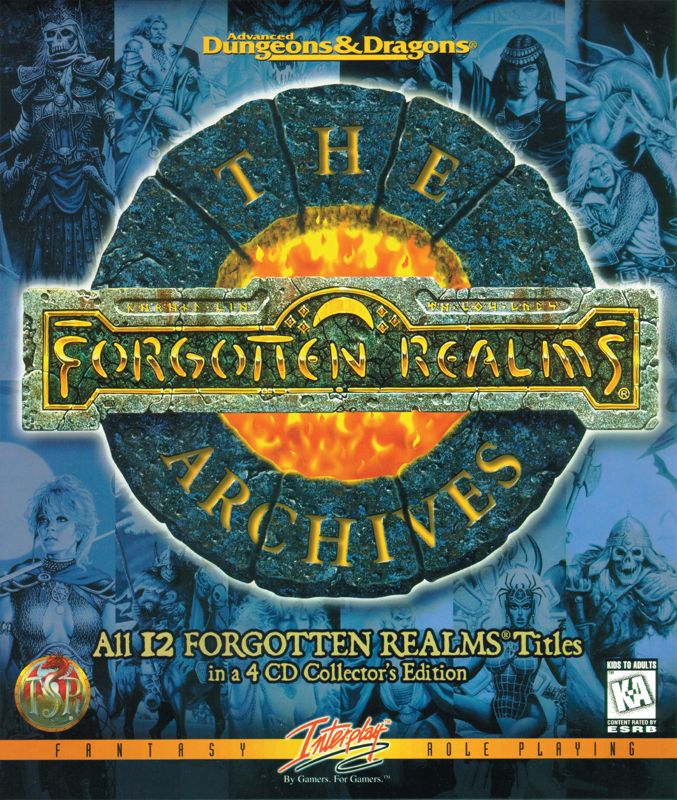
The Forgotten Realms Archives stands as a remarkable value proposition for fans of classic RPGs. With twelve full titles plus the Blood & Magic demo, it offers dozens of hours of adventuring, tactical skirmishing, and story-driven questing. The oversized box and printed manuals evoke the heyday of PC gaming, and the physical packaging remains a collector’s delight if you can find it in good condition. Even digitally, the compilation’s completeness is a major selling point.
While modern conveniences like auto-saving and streamlined UIs are absent, the authenticity of the original gameplay is preserved. Running these games via DOSBox or on modern re-release platforms is generally smooth, though occasional hiccups with sound emulation or key mappings can arise. Enthusiasts will appreciate digging into the manual for spell lists, monster stats, and lore tidbits—elements that today’s instant-tutorial era often overlooks.
Ultimately, The Forgotten Realms Archives is a treasure trove for anyone eager to experience foundational CRPG design. Its strengths lie in the breadth of content, nostalgic charm, and the enduring appeal of AD&D mechanics. Whether you’re a veteran looking to revisit Phlan’s charred walls or a newcomer curious about the genre’s roots, this collection delivers a deep, varied, and wholly authentic Dungeons & Dragons experience.


Reviews
There are no reviews yet.