 Retro Replay Retro Replay gaming reviews, news, emulation, geek stuff and more!
Retro Replay Review
Gameplay
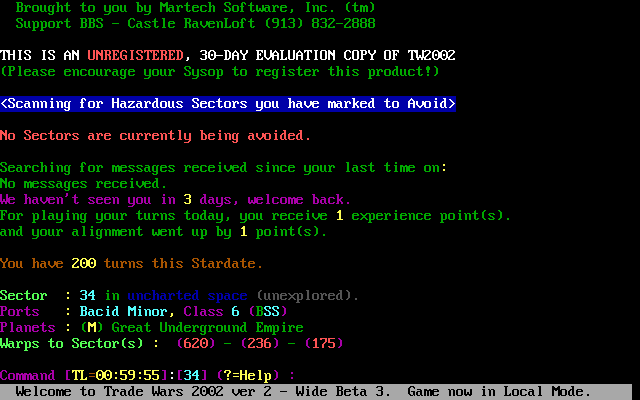
Trade Wars 2002 excels at blending strategic planning with real-time action in a purely text-based environment. From the moment you log in via telnet or dial-up BBS, you’re presented with a galaxy map composed of ASCII characters. Navigating this map requires careful attention to the coordinates and the resources available in each system. Every decision—from which commodities to buy, to whether to attack a rival trader—carries the weight of potential gain or loss.
(HEY YOU!! We hope you enjoy! We try not to run ads. So basically, this is a very expensive hobby running this site. Please consider joining us for updates, forums, and more. Network w/ us to make some cash or friends while retro gaming, and you can win some free retro games for posting. Okay, carry on 👍)
One of the most compelling aspects of Trade Wars 2002 is its multiplayer integration. Unlike single-player space sims, here you’re pitted against real people, each jockeying for control of the trading lanes and lucrative star systems. Forming alliances, staging coordinated raids on enemy convoys, or forging uneasy truces around neutral commodity hubs becomes a core part of your daily routine. The dynamic economy shifts according to player actions, ensuring no two play sessions feel the same.
Building citadels and ports sets this game apart from many contemporaries. Once you’ve amassed enough credits, you can invest in constructing or upgrading stations that serve as safe havens and resource exchange points. These installations not only generate passive income but also become strategic choke points for rival factions. Securing and defending your citadel demands tactical foresight, making every firefight and trade negotiation carry long-term consequences.
The command interface, while text-driven, is surprisingly intuitive once you acclimate. Commands for buying, selling, moving, and combat are entered via simple one-letter keystrokes, minimizing downtime and keeping the focus on strategy. Additionally, the open-ended nature of objectives—from amassing wealth to military domination—ensures you can tailor your playstyle to your personal strengths.
Graphics
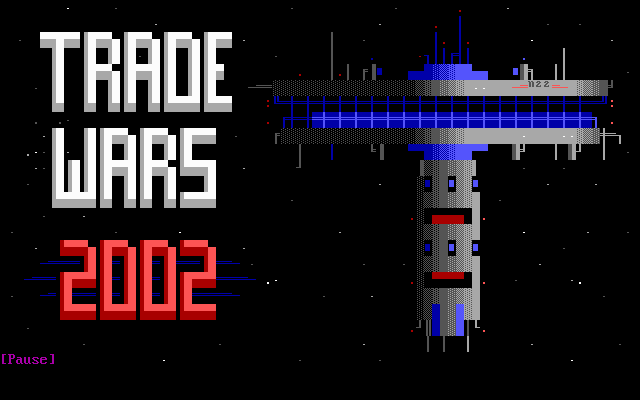
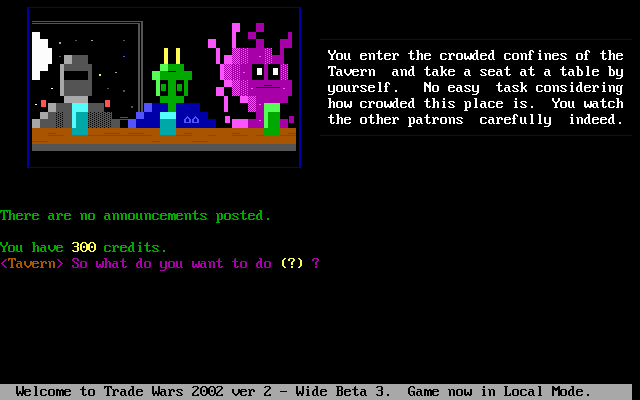
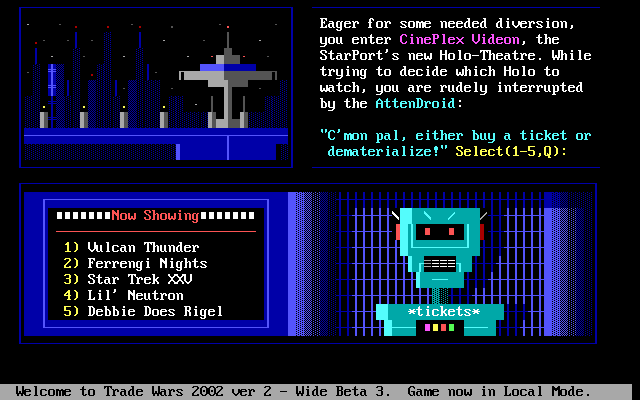
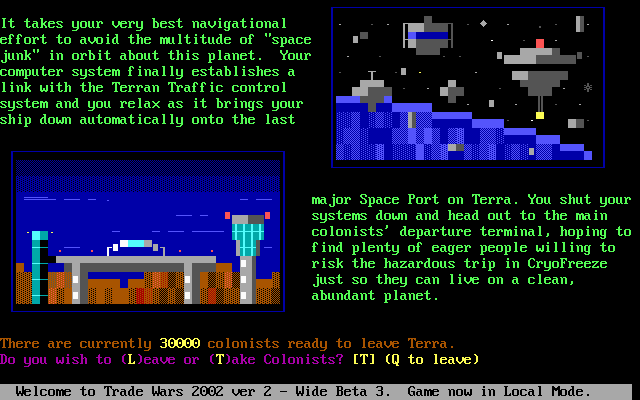
As a descendant of the early BBS era, Trade Wars 2002 offers no polygonal models or photorealistic vistas. Instead, its graphics are rendered entirely with ASCII and ANSI art. Stars, ships, and stations are all represented by characters on the screen, turning your terminal window into a living map of the cosmos. While minimalist by modern standards, this approach has its own charm, evoking the golden age of text adventures.
ANSI color codes breathe life into the otherwise monochrome display, distinguishing factions, resource types, and alert statuses at a glance. A well-placed cluster of green “>” symbols signals friendly traffic lanes, whereas red “X” icons warn of pirate-infested systems. Though rudimentary, this color-coded scheme serves its purpose with surprising clarity, guiding you through complex tactical situations.
Beyond aesthetics, the simplicity of the visuals has practical advantages. Load times are nearly nonexistent, and the game can run on virtually any machine or terminal emulator. Whether you’re on a modern desktop or a legacy DOS box, the experience remains consistent. This universal compatibility ensures that Trade Wars 2002 is as accessible today as it was in its dial-up heyday.
Story
Trade Wars 2002 doesn’t offer a scripted narrative or voiced cutscenes. Instead, it delivers emergent storytelling driven by player interaction and hub-based lore. Each server operates like its own sandbox universe, complete with overlapping allegiances, trade consortiums, and pirate clans. Over time, communities develop legends around certain players or factions, crafting their own backstories and rivalries.
While there’s no canonical protagonist, the framework encourages you to write your own saga. Will you rise as a benevolent trader, using your citadel to shelter struggling colonists? Or will you embrace the pirate’s life, preying on supply convoys and forging a reputation as the galaxy’s most feared marauder? These sandbox elements empower you to create a narrative that’s uniquely yours.
Server administrators often host special events—rescue missions, resource sweeps, or inter-faction tournaments—that add episodic drama to the persistent universe. These community-driven story beats inject bursts of excitement, offering structured goals alongside the open-ended free-for-all. The result is a tapestry of anecdotes, rivalries, and alliances that outshines any prewritten plot.
Overall Experience
Trade Wars 2002 may look antiquated to newcomers, but its depth and community focus make for an enduring experience. Trading, combat, diplomacy, and empire-building combine into a cohesive package that rewards patience, strategy, and social engagement. New players can join any public server or host their own, and the supportive veteran communities often welcome rookies with tips and low-stakes practice runs.
The free-to-play model removes barriers to entry, ensuring that anyone with an internet connection and a telnet client can dive in. Whether you’re chasing nostalgia or discovering text-based gaming for the first time, you’ll find a surprising level of complexity behind the simple facade. Every raid, alliance, or economic coup carries personal satisfaction precisely because it springboards from player initiative rather than scripted missions.
In an era dominated by flashy graphics and cinematic experiences, Trade Wars 2002 stands as a reminder that engaging gameplay and vibrant communities can thrive even in the most stripped-down presentation. If you’re eager for a strategic challenge, a sandbox economy, and a living galaxy shaped by human competitors, then Trade Wars 2002 is an experience well worth exploring.


Reviews
There are no reviews yet.