 Retro Replay Retro Replay gaming reviews, news, emulation, geek stuff and more!
Retro Replay Review
Gameplay
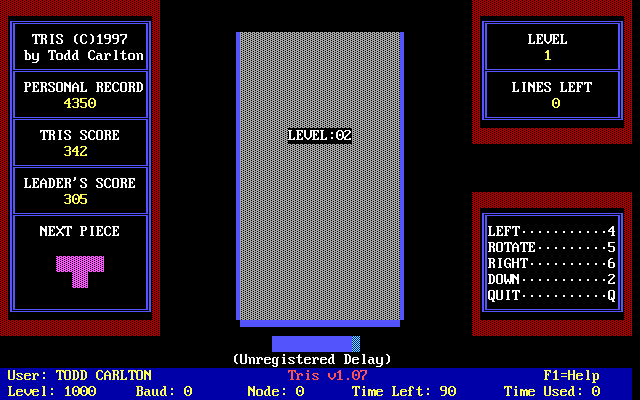
Tris delivers the classic Tetris experience with remarkably faithful mechanics, even in its stripped-down BBS door game form. Blocks of varying shapes descend at a steady pace, challenging players to rotate and position them so that full horizontal lines form and disappear. Despite its textmode presentation, the controls are tight and responsive—using simple keyboard inputs, you can swiftly rotate pieces, nudge them left or right, and slam them down into place. For anyone who has cut their teeth on falling-block puzzles, Tris feels instantly recognizable.
(HEY YOU!! We hope you enjoy! We try not to run ads. So basically, this is a very expensive hobby running this site. Please consider joining us for updates, forums, and more. Network w/ us to make some cash or friends while retro gaming, and you can win some free retro games for posting. Okay, carry on 👍)
One of the most engaging aspects of Tris is its pacing. The game offers three distinct levels—easy, medium, and hard—each escalating the drop speed and demanding quicker reflexes. In the unregistered version, you can cycle through all three difficulty settings, giving you a solid taste of what’s on offer before deciding whether to unlock the full suite. Even at the easiest level, the game doesn’t hold your hand, and by the time you hit the hardest tier, lines start disappearing almost as soon as you can maneuver them.
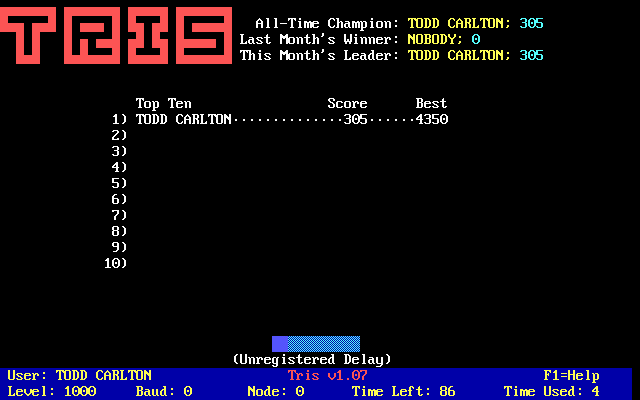
For those who remember the golden age of BBS door games, Tris over modem play brings a wave of nostalgia. Connection lag and occasional text flicker only add to the authentic feel—though the local-play option lets you sidestep these quirks if you prefer a smoother run. Whether dialing in remotely or tapping away in your terminal emulator, the core fun remains intact: clear lines, avoid overstacking, and push your high score as far as your fingertips will allow.
Graphics
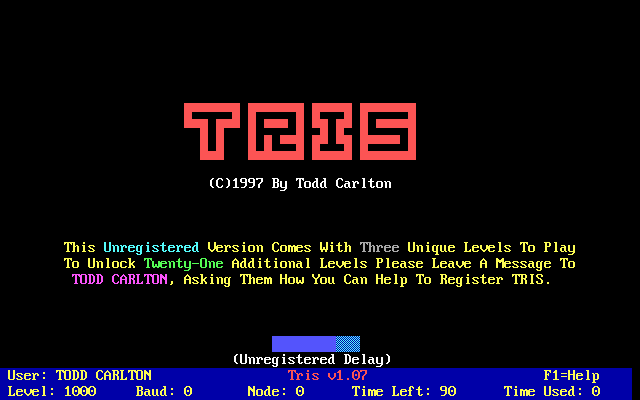
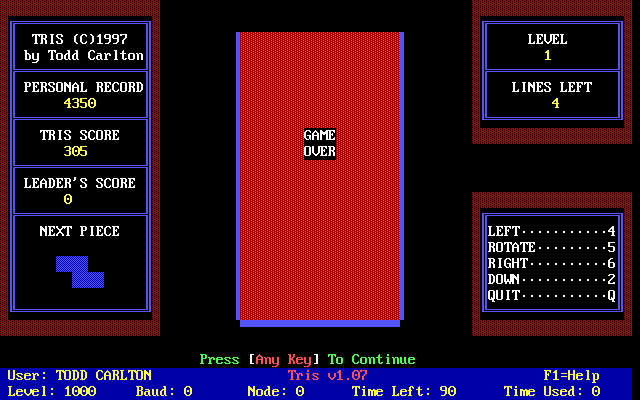
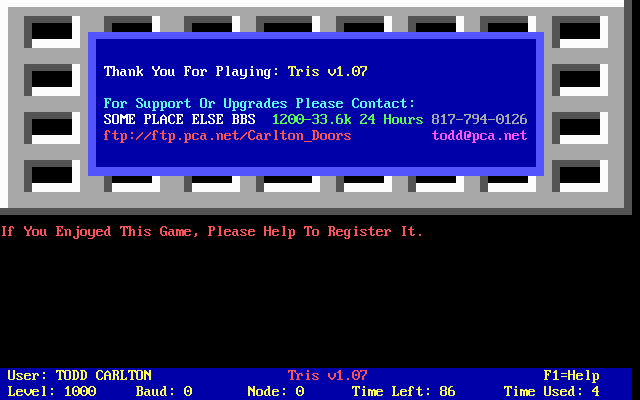
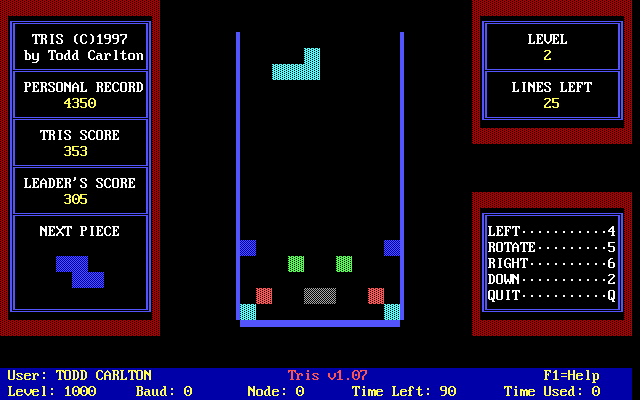
Graphically, Tris goes back to basics with pure textmode. Blocks are rendered using simple character sets, with each tetromino represented by shaded ASCII symbols and terminal color codes. While modern gamers may find the visuals stark compared to today’s high‐resolution, sprite‐based counterparts, the charm lies in its clarity. You always know exactly where each piece sits, and the absence of fancy animations keeps the focus squarely on puzzle strategy.
The limited palette of textmode can surprise you with its efficiency. Different block types are easily distinguishable by brightness and character style, helping you quickly scan the well for gaps. In full-screen terminal settings, the playfield feels spacious, and the minimalism reduces visual clutter—no background music or flashy effects to distract you. It’s Tetris in its purest, most distilled state.
On the downside, newcomers might find the stark interface less inviting than colorful arcade ports. There’s no tutorial or in-game guide beyond basic key mappings—so a slight learning curve emerges if you’re not already familiar with piece shapes or controls. Still, once you acclimate, the austere graphics become a feature, underscoring the game’s roots in the BBS era and emphasizing skill over spectacle.
Story
True to its Tetris lineage, Tris foregoes a traditional narrative. There’s no protagonist, no plot twists, and no looming final boss—just an endless stream of tetrominoes demanding organization. For many players, that’s precisely the point: it’s a game built around pure, undiluted puzzle action. Every session writes its own story of near-misses, frantic rotations, and triumphant line clears.
That said, Tris carries an unspoken backstory of bulletin board systems, modem noises, and late-night community gaming. Playing it locally or over a dial-up link evokes a bygone era when strategy and social interaction blended through text screens. In this sense, the “story” comes from the mental challenge you set for yourself, the self-imposed goal of beating your previous high score or conquering the most relentless difficulty.
If you’re looking for a narrative-driven adventure, Tris may leave you wanting. However, its open-ended design encourages players to craft their own journey—whether that’s mastering level three’s breakneck speed or competing against friends for bragging rights. The lack of a formal storyline only underscores the timeless appeal of Tetris-style puzzles: brains versus blocks in an infinite duel.
Overall Experience
Tris stands out as a concise yet compelling tribute to Tetris, ideal for retro enthusiasts and puzzle purists alike. Its textmode graphics and keyboard-driven controls may feel austere at first glance, but these design choices reinforce the game’s focus on strategic precision. There’s no handholding, no narrative detours—just you, the tetrominoes, and the ever-tightening space to fill.
The inclusion of three difficulty levels in the unregistered version ensures a taste of what the full release promises, while the local-play and modem-play options cater to both solitary sessions and nostalgic BBS interactions. If you’re curious about the roots of online multiplayer or simply want a blitz session of classic block stacking, Tris delivers. Its modest system requirements and textmode fidelity make it accessible on nearly any machine equipped with a terminal emulator.
While it lacks colorful sprites and modern frills, Tris offers an authentic slice of gaming history alongside rock-solid gameplay. For potential buyers seeking a pure, no-nonsense puzzle challenge—or anyone longing for the days of dial-up door games—Tris is a memorable and worthwhile addition to your library. Pop in your modem (or open a terminal window), and get ready to clear lines like it’s 1989 all over again.


Reviews
There are no reviews yet.