 Retro Replay Retro Replay gaming reviews, news, emulation, geek stuff and more!


Retro Replay Review
Gameplay
Tube throws you into a deceptively simple premise: navigate an endless, forward-moving tunnel before your countdown timer hits zero. You’re in constant motion, thrust down the length of the track by your own acceleration, and must balance speed with precision. Obstacles appear without warning, demanding quick reflexes to dodge or destroy them. Missing a jump or colliding with barriers eats away precious seconds, so timing is everything.
(HEY YOU!! We hope you enjoy! We try not to run ads. So basically, this is a very expensive hobby running this site. Please consider joining us for updates, forums, and more. Network w/ us to make some cash or friends while retro gaming, and you can win some free retro games for posting. Okay, carry on 👍)
Combat in Tube is straightforward yet satisfying. As you speed along, weapon power-ups drift into view—lasers, homing missiles, and spread shots. Snagging these gives you the firepower necessary to clear the path ahead, but ammo is limited. You quickly learn to switch weapon types on the fly, conserving shots until an especially dense cluster of obstacles demands a heavier hitter. This ebb and flow of offense and defense keeps each run engaging.
Progression hinges on mastering the track’s rhythm. While the tunnel is procedurally endless, subtle variations in obstacle patterns and power-up placement ensure you never quite fall into autopilot. The challenge ramps up steadily, as tighter corridors, faster-moving walls, and trickier jump sequences force you to hone your split-second decisions. Tube’s addictive “just one more run” loop rewards perseverance—every successful stretch feels earned, and every crash teaches you something new.
Graphics
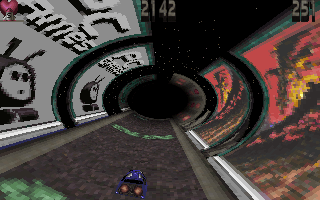
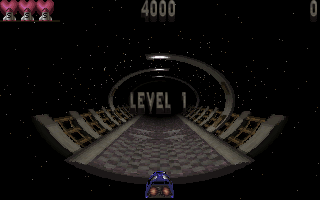
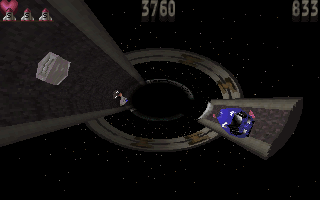
Tube’s visual style is a direct descendant of classic vector-based demos. The tunnel walls and obstacles are drawn in crisp lines and geometric shapes that pulse with neon hues, giving the illusion of depth and speed. It might look simplistic by modern standards, but the seamless scrolling and cleverly placed fades create an immersive sense of motion that few contemporary indie titles replicate.
Despite its modest palette, Tube makes great use of bright accent colors to highlight pickups and hazards. Laser beams, explosive flares, and speed boosts all glow against the darker tunnel backdrop, ensuring that critical gameplay elements pop instantly into view. The minimalist aesthetic also means that performance remains rock-solid, even on older hardware, which was a smart design choice given its origins as a quick in-house test application.
Subtle graphical touches—the occasional flicker as you zip past a wall segment, the stretching perspective of converging lines—add polish without overcomplicating the presentation. While there’s no texture detail or elaborate lighting, the consistent frame rate and smooth animations make Tube’s vector world feel alive. It’s a testament to Bullfrog’s ability to squeeze maximum impact out of minimal resources.
Story
Tube doesn’t weave a deep narrative, and that’s part of its charm. Originally conceived as a new-employee test at Bullfrog, it was never meant to be a blockbuster title; rather, it exists purely as an arcade challenge. There’s no plot to unravel, no characters to root for—just you, your speeding craft, and an endless corridor of hazards. This blank-slate approach keeps the focus squarely on gameplay mechanics and high-score mastery.
While some players might miss a guided storyline or cutscene-driven progression, Tube’s barebones premise fosters imagination. You can invent your own backstory: a secret tunnel beneath a futuristic city, a dimensional wormhole race, or a training simulator for virtual pilots. The absence of defined lore means each run is a fresh beginning, free from narrative constraints.
Trivia buffs will appreciate the game’s underdog heritage: released as freeware after Bullfrog decided not to develop it further, Tube earned a second life among retro enthusiasts. It stands as a curious footnote in the studio’s history—a glimpse of what might have been had the project been given a larger budget or marketing push. Today, Tube invites players to discover it on merit alone, an unpolished gem waiting for those who value pure, arcade-style thrills.
Overall Experience
Playing Tube is like finding a hidden arcade classic in your attic. It’s unassuming at first glance, but once you dive in, you’re hooked by its simple-yet-challenging mechanics. The game’s freeware status makes it risk-free to try, and its low system requirements mean you can experience the full-speed rush on virtually any machine.
Tube isn’t without flaws. Its lack of variety—one tunnel, a handful of obstacle types, no real endgame—can feel repetitive after extended sessions. There are no checkpoints or branching paths, so once you’ve memorized certain patterns, the novelty can wear off. Still, if you approach it as an exercise in reflex training rather than a sprawling adventure, you’ll appreciate its addictive core loop.
For players seeking a pure arcade challenge, Tube delivers in spades. Its combination of deft controls, strategic weapon usage, and raw speed provides a focused, adrenaline-fueled experience. Whether you’re a retro gaming aficionado curious about Bullfrog’s lesser-known catalog or someone in search of a quick, gratifying time trial, Tube offers a unique ride down an endless neon corridor—you might just find it’s exactly the kind of hidden gem you didn’t know you were missing.


Reviews
There are no reviews yet.