 Retro Replay Retro Replay gaming reviews, news, emulation, geek stuff and more!

Retro Replay Review
Gameplay
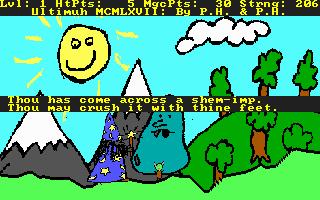
Ultimuh MCMLXVII: Part 2 of the 39th Trilogy – The Quest for the Golden Amulet adopts an intentionally rudimentary side-scrolling formula that both parodies and pays homage to early Ultima titles. You guide a lone wizard strictly to the right, facing oversized, static monsters that serve more as speed bumps than true obstacles. Combat is reduced to tapping the “A” key in close quarters, with each press landing a reliable, if monotonous, blow. The simplicity of this loop underscores the satirical spirit: you feel both empowered and slightly cheated by how trivial every encounter becomes.
(HEY YOU!! We hope you enjoy! We try not to run ads. So basically, this is a very expensive hobby running this site. Please consider joining us for updates, forums, and more. Network w/ us to make some cash or friends while retro gaming, and you can win some free retro games for posting. Okay, carry on 👍)
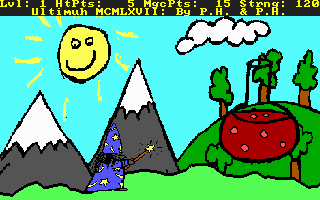
Progression is tied to a handful of visible statistics—health, mana, maybe a cryptic “Virtue” meter—that rise and fall as you wander, brawl and loiter in the pixelated wilderness. Replenishing these stats is likewise overtly simplistic: just bump into giant, glowing potions scattered on the ground. These items restore everything at once, leaving little room for resource management or strategic downtime. What exists here is a parody of grinding, where every “upgrade” feels more like an in-joke than a genuine reward.
That same repetition pervades every level. You trudge rightward across near-identical backdrops, dispatch cookie-cutter foes, pick up a phony golden amulet (decoy), and press onward. Each stage demands one extra hit to fell those same static beasts, lending a mathematical tedium rather than a sense of evolving challenge. It’s clearly deliberate—a mockery of old-school side-scrollers—but players craving nuanced mechanics or meaningful difficulty curves will find themselves tapping out well before the end of the trilogy.
Graphics
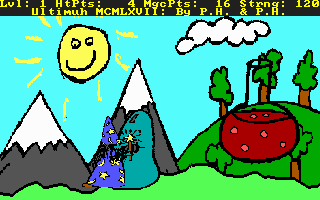
The visual style of Ultimuh MCMLXVII is perhaps the boldest satire on the roster. Every scene looks as if drawn by a Grade 2 student on MS Paint: jagged lines, flat colors, and an unholy abundance of primary hues. There’s little to no animation beyond the wizard’s flashing staff and a monster’s jerky, two-frame stomp. While that could be bandied about as “retro charm” in some indie circles, here it reads as a purposeful lampoon of the bland, uninspired backgrounds once seen in amateur Ultima homages.
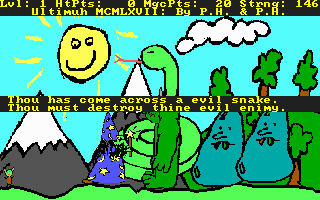
Monsters are huge, static, and crudely rendered silhouettes—an aesthetic choice that drives home the parody. Their lack of movement or attack animations makes them feel like set dressing more than living adversaries, a stark contrast to the fluid NPCs of the original Ultima series. The environments, too, are static tableaux that hardly change from level to level: a meager attempt to capture a “vast wilderness” when in fact it’s one long corridor peppered with identical trees and rocks.
Despite (or because of) its minimalism, the art direction succeeds on a satirical level. It sends a clear message about the pitfalls of amateur game development and how nostalgia can sometimes mask technical shortcomings. That said, don’t expect beautiful vistas or detailed character portraits—this is primitivism as purposeful parody, and it knows exactly how grating it can be to the modern eye.
Story
The narrative of Ultimuh MCMLXVII is almost laughably thin: a wizard on an endless quest for the Golden Amulet, apparently a legendary artifact of immeasurable worth. In practice, each amulet you find turns out to be a worthless replica, forcing you to sprint into the next identically-designed landscape for another round of button-mashing. The plot reads like an in-junction to keep you moving, a wink from the developers at the expense of your time.
Olde Tyme Englishe diction is sprinkled throughout warning screens and item descriptions, though the result is more clumsy than archaic. It feels like a teenager’s half-remembered attempt at medieval lingo—“Thou hast been vanquished by gobbelin beguilers!”—rather than an authentic nod to the richly woven stories of the original Ultima titles. This injects a layer of unintentional comedy, highlighting both the developer’s ambition and their limited grasp of period vocabulary.
Ultimately, there’s no meaningful character development, no twist, and no sense of worldbuilding beyond the vaguest scraps of lore. Instead, you’re left with a meta-narrative about game design itself: how much repetition can you endure, and at what point does homage become hollow drudgery? If you approach the story expecting heartfelt heroism, you’ll find only the shadows of parody staring back.
Overall Experience
Playing Ultimuh MCMLXVII is akin to sitting through a clever sketch that wears out its welcome after the first punchline. Its satirical core is undeniably clear: a cheeky critique of DIY fan games and the sometimes questionable charm of pixel-perfect nostalgia. For a brief time, you may chuckle at the primitive art, the repetitive loops, and the dubious Olde Englishe phrases that crop up like weeds.
However, that novelty fades quickly. With no real challenge, scant story, and a level of repetition that borders on self-parody, the title struggles to sustain engagement over more than a handful of levels. If you treasure every ounce of nostalgia for the birth of CRPGs, or if you’re invested in the indie satire scene, you might appreciate this experiment. Otherwise, you’ll likely tire of the one-note design long before the satirical point fully sinks in.
In the end, Ultimuh MCMLXVII: Part 2 of the 39th Trilogy – The Quest for the Golden Amulet is best suited for players who enjoy wry commentary on retro game tropes or those studying the evolution of fan-made tributes. As a standalone entertainment product, it offers more in terms of comedic critique than genuine gameplay satisfaction. Approach it with a sense of humor and a tolerance for monotony, and you may find a glimmer of amusement hidden amidst its intentionally crude veneer.


Reviews
There are no reviews yet.