 Retro Replay Retro Replay gaming reviews, news, emulation, geek stuff and more!


Retro Replay Review
Gameplay
Lunatic Dawn II embraces a classic Western-style RPG structure, centered entirely on open-ended exploration and player agency. From the moment you create your character—selecting gender, social status, strengths, and weaknesses—you’re plunged into a world without a rigid main storyline. This freedom lets you chart your own path, whether that means taking on local “jobs” at inns, hunting down treasure, or forging alliances with wandering masters across the kingdom.
(HEY YOU!! We hope you enjoy! We try not to run ads. So basically, this is a very expensive hobby running this site. Please consider joining us for updates, forums, and more. Network w/ us to make some cash or friends while retro gaming, and you can win some free retro games for posting. Okay, carry on 👍)
The recruitment system encourages experimentation: you can summon various masters at almost every location, and inns teem with potential party members. Each NPC you encounter comes with distinct parameters—strength, stamina, charisma—but their personalities remain utilitarian, designed to bolster your party’s capabilities. Managing a six-member team forces you to weigh each companion’s skills and plan your long-term strategy, especially if you’re venturing far from civilization.
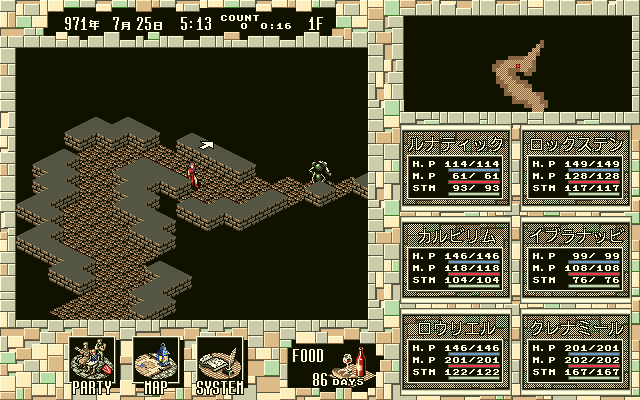
Survival mechanics play a pivotal role in shaping your adventure. A real-time calendar tracks each passing day, and you’ll need to stockpile food rations before embarking on extended journeys. This adds an extra layer of realism to your explorations, making every trek into uncharted territory an exercise in careful planning. Failing to prepare properly can leave your party stranded, hungry, or vulnerable to unexpected encounters.
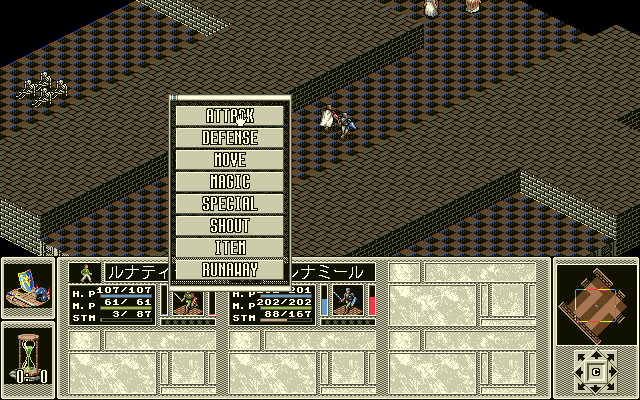
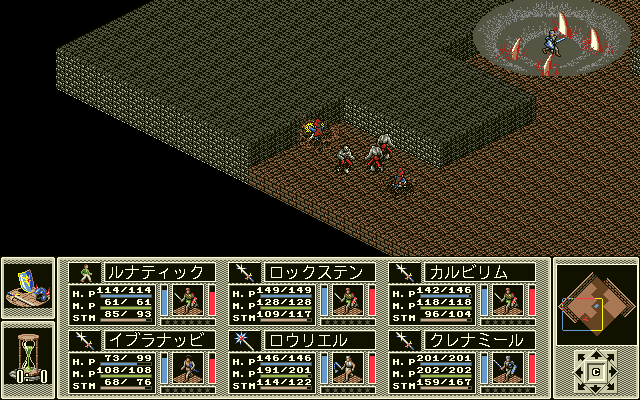
Combat in Lunatic Dawn II unfolds on a separate isometric plane: once you bump into an enemy on the top-down world map, the game switches to a turn-based battle screen. You directly control only your main character, while the rest of the party acts according to assigned tactics. This semi-automated approach speeds up skirmishes and lets you focus on strategic directives rather than individual commands, though purists might miss full party control.
Graphics
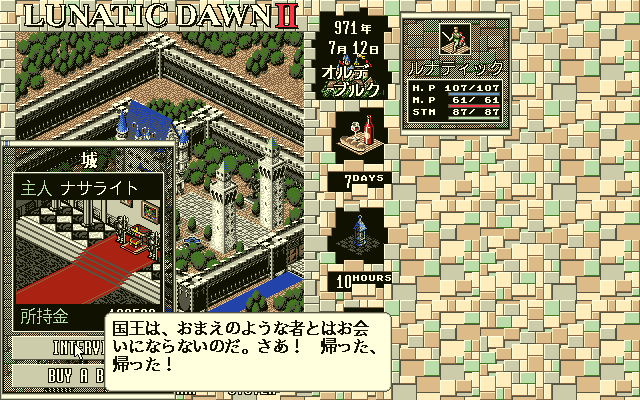
While still bearing the hallmarks of its early-’90s Japanese RPG roots, Lunatic Dawn II significantly improves upon its predecessor’s visuals. Cityscapes are richly detailed, with distinct shops, stables, and even a ruler’s castle rendered in pixel art that pops with color and depth. Each locale feels like a living, breathing settlement rather than a generic tile set.
On the world map, terrain transitions—forest to plain to mountain—are smooth, making navigation intuitive and visually engaging. The addition of horse-drawn carriages as a fast-travel system is not only practical but looks charming, with quaint sprites depicting your party gliding along winding roads. These touches enhance immersion and reward players who take time to appreciate the scenery.
Dungeon environments benefit from the isometric perspective, which provides a clearer sense of spatial relationships and enemy placement. Walls and floors feature subtle shading, and ambient details like torches or water pits help differentiate one subterranean realm from another. Although graphics remain pixel-based, the improved resolution and varied color palettes elevate the overall presentation.
Character and monster sprites are functional rather than flashy, but their animations—attack swings, spell effects, and enemy deaths—are smooth and satisfying. UI elements are straightforward, with clear icons for health, stamina, and active buffs or debuffs. While modern gamers might find the aesthetic retro, those who appreciate classic RPG charm will feel right at home.
Story
Unlike many RPGs that hinge on a defined narrative arc, Lunatic Dawn II offers only the barest lore framework: an opening sequence speaks of legendary heroes who vanquished demons only to become demons themselves. Beyond that cryptic prologue, the world is yours to shape with virtually no scripted plot events or main quests. The sense of mystery arises from exploration rather than exposition.
This approach to storytelling might frustrate players expecting a linear epic, but it will delight those who prefer sandbox role-playing. You decide which factions to support, whom to befriend, and which dangers to pursue. Every town rumor or job listing becomes a potential plot thread, granting a sense of emergent narrative that evolves organically rather than following a predetermined path.
The lack of a central antagonist or definitive goal does not equate to a narrative void. Instead, ambiance and world-building come through in environmental details, character interactions at inns, and the day-to-day struggle to survive and prosper. Over time, you piece together bits of history—forgotten ruins, local legends, and NPC anecdotes—that lend an understated depth to the setting.
Ultimately, Lunatic Dawn II’s story is what you make of it. If you relish forging your own saga—leading a caravan of misfits, uncovering hidden dungeons, or rising to become a regional power—this game provides the canvas. Players seeking a tight storyline with dramatic plot twists, however, may find the hands-off narrative approach too sparse.
Overall Experience
Lunatic Dawn II stands as a captivating throwback for RPG enthusiasts who cherish old-school exploration and player-driven progression. Its blend of open-world mechanics, nuanced character creation, and semi-automated combat offers a refreshing alternative to more scripted modern titles. Success depends heavily on your willingness to embrace its sandbox ethos and manage the intricacies of resource planning.
The game’s retro visuals and functional soundtrack will appeal to fans of ’90s-era JRPGs, though newcomers accustomed to cinematic presentations might need time to adjust. The freedom to recruit companions, undertake diverse “jobs,” and navigate the calendar-based survival system creates a tapestry of experiences that can feel deeply rewarding once you master the mechanics.
On the flip side, the absence of a main quest or charismatic NPCs can render the world feeling empty for some players. The AI-driven party behavior in combat is convenient but occasionally unpredictable, prompting strategic interruptions to reissue commands. Food management and travel logistics add realism but may feel like micromanagement to those seeking pure dungeon-crawling thrills.
Overall, Lunatic Dawn II is best enjoyed by those who appreciate a slow-burn RPG where exploration, experimentation, and self-directed storytelling take center stage. If you’re looking to carve out your own legend in a richly detailed yet untamed world, this is an adventure well worth embarking upon.


Reviews
There are no reviews yet.