 Retro Replay Retro Replay gaming reviews, news, emulation, geek stuff and more!
Retro Replay Review
Gameplay
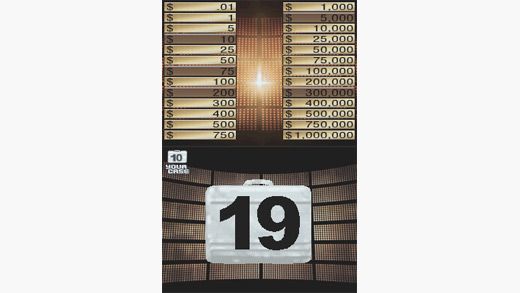
Deal or No Deal’s gameplay centers entirely on the suspense of picking briefcases and weighing banker offers. You begin by selecting one of 26 sealed cases, each hiding a cash amount from $0.01 up to $1,000,000. In the first round you open six cases, then five in the second, and four in the third. After each round the banker calculates a deal based on the remaining values. Deciding whether to accept a guaranteed sum or press your luck drives every heartbeat of this adaptation. The tension is built purely through numbers and timing, replicating the TV show’s nail-biting appeal.
(HEY YOU!! We hope you enjoy! We try not to run ads. So basically, this is a very expensive hobby running this site. Please consider joining us for updates, forums, and more. Network w/ us to make some cash or friends while retro gaming, and you can win some free retro games for posting. Okay, carry on 👍)
Beyond the classic “TV Game” mode, there are two additional single-player challenges. Vault Game asks you to crack a three-digit combination in as few turns as possible, starting with a $500,000 prize that dwindles with each guess. High Low shifts focus to pattern recognition: you pick a briefcase, then predict if the next case’s value is higher or lower, boosting your pot for every correct call. Two-player options include Head to Head—where each player vies for the better deal with identical cases—and Best Deal, which grants one participant the banker’s seat. These variations inject modest twists, but the core mechanic remains case selection and probability management.
There’s no hidden minigame or action sequence to break up the rhythm—your only tools are logic and nerve. If you thrive on pure decision-making and enjoy watching odds shift as high prizes get knocked out, you’ll find a steady thrill. However, the minimalist interaction may feel repetitive if you prefer deeper mechanics or character-driven challenges. Still, the pacing mirrors the television experience, with each reveal and offer carrying genuine stakes, making every session a concise gamble.
Graphics
The visual presentation leans heavily on faithfully recreating the TV set’s slick veneer. Briefcases are rendered in polished 3D, popping open with a satisfying digital flourish. The on-screen board clearly highlights which amounts remain, and the banker’s offer window slides in smoothly without jarring transitions. Menus and overlays stay out of the way, allowing you to focus on the core selection process. Overall, the interface is intuitive and uncluttered.
Backgrounds and stage elements echo the show’s dramatic lighting, with spotlights framing the briefcase podium and a softly blurred studio environment behind it. Although character models (like your digital host or banker silhouette) aren’t highly detailed, they serve their purpose, creating an authentic atmosphere without demanding a powerhouse GPU. Animation is functional rather than fancy—expect no elaborate camera swoops or facial expressions beyond basic movement.
On handheld or lower-end consoles, the game maintains stable performance, with pop-ins and frame drops kept to a minimum. Color coding on the money ladder ensures quick readability, crucial when high-stakes amounts disappear mid-round. While there’s little in the way of dynamic weather or elaborate set pieces, the graphics do exactly what they need to: reinforce the tension of each decision without distraction.
Story
As an adaptation of a game show, Deal or No Deal forgoes a traditional narrative arc. There’s no protagonist to follow or lore to unravel—your experience is purely episodic, with each game acting as its own mini-story of risk and reward. The sense of progression comes from the mounting intensity as values are eliminated and offers fluctuate, rather than from any scripted plot points.
The “story” emerges organically through your successes and failures. When the banker raises his offer dramatically after several high amounts vanish, you feel the dramatic tension that television viewers know well. Conversely, enduring multiple rounds with your case still sealed builds anticipation, turning your personal gamble into a self-directed storyline. It’s a different kind of narrative, one built on probability curves and psychological brinkmanship.
For players expecting cutscenes or character development, the absence of a formal story might feel stark. Yet this minimalist approach maintains focus on the game show premise, inviting you to craft your own triumphs and regrets. The emotional highs and lows come directly from the stakes at hand, proving that a compelling “story” can emerge from pure mechanics when tension is managed effectively.
Overall Experience
Deal or No Deal delivers exactly what it promises: a virtual replication of the beloved TV game show. Fans will appreciate the faithful pacing, the variety of single- and multiplayer modes, and the unrelenting suspense of each banker offer. The streamlined interface and stable performance keep the focus razor-sharp on case picks and decisions, making for quick sessions perfect for party settings or short breaks.
However, the title’s laser focus on probability and simple input means there’s little innovation beyond case selection. If you crave deeper strategic options, lush storylines, or varied gameplay loops, you may find the experience limited. Even with the Vault Game and High Low diversions, the core remains a series of number reveals and odds calculations—great for fans of luck-based tension, less so for those seeking complex challenges.
In sum, Deal or No Deal is an engaging, if narrowly focused, party and puzzle offering. It shines when you embrace its show-style thrills and resist expecting more traditional gaming depth. For buyers drawn to the original program or looking for a low-key multiplayer gamble, it’s a solid pick. Casual players and group gatherings will find plenty of suspense, while solo risk-takers can appreciate the quiet drama of every banker’s pitch.



Reviews
There are no reviews yet.