 Retro Replay Retro Replay gaming reviews, news, emulation, geek stuff and more!


Retro Replay Review
Gameplay
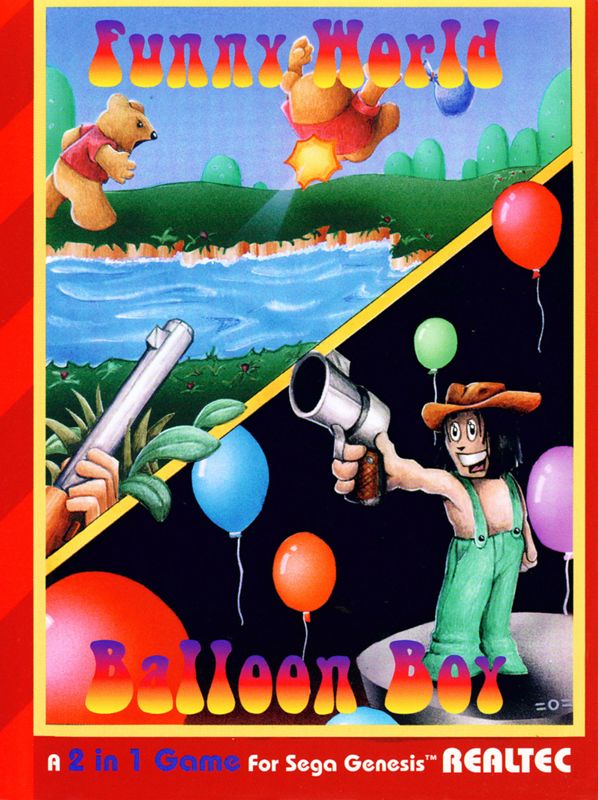
Funny World & Balloon Boy delivers a straightforward action experience split between two arcade-style mini-games. In Funny World, you’re tasked with shooting an assortment of quirky creatures—“funnys”—as they traverse the screen. The core loop is simple: aim, fire, and prevent too many funnys from reaching the opposite side. A limited supply of boulders adds a tactical twist, allowing you to clear clusters of targets when precision shooting becomes too risky.
(HEY YOU!! We hope you enjoy! We try not to run ads. So basically, this is a very expensive hobby running this site. Please consider joining us for updates, forums, and more. Network w/ us to make some cash or friends while retro gaming, and you can win some free retro games for posting. Okay, carry on 👍)
The challenge ramps up in subtle ways. Some funnys plod along slowly, while others zip or zig-zag unpredictably. Accurate timing and target prioritization are key, especially when female funnys appear and must be left unscathed to avoid losing a life. Missing shots or wasting boulders carries a penalty, making every projectile count.
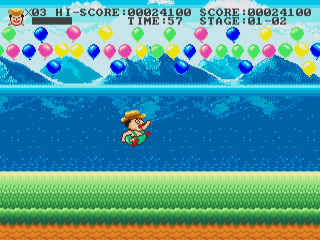
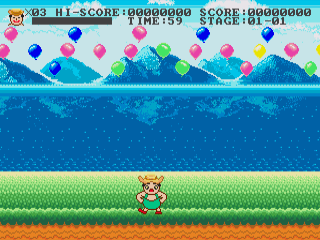
Balloon Boy shifts the focus skyward: you control a boy positioned at the bottom of the screen, aiming upward to pop floating balloons. Each burst balloon either releases a helpful item—bonus points or extra time—or a trap that quickly ends your run if you’re not quick to dodge. As with Funny World, stages grow progressively tougher, demanding sharper reflexes and stage memorization to clear before the clock runs out.
Both games reward pattern recognition and efficient use of limited resources. Lives are scarce, and mistakes can be harsh, but each success feels earned. The two titles offer distinct pacing—Funny World’s tense volleys of targets contrast nicely with Balloon Boy’s faster, more playful rhythm. For fans of pick-up-and-play challenges, this dual-pack can provide satisfying short sessions.
Graphics
Graphically, Funny World & Balloon Boy embraces the aesthetic constraints of unlicensed 8-bit cartridges. Character sprites are rudimentary but identifiable: the “funnys” are crudely drawn yet charming in their odd proportions, and Balloon Boy’s bright balloons pop against a plain background for clear visibility.
The limited color palettes lead to high contrast visuals, ensuring targets stand out even in hectic moments. Backgrounds remain static, preventing visual clutter and keeping player focus on the action. While you won’t find intricate parallax scrolling or subtle shading, the minimalism works in favor of readability and fast-paced gameplay.
Animations are basic but functional. Funnys shift frames when changing speed or direction, and balloons wobble gently before bursting. There’s a nostalgic flicker reminiscent of early console titles, though you may notice occasional sprite flicker or slowdown when too many objects occupy the screen—an artifact of unlicensed hardware rather than poor design.
Overall, the visuals lean toward utilitarian rather than ambitious. If you appreciate retro charm and can overlook blocky graphics and simple backgrounds, the game’s presentation supports its arcade action without overstaying its welcome.
Story
Funny World & Balloon Boy offers almost no narrative beyond the basic premise of each mini-game. There’s no opening cutscene, character bios, or plot twists—just pure gameplay. In Funny World, you’re implicitly cast as a marksman protecting the world from an invasion of oddball creatures. In Balloon Boy, you’re a balloon-popping hero racing against time.
This lack of story might be disappointing to players seeking rich lore or character development. However, the title wasn’t designed to deliver a deep narrative; it was likely created to capitalize on simple arcade mechanics in cartridge form. If you approach it expecting a story-driven adventure, you may feel underwhelmed.
That said, the games’ minimal context does leave room for imagination. You can invent your own scenarios—perhaps the funnys are mischievous invaders or the balloons carry secrets from a whimsical kingdom. For some players, these blank slates can be a canvas for personal storytelling during play sessions.
Ultimately, the “story” here is more about the act of play than any in-game lore. If you’re looking for narrative depth, you’ll need to look elsewhere. But as a quick-action diversion, the premise is serviceable enough to keep you engaged between more plot-driven titles.
Overall Experience
Funny World & Balloon Boy stands out as a curiosity for retro collectors and fans of unlicensed cartridges. Its dual-game format offers variety beyond many single-title releases from the same era. Short levels, limited lives, and steep difficulty curves echo classic arcade challenges, making it ideal for brief, focused play sessions.
While the graphics and sound may feel dated, they contribute to the cartridge’s old-school appeal. There’s a certain satisfaction in mastering each stage’s patterns, beating high scores, and discovering how far you can push your reflexes before the next game over. If you grew up on early console shooters or enjoy testing your skills on minimalistic action games, this title delivers modest thrills.
However, modern audiences seeking depth, polish, or narrative richness may find the experience too barebones. The repetitive nature of both mini-games can become monotonous over extended play, and the absence of a save feature means progress must be made in single sittings.
In summary, Funny World & Balloon Boy is a neat piece of retro gaming history. It offers a straightforward, no-frills challenge that evokes the simplicity of early console titles. For collectors and arcade enthusiasts, it’s a fun addition to the library. For those seeking more content or sophistication, it may serve best as a nostalgic diversion rather than a mainstay of your gaming rotation.



Reviews
There are no reviews yet.