 Retro Replay Retro Replay gaming reviews, news, emulation, geek stuff and more!

Retro Replay Review
Gameplay
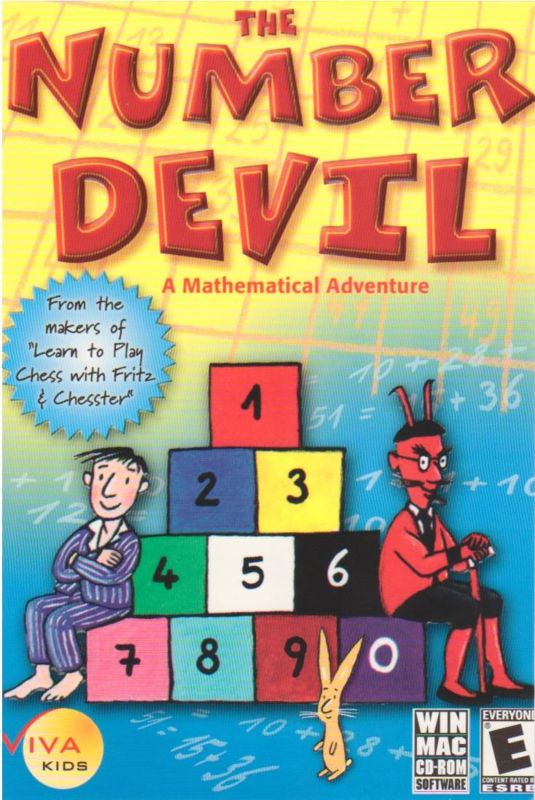
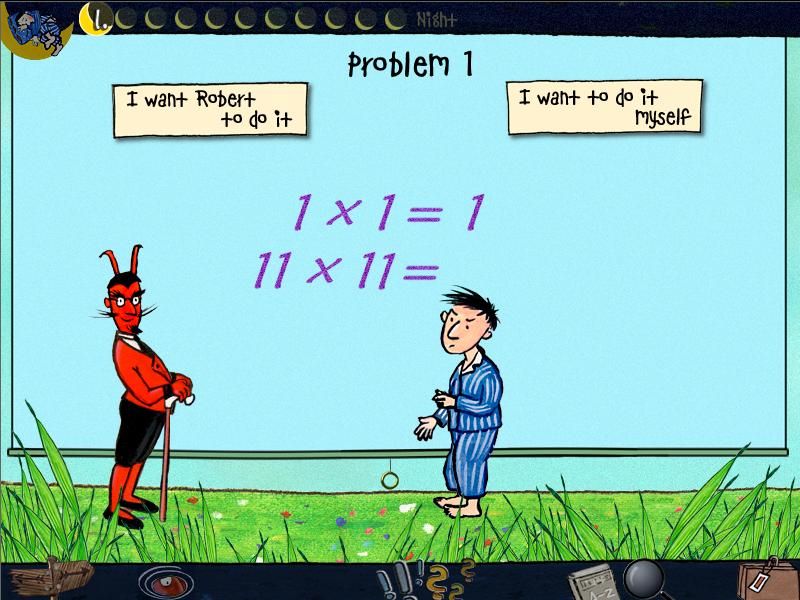
The Number Devil: A Mathematical Adventure offers a predominantly point-and-click interface that makes navigating the dream world both intuitive and engaging. Players guide Robert through each nightly lesson by clicking on interactive elements, using the mouse to select objects, and occasionally switching to the keyboard for number entry. Arrow keys come into play during chapter-ending mini-games, ensuring that the control scheme remains varied yet approachable for younger audiences.
(HEY YOU!! We hope you enjoy! We try not to run ads. So basically, this is a very expensive hobby running this site. Please consider joining us for updates, forums, and more. Network w/ us to make some cash or friends while retro gaming, and you can win some free retro games for posting. Okay, carry on 👍)
Each of the ten lessons introduces a new mathematical concept in turn. After meeting the Number Devil, Robert is invited to participate directly in demonstrations—whether dragging “rutabagas” to represent square roots or lining up “prima donnas” to explore prime numbers. This hands-on approach keeps players actively involved in the learning process, reinforcing ideas as they arise rather than presenting dry theory.
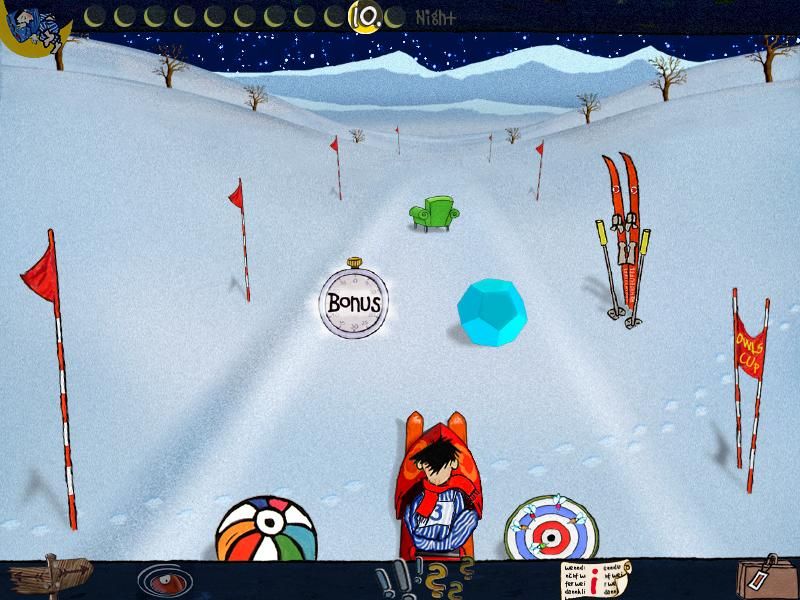
At the conclusion of each night’s lesson, a themed game reinforces the featured topic. You might navigate a Pac-Man–style maze to dodge divisors, stack blocks in a Tetris-inspired challenge to illustrate geometric packing, or participate in a sled race through Owl’s Wood to practice mental arithmetic under time constraints. Moreover, top performers unlock an eleventh, invitation-only level, adding replay value for those determined to master every concept.
Graphics
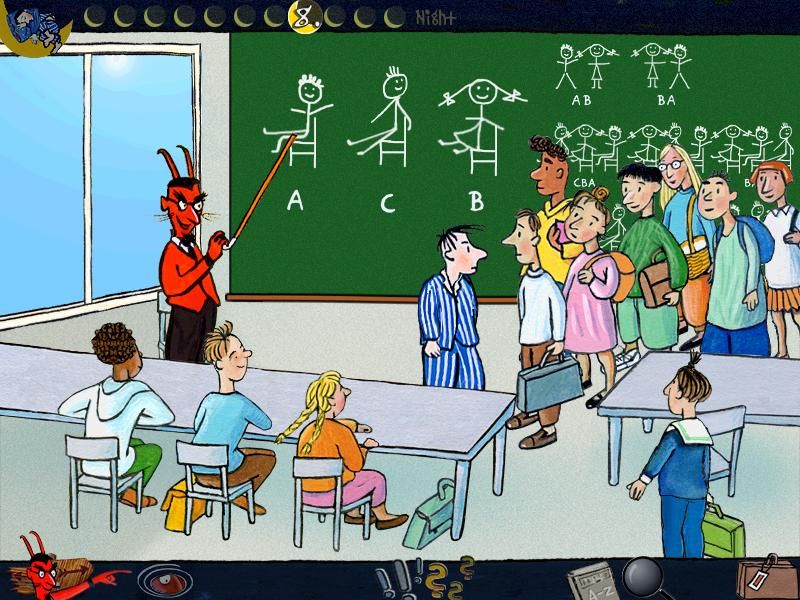
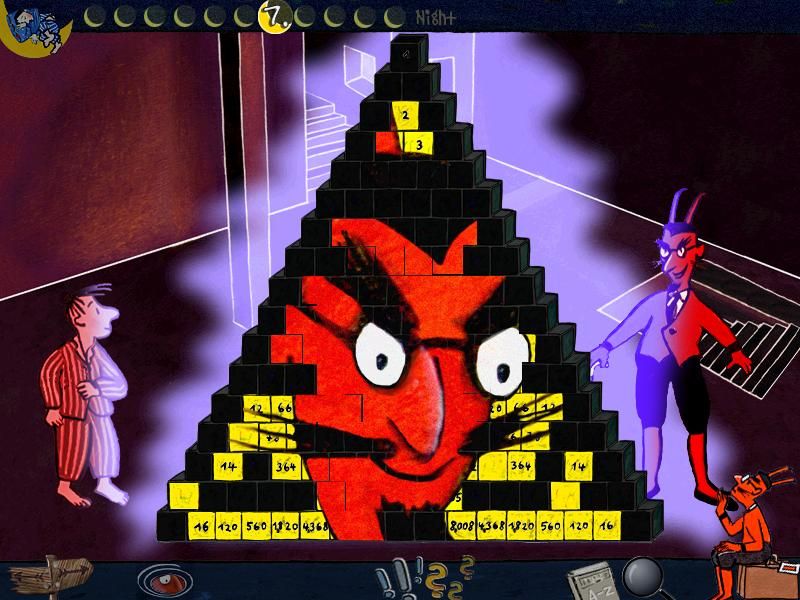
The visual style of The Number Devil closely mirrors Rotraud Susanne Berner’s original illustrations, resulting in a charming, storybook aesthetic that feels both whimsical and coherent. Soft lines and pastel hues evoke the dreamy atmosphere of Robert’s nighttime adventures, while character designs—with the sly grin of the Number Devil and Robert’s expressive reactions—add personality to every scene.
User interface elements are clearly laid out along the bottom of the screen, with icons for back and forward navigation, volume control, scoreboard, help, and exit. Particularly noteworthy are the Glossary and Table of Contents icons: they open beautifully rendered in-game books that fit seamlessly into the overall art direction. These overlays maintain the same artistic flair, ensuring the educational tools never feel out of place.
Animations throughout the game are smooth and purposeful, from the fluttering of pages in Robert’s glossary to the playful antics of floating numerals during lessons. Backgrounds shift between cozy classroom settings and surreal mathematical landscapes—twisting planes, knotted ropes, and golden rectangles—that illustrate concepts dynamically. The result is a visually consistent world that enhances both immersion and understanding.
Story
Your journey begins with Robert, a boy whose math teacher, Mr. Bockel, has made arithmetic so dull that Robert has developed a deep-seated number aversion. That night, however, he dreams of the mischievous Number Devil, who whisks him away into a vibrant realm where every mathematical idea takes on a life of its own. This premise provides a compelling “hook,” transforming Robert’s dread into wonder over ten consecutive nights.
Each night unfolds as a self-contained chapter: one evening explores the story of zero’s discovery, the next dives into the magic of Fibonacci’s sequence or the allure of the Golden Section. The Number Devil’s witty banter and playful demonstrations turn abstract notions into memorable episodes—he might grow oversized tentacles to illustrate multiplication or shrink Robert to crawl through a labyrinth of prime checkpoints. This narrative structure keeps players eager for the next lesson while reinforcing concepts through storytelling.
The game closely follows Hans Magnus Enzensberger’s beloved book, preserving its humor and imaginative flair. References to historical figures and advanced topics (such as planes, knots, and lines) sit alongside simpler ideas, creating a layered storyline that grows with the player. Even the glossary entries double as storytelling elements, revealing quirky nomenclature—“rutabagas” for roots, “prima donnas” for prime numbers—that deepen the sense of a cohesive universe.
Overall Experience
The Number Devil strikes a superb balance between education and entertainment. Concepts span a wide spectrum—from basic operations and Roman numerals to complex ideas like the Golden Section—making the game suitable for curious learners aged eight through high school and beyond. The in-game Glossary and Table of Contents allow players to review topics on demand, transforming the title into a handy reference as well as a lesson plan.
Humor and interactivity breathe life into what could otherwise be dry math tutorials. The Number Devil’s playful mischief, combined with Robert’s evolving confidence, creates an emotional through-line that encourages persistence. End-of-chapter challenges further motivate players by offering tangible goals—high scores, leaderboard bragging rights, and the secret eleventh level to unlock.
For parents, teachers, and students seeking an engaging introduction to mathematics, The Number Devil: A Mathematical Adventure delivers. It succeeds as both a faithful adaptation of a beloved book and a standalone interactive experience. Whether used in the classroom or enjoyed at home, it transforms abstract numbers into vivid, interactive worlds—making math feel less like a chore and more like an adventure.


Reviews
There are no reviews yet.