 Retro Replay Retro Replay gaming reviews, news, emulation, geek stuff and more!
Retro Replay Review
Gameplay
DOME is closer to a Japanese adventure novel than to the puzzle-box adventures many players may expect from the era. Much of your time is spent reading extended dialogue and descriptions, sometimes with no input required, then weighing the occasional choice. The first hour asks you to settle into that rhythm rather than conquer it. If the premise catches you, the quiet accumulation of information can be compelling; if it does not, the pauses between meaningful decisions can feel interminable.
There is more interaction here than the label “visual novel-like” initially suggests. You can use verb-object commands, look back over information on recent events and characters, and take or examine objects. These touches matter because they give you something to do besides advance text, and the event-and-character review is especially welcome in a dialogue-dense game. Still, this is not a game driven by fiendish inventory problems or elaborate puzzles. Treat the commands as ways of participating in the investigation, not as a promise of constant mechanical variety.
The friction comes from the balance between its two sides. DOME wants you to read at length, but it also occasionally asks you to engage with its adventure interface. That can make the game feel more hands-on than a pure branching novel, yet less focused than a conventional command adventure. Go in ready to read carefully and use the information review instead of trying to rush from interaction to interaction. The slower pace is the point, but it will only work if you are willing to meet it halfway.
Graphics
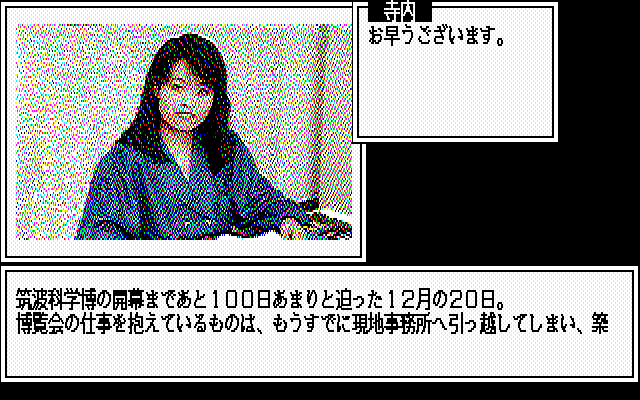
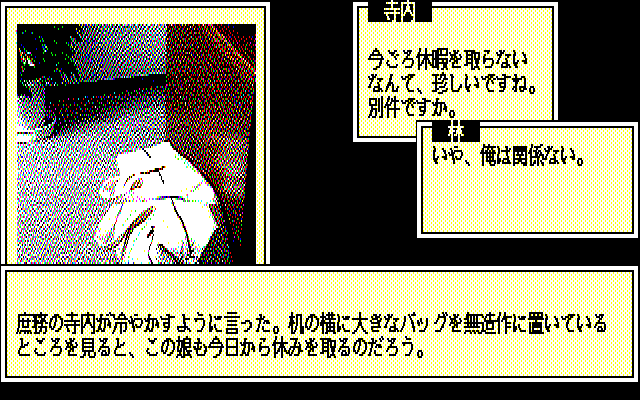
DOME uses sparse digitized photos of people and objects rather than detailed drawn locations. The images give faces and important items a concrete presence, but they do not turn the MSX screen into a richly illustrated world. You will spend far more time with text than studying elaborate scenes.

Story
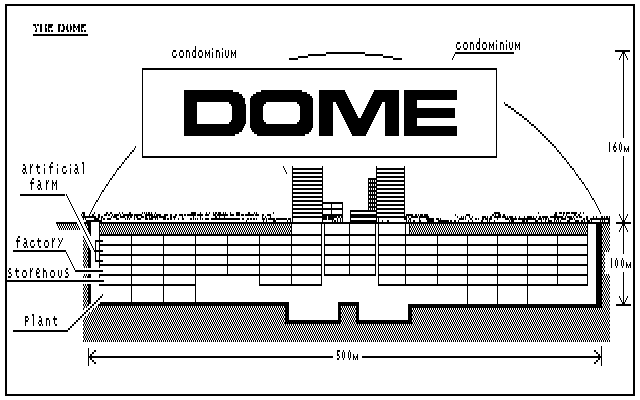
The central idea has real weight: an atomic war may be coming, and the shelter known as The Dome is meant to protect humanity from it. You play an advertising-company employee tasked with building public awareness and collecting donations, which is a refreshingly indirect role for an adventure protagonist. The tension comes not from fighting the threat yourself, but from trying to persuade others that preparation matters.
Because the game is based on Shizuko Natsuki’s novel, its writing-led structure makes sense. DOME is interested in explanation, conversation, and the human response to an enormous disaster looming on the horizon. That makes its subject matter more serious than its sparse graphics might imply. It is not a breezy after-school adventure; it asks you to spend time with a grim civic problem.
That focus is also why the game’s long non-interactive passages are easier to accept when you are invested in the premise. The payoff is not a parade of plot twists or action scenes, but the chance to inhabit a story about fear, persuasion, and collective responsibility. If that sounds dry, DOME probably will be. If it sounds unsettlingly compelling, its patient format has a reason to exist.
Overall Experience
DOME is historically interesting as the opening entry in System Sacom’s Novel Ware series, but its stronger argument is that it tries to fuse a novel’s sustained reading with a traditional Japanese adventure’s basic investigative tools. The result is uneven, though rarely empty: the text carries the experience, while the commands and object examination keep you from becoming only a spectator.
You should give it a chance if you enjoy old-school Japanese adventures for their writing and are comfortable with long stretches of reading. The nuclear-shelter premise is unusual enough to sustain curiosity, and the role of an ad employee raising awareness gives the game a distinct angle. Come for a thoughtful, restrained scenario rather than puzzles, speed, or visual variety.
For everyone else, DOME can feel like a demanding artifact of its time. Its sparse photos and deliberately limited interaction will test your patience, and the game does not disguise its novel-first priorities. But if you can accept that pace, there is something memorable about an adventure willing to build its tension around words, public anxiety, and the difficult work of getting people to care before it is too late.


Reviews
There are no reviews yet.