 Retro Replay Retro Replay gaming reviews, news, emulation, geek stuff and more!
Retro Replay Review
Gameplay
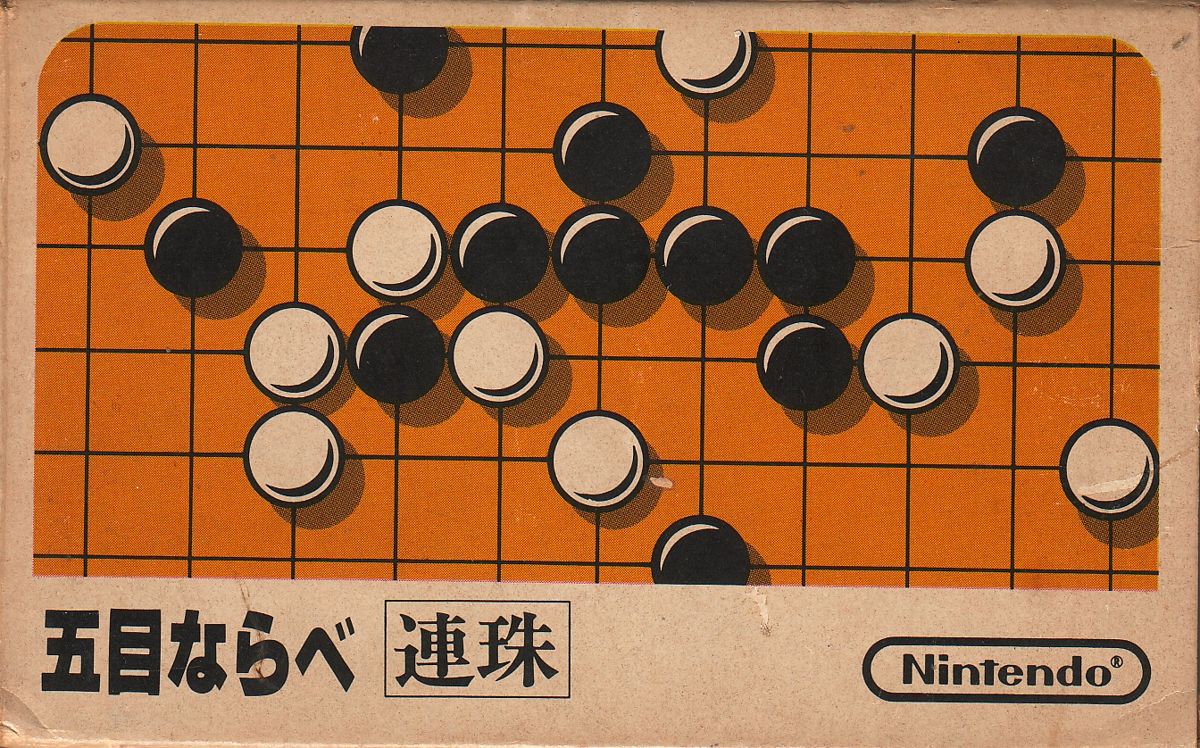
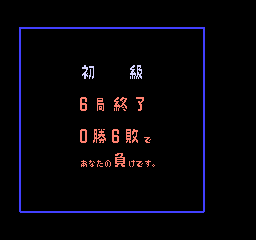
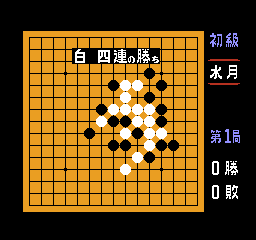
Gomoku Narabe Renju distills the essence of abstract strategy into a deceptively simple objective: connect five of your pieces in a straight or diagonal line while preventing your opponent from doing the same. Turn-based placement mechanics keep each move meaningful, forcing you to balance offense and defense as you build multiple threats across the board. Victory in each individual round earns a point, and the cumulative score over a predetermined number of games determines the overall winner.
(HEY YOU!! We hope you enjoy! We try not to run ads. So basically, this is a very expensive hobby running this site. Please consider joining us for updates, forums, and more. Network w/ us to make some cash or friends while retro gaming, and you can win some free retro games for posting. Okay, carry on 👍)
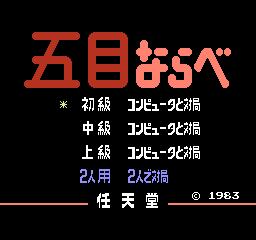
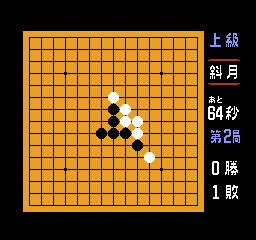
The title offers three distinct difficulty modes that cater to both newcomers and seasoned veterans. On the easiest setting, the AI makes occasional missteps, allowing you to experiment freely with basic tactics. Medium difficulty sharpens the computer’s foresight, rewarding careful planning and pattern recognition. For players seeking a true test, the hardest mode introduces a ticking clock: you must secure victory in each game before the timer hits zero, adding a thrilling sense of urgency to every move.
Beyond raw strategy, Gomoku Narabe Renju’s pacing feels balanced. Short, best-of-three or best-of-five match series create a natural ebb and flow—momentum swings keep you on your toes while the point-based structure encourages comeback potential. Whether you’re grinding out a late lead or recovering from an early deficit, the format fosters a satisfying meta-game that extends well beyond individual boards.
Graphics
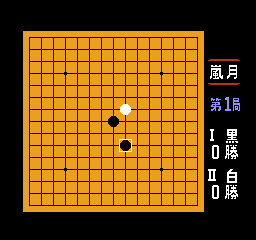
Visually, Gomoku Narabe Renju embraces a clean, minimalist design that puts the focus squarely on the board. The grid of intersections is crisply rendered, with high-contrast pieces that remain easy to track even during frantic endgame scenarios. Subtle shading and occasional lighting effects lend depth to the playing surface without distracting from core gameplay.
The user interface is intuitive, offering quick access to difficulty settings, match history, and timer controls. Animations for placing stones are swift and responsive, giving a tactile sense of satisfaction as each piece snaps into place. Menus feature clear typography and streamlined navigation, so you’ll never waste time digging through submenus when you want to jump straight into a rematch.
Accompanying sound design further enhances concentration: gentle ambient tones underscore each move, while a soft click punctuates stone placement. In timed mode, the escalating beeps of the countdown add tension without veering into anxiety, ensuring the audio cues complement rather than overwhelm the visual simplicity.
Story
As an abstract strategy title, Gomoku Narabe Renju does not weave a traditional narrative or cast of characters. Instead, it draws its dramatic tension from the timeless cultural heritage of Renju—a refined variant of Gomoku with a storied history in East Asia. By faithfully recreating the feel of a classic boardroom duel, the game taps into centuries of strategic tradition without imposing a fictional backdrop.
Rather than a plot, the “story” here emerges from your own matches. Each victory or defeat contributes to a personal journey of improvement, with the shifting scoreboard serving as a chronicle of hard-fought battles. In this way, the game turns your head-to-head encounters with the AI into moments of narrative significance, as patterns evolve and strategies sharpen over time.
Supplementary documentation provides brief historical context on Renju’s origins, offering curious players insight into the real-life masters who shaped the rules. While optional, these tidbits of tradition lend a sense of continuity between the digital board and centuries-old tournament halls, enriching the overall experience for fans of classic strategy.
Overall Experience
Gomoku Narabe Renju delivers a focused, elegant experience that excels at what it sets out to do: offer pure, undiluted abstract strategy. Its straightforward mechanics conceal a deep strategic well, and the inclusion of three difficulty tiers ensures the game remains approachable for beginners while still challenging veteran tacticians. The timed mode on the hardest difficulty adds a rush of adrenaline that keeps even experienced players on edge.
With its minimalist presentation and emphasis on core gameplay, this title is ideal for quick sessions on a commute or more extended bouts at home. The lack of extraneous features means there’s no barrier to entry—just you, the board, and your opponent. Though there is no online multiplayer, local pass-and-play or solo matches against the AI provide ample replay value through repeated showdowns across multiple boards.
Ultimately, Gomoku Narabe Renju stands out as a refined digital interpretation of a classic pastime. It rewards thoughtful planning, pattern recognition, and adaptability, all wrapped in a user-friendly package. For players seeking a cerebral challenge that can be enjoyed in short bursts or marathon sessions alike, this game represents a compelling purchase.


Reviews
There are no reviews yet.