 Retro Replay Retro Replay gaming reviews, news, emulation, geek stuff and more!



Retro Replay Review
Gameplay
From the moment you pick up the controller for Somari the Adventurer, it’s clear that the developers aimed to capture the lightning-fast thrill of the original Sonic the Hedgehog on the Sega Genesis. Movement is remarkably smooth considering the hardware limitations of the NES, and Somari’s acceleration and inertia mimic Sonic’s signature feel. The added spindash ability—bearing down on the D‐pad and pressing A or B—gives Somari an edge straight from Sonic the Hedgehog 2, allowing players to breach obstacles and enemies with dramatic flair. Controls are tight and responsive, making for an adrenaline‐pumping platform experience.
(HEY YOU!! We hope you enjoy! We try not to run ads. So basically, this is a very expensive hobby running this site. Please consider joining us for updates, forums, and more. Network w/ us to make some cash or friends while retro gaming, and you can win some free retro games for posting. Okay, carry on 👍)
Ring collection remains at the core of Somari’s survival, yet the hit‐reaction has been rebalanced. Instead of losing all collected rings when struck, Somari only drops three rings per hit, regardless of his current stash. This tweak mitigates the frustration of perpetual ring hunting found in the original, enabling a more forgiving and beginner-friendly experience. Still, the risk-reward tension endures: holding rings offers protection, but comes at the expense of targeting them midair if you take damage.
Level progression follows the blueprint set by Sonic the Hedgehog, progressing through lush Green Hill landscapes, undersea routes, and mechanized zones. However, the Scrap Brain Act was never completed and is absent from the final release, trimming the overall stage count. Even so, the level layouts have been adjusted throughout, introducing subtle variations in platform placement, enemy spawns, and ring paths. This ensures that veteran Sonic players will find fresh surprises while newcomers will appreciate the carefully paced difficulty curve.
Enemies and hazards remain faithful to their Genesis counterparts—caterkiller bots, rolling buzz bombs, and flicky-riding badniks all make appearances. Their AI is basic but serviceable, behaving in predictable patterns that reward observation and timing. Collectibles such as extra lives and powerups are neatly hidden or off the beaten path, encouraging exploration beyond the straight‐line rush. Overall, Somari’s gameplay nails the spirit of classic Sonic action while carving out small but welcome differences for NES aficionados.
Graphics
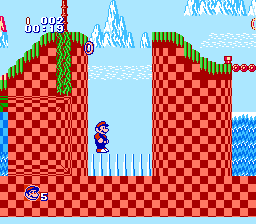
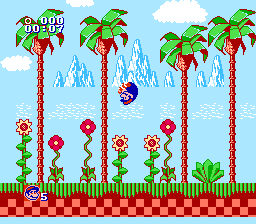
Visually, Somari the Adventurer is a striking feat on the NES. The color palette has been stretched to its limits, yielding vibrant greens, brilliant blues, and deep oranges that evoke the Genesis original. Sprite work is impressively detailed: Somari’s pixel animation reflects Sonic’s trademark roll and stand poses, while his distinct red cap and overalls nod to Mario heritage. The background layers sometimes exhibit slight flicker, but they don’t detract from the overall sense of speed or immersion.
Stage aesthetics maintain a high degree of fidelity to the original zones, even if some layouts have been retooled. Textured tilesets in the Green Hill Zone—complete with checkerboard patterns and palm trees—transition smoothly to more industrial layouts in the Marble and Spring Yards. Occasional slowdown occurs when too many enemies or objects occupy the screen, but it rarely impedes player momentum or control precision.
Character and enemy sprites are instantly recognizable to Sonic fans, yet bear subtle stylistic differences that showcase the port’s NES identity. Rings and item capsules shimmer distinctly despite the platform’s limited sprite channels, and special stage loops are rendered in charming monochrome, emphasizing their rotation and height without overwhelming the hardware. Though lacking the polish of a first-party Nintendo release, Somari’s graphics punch well above their weight.
Screen transitions and boss encounters are handled with surprising flair: mini-cinematic moments—such as the ring release upon damage—are animated crisply. The occasional palette shift between acts underscores stage changes and boss activations. Taken together, these graphical flourishes make Somari the Adventurer one of the NES’s most visually ambitious fan‐driven efforts.
Story
Somari the Adventurer’s narrative is best described as minimalist by design, placing gameplay above plot. You assume the role of Somari—a fusion of Mario and Sonic—racing through Dr. Robotnik’s mechanical strongholds to rescue captured creatures and thwart his diabolical schemes. While there’s no deep dialogue or cutscene exposition, the premise is clear: speed, platforming prowess, and ring collecting are your tools to bring peace back to the islands.
Because the story is light on text, each level introduction screen and final boss defeat sequence serves as the primary vehicle for narrative progression. A handful of static images convey Robotnik’s frustration and Somari’s victory pose, evoking the charm of early ’90s cartridge gaming. Though it lacks a robust lore or character development, the game’s simplicity mirrors that of its source material—a deliberate choice that maintains focus on pure platforming thrills.
Fans of Mario or Sonic will appreciate the tongue-in-cheek mash-up premise: Mario in Sonic’s shoes (literally) blends two iconic universes in a playful, non‐canonical romp. This crossover charm fuels player engagement more than any elaborate story beats could. Newcomers simply wanting a fast-paced NES platformer will find enough context in the goal of defeating Robotnik to stay motivated, without wading through lengthy cutscenes or dialogue blocks.
While purists may lament the absence of a deeper backstory, Somari the Adventurer succeeds at delivering an arcade-style progression that trades plot complexity for immediacy. In doing so, it captures the nostalgic essence of early console titles—where the journey through each zone was narrative enough.
Overall Experience
Somari the Adventurer stands as an impressive fan‐crafted feat that brings the Sonic formula to a different generation of hardware. Despite the NES’s limitations, the game delivers exhilarating speed, tight controls, and an authentic feel that will resonate with retro enthusiasts. Occasional slowdown and minor graphical quirks are forgivable given the platform’s constraints and the project’s unofficial status.
The blend of Mario aesthetics on Sonic levels offers a whimsical charm few other hacks or ports achieve. It’s not merely a palette swap but a cohesive integration of character animation and platform design that respects both franchises. Whether you’re chasing down high ring counts, hunting secret paths, or simply powering through level after level, the experience remains consistently engaging.
Music and sound effects further elevate the adventure: chiptune renditions of classic Sonic themes are rendered with tasteful tempo shifts, lending a fresh sonic identity to familiar melodies. Coincidentally, these tracks highlight the NES’s unique audio strengths, turning potential limitations into distinctive musical flourishes.
For players seeking a blast of retro platforming with a twist, Somari the Adventurer is a must‐play. It captures the essence of early ’90s gaming, blending speed, exploration, and lighthearted fan service into a seamless NES package. Its minor technical hiccups do little to dampen the thrill of racing through vibrant zones at breakneck pace. In sum, Somari the Adventurer offers a delightfully nostalgic, action‐packed journey that both Sonic and Mario fans can rally behind.


Reviews
There are no reviews yet.