 Retro Replay Retro Replay gaming reviews, news, emulation, geek stuff and more!



Retro Replay Review
Gameplay
Stadium Events puts you right on the starting line with the Nintendo Power Pad, challenging your speed, timing, and reflexes across four classic track and field disciplines. You’ll sprint through the 100m dash, bound forward in the long jump, hurdle your way across 110m hurdles, and coordinate rhythm and power in the triple jump. The physicality of tapping or stepping on the pad’s panels gives each event a tactile thrill that onscreen controls simply can’t match.
(HEY YOU!! We hope you enjoy! We try not to run ads. So basically, this is a very expensive hobby running this site. Please consider joining us for updates, forums, and more. Network w/ us to make some cash or friends while retro gaming, and you can win some free retro games for posting. Okay, carry on 👍)
The single-player mode introduces a clear progression system: beat Turtle to move on to Bear, then Horse, Rabbit, Bobcat, and finally Cheetah. As opponents grow faster, you’re rewarded with increasingly prestigious medals and trophies, giving you tangible goals to chase. This ladder of competitors encourages you to refine your technique and improve your stamina, making each victory feel earned.
In multiplayer, up to six friends can compete in “Olympics” mode, though hardware limits allow only two players on the pad simultaneously during running events and one at a time for jumps. Passing the pad around adds a social, party-game element—rooting for the next sprinter or jumper feels just as exciting as racing yourself. This rotating format keeps everyone engaged, with a final cumulative score to determine the ultimate champion.
Graphics
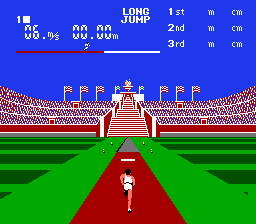
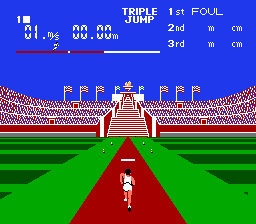
On the original NES hardware, Stadium Events delivers simple yet charming visuals that capture the essence of early ’90s sports games. Character sprites are blocky but distinct—each competitor is recognizable, and their running and jumping animations convey a surprising amount of personality given the limited palette. Backgrounds are minimal, focusing attention on the action and avoiding distracting details.
Event layouts are clean and functional. The 100m dash track is marked in high-contrast stripes, hurdles stand out clearly against a flat backdrop, and the sandpit in long and triple jump events features a readable distance marker. While there’s no parallax scrolling or elaborate scenery, the game’s UI elements—timers, distance readouts, and medal icons—stay sharp and uncluttered, ensuring you’re always aware of your performance metrics.
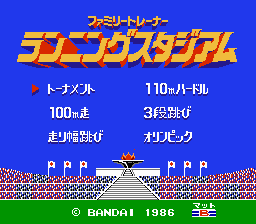
Compared to its re-release as World Class Track Meet, the core graphics remain identical, preserving the nostalgic aesthetic. Any enhancements made in the later version are subtle, focusing on minor tweaks to color-balancing or title-screen artwork. If you’re drawn to retro visuals and don’t mind the occasional flicker or sprite pop-in, Stadium Events delivers a straightforward, easily readable presentation that supports focused, fast-paced gameplay.
Story
Stadium Events doesn’t spin an epic narrative; instead, its “story” unfolds through your own progression and the tale of its rarity. Originally released by Bandai in early 1987, the game was pulled from shelves almost immediately and rebranded by Nintendo of America as World Class Track Meet. Today, original Stadium Events cartridges are among the rarest and most collectible titles in the NES library, making every play session a brush with gaming history.
Your journey is essentially one of athletic mastery: a grassroots sprinter taking on increasingly formidable rivals until you stand at the summit, having conquered the cheetah-fast competition. The evolving difficulty tiers and the symbols of achievement—medals and trophies—form a minimalist player-driven narrative that records your personal triumphs on the global stage.
For collectors and retro enthusiasts, the real storyline often centers on tracking down an authentic Stadium Events cartridge, complete with original box and manual. Owning and playing such a scarce title becomes part of your gaming legend, and each winning performance feels like a chapter in your own sports saga. In that sense, Stadium Events weaves its narrative not through cutscenes, but through the legacy and lore that surrounds the cartridge itself.
Overall Experience
Stadium Events is a unique blend of physical exertion and digital competition. The requirement of the Power Pad adds novelty and immersion—but also limits accessibility, as you must own both the game and the specialized peripheral. If you’re willing to hunt for that elusive cartridge or settle for the rebranded World Class Track Meet, you’ll find an experience that stands out among NES sports titles for its interactivity and social appeal.
The game’s lasting charm lies in its simplicity: four well-chosen events, a clear progression path, and a party-style multiplayer mode that gets everyone involved. It’s easy to pick up, yet hard to master, especially as you chase that final Cheetah-level trophy. Replay value is high for groups and solo players alike, as shaving fractions of a second off your best times remains a rewarding challenge.
While modern sports titles boast advanced graphics, deep career modes, and online competition, Stadium Events thrives as a pure, focused arcade experience. It’s a snapshot of an era when gameplay mechanics and physical interaction took center stage. For retro gamers, collectors, or anyone curious about early NES innovations, this game offers a spirited competition that feels as fresh today as it did when it first crossed the finish line.


Reviews
There are no reviews yet.