 Retro Replay Retro Replay gaming reviews, news, emulation, geek stuff and more!
Retro Replay Review
Gameplay
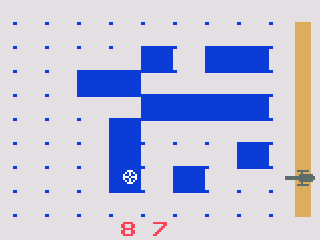
Depth Charge delivers a thoughtful twist on the classic Battleship formula by placing you in direct control of a cannon perched above an 8×8 grid. You slide a crosshair across the water’s surface using the joystick and fire the action button to probe each square. Hits are marked by blue squares, while misses trigger an audibly distinct warning sound and leave the grid unticked. With seven submarines of varying lengths—three single-cell, two two-cell, one three-cell and one four-cell—you must balance luck and deduction to clear the field in as few shots as possible.
(HEY YOU!! We hope you enjoy! We try not to run ads. So basically, this is a very expensive hobby running this site. Please consider joining us for updates, forums, and more. Network w/ us to make some cash or friends while retro gaming, and you can win some free retro games for posting. Okay, carry on 👍)
The strategic depth lies in interpreting patterns of hits and misses. Rarely does a shot stand in isolation; instead, every misses funnel you toward the remaining submarine positions. Tracking shot count adds a competitive edge, encouraging players to hone an efficient search algorithm. The lack of time pressure fosters relaxed yet methodical play, making each successful hit a satisfying reward for careful planning.
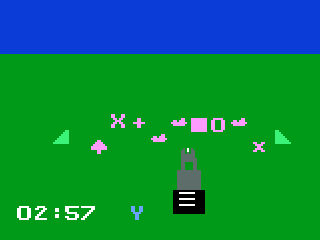
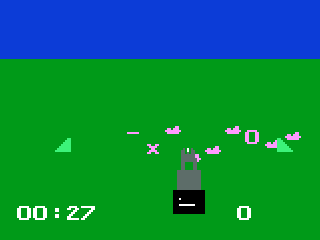
Marksman, by contrast, turns the spotlight on reflexes and precision under time constraints. You view a rifle stock and a scrolling row of targets from a first-person perspective. Targets bounce up and down as they move right-to-left, and you have 24 bullets to amass points. Choose between a 1-minute dash or a more forgiving 3-minute session. Each target carries a value of 1 to 9 points, and once you hit 100 points, the pace intensifies, forcing you to adapt to faster-moving silhouettes.
The energy curve in Marksman is unmistakable: peaceful warm-up at the start, a spike of excitement once you break the 100-point threshold, and a frantic endgame race against both time and ammo. Missing shots not only wastes ammunition but also saps momentum, while well-timed bursts deliver a thrilling sense of mastery. The dual-mode timer selection adds replay value, catering both to casual shooters seeking a brief diversion and to high-score chasers craving a deeper challenge.
Graphics
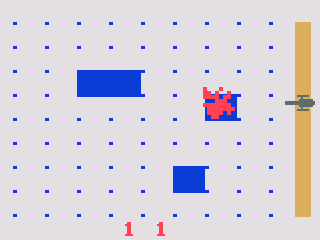
Visually, Depth Charge embraces minimalism with a stark, top-down grid and simple blue-and-white color palette. The water is represented by a static background, while the crosshair and shot markers remain clean and easily distinguishable. There’s no pretense of high-resolution sprites or lush environments, but every element is clear at a glance—a necessity in a game hinging on careful observation and precise targeting.
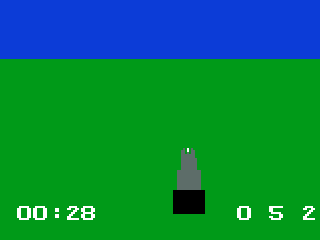
Marksman trades minimalist abstraction for a first-person shooting gallery aesthetic. The rifle stock and barrel occupy the lower portion of the screen, while multicolored targets oscillate across the midpoint. The pixel art is modest but serviceable: each target type has a distinct silhouette and color, ensuring you can quickly identify higher-value targets even when the action accelerates. Target movement feels fluid within the hardware’s limits, and speed changes are perceptible without jarring the player.
Both titles convey their respective moods through purposeful graphical choices. Depth Charge’s clean grid reinforces the cerebral nature of submarine-hunting, whereas Marksman’s moving targets and rifle perspective evoke the carnival-shooting gallery nostalgia. Neither game aims for visual spectacle; instead, they prioritize clarity and function, ensuring that every shot—hit or miss—is immediately understandable.
Story
Neither Depth Charge nor Marksman follows a traditional narrative structure, yet each carries an implied premise. In Depth Charge, you assume the role of a lone naval gunner tasked with rooting out hidden submarines before they can strike. The tension of the unseen enemy lurking beneath the waves supplies its own form of silent drama, turning each square you probe into a potential battleground.
Marksman invites you into the timeless world of shooting galleries—an experience as old as arcade halls themselves. While there’s no backstory, the setting is instantly recognizable: communities gathering around to test marksmanship, the satisfying ping of a hit target, and the ticking clock as a subtle antagonist. The absence of plot puts the focus squarely on score-chasing and the personal narrative of improving one’s own performance.
Together, these two mini-games demonstrate how atmospheric context can emerge from pure gameplay mechanics. Depth Charge’s hidden threats and Marksman’s ticking clock each suggest a scenario without spelling out names, dates or dialogue. This design choice lets players fill in their own stories, whether imagining covert naval operations or carnival festivities.
Overall Experience
Depth Charge and Marksman form a complementary duo that caters to both slower-paced strategists and adrenaline-seeking shooters. Depth Charge rewards meticulous planning and logical deduction, while Marksman challenges your reflexes and hand-eye coordination under pressure. Packaging both experiences on a single cart adds variety and encourages extended play sessions to switch gears when fatigue or frustration sets in.
While neither title pushes graphical boundaries or weaves an elaborate plot, each succeeds within its defined scope. Depth Charge’s methodical probing and shot tracking deliver a calm yet intellectually engaging puzzle, and Marksman’s escalating speed and point thresholds create a satisfying arc of tension and release. Together, they offer a balanced arcade package that highlights the strengths of retro design: straightforward objectives, immediate feedback and easy-to-learn controls.
For collectors and retro enthusiasts, this cart provides two distinct arcade experiences in one affordable bundle. Depth Charge appeals to those who enjoy Battleship-style deductions without an opponent’s mind games, whereas Marksman offers quick bursts of challenge ideal for leaderboard competition. Both games are easily approachable for beginners yet possess enough depth to hold the interest of seasoned players seeking to refine their strategies or top their personal bests.


Reviews
There are no reviews yet.