 Retro Replay Retro Replay gaming reviews, news, emulation, geek stuff and more!
Retro Replay Review
Gameplay
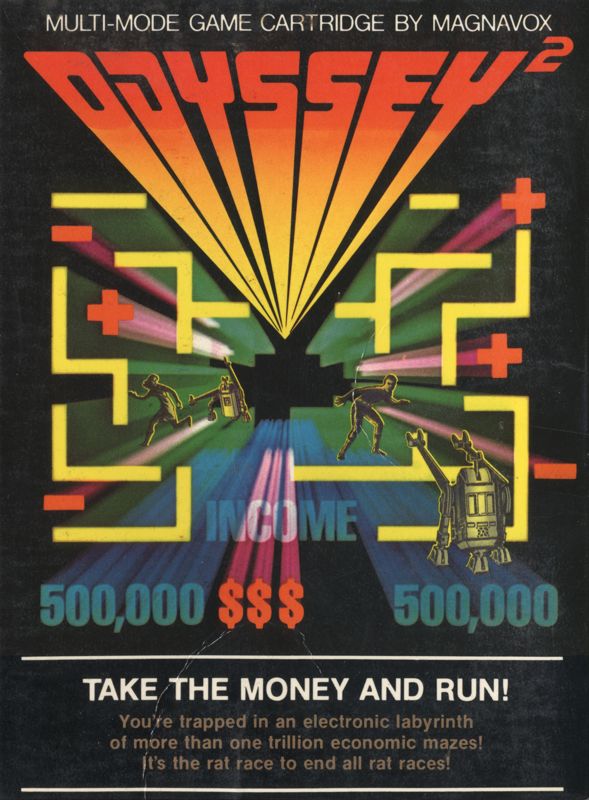
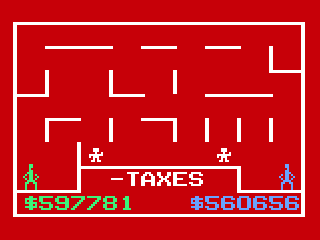
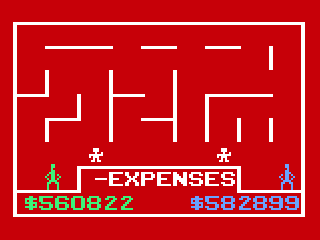
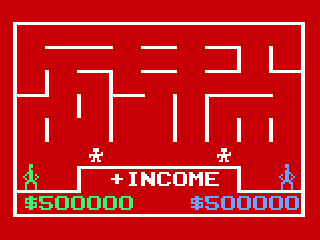
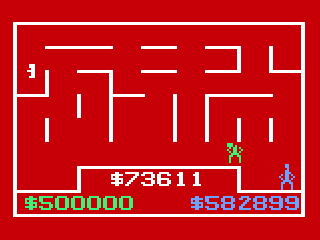
Take the Money and Run! transforms maze-navigation into an economic battleground, challenging players to outwit robotic representations of fiscal forces. Each of the seven circuit-like labyrinths—Income, Reward, Investment, Expenses, Thief, Taxes, and Inflation—introduces a unique risk/reward dynamic. In the first three mazes, you actively pursue the robots to bank gains, while in the latter four you must evade capture to avoid financial penalties. This push-and-pull keeps every playthrough suspenseful, as a single slip can cost you thousands of virtual dollars.
(HEY YOU!! We hope you enjoy! We try not to run ads. So basically, this is a very expensive hobby running this site. Please consider joining us for updates, forums, and more. Network w/ us to make some cash or friends while retro gaming, and you can win some free retro games for posting. Okay, carry on 👍)
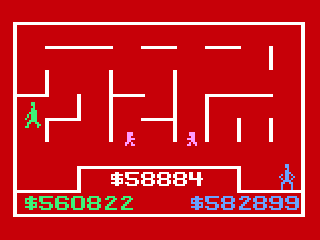
The control scheme emphasizes both strategy and agility. Your character moves at full speed on open corridors, but when approaching low-ceiling sections you’ll need to duck with the action button. Traveling in a crouched position reduces your pace to two-thirds, while ignoring the low overhang will throttle you down to half speed—forcing you to weigh the short-term setback of slowing yourself against the long-term benefit of avoiding a costly collision. Bumping into maze walls further hampers your momentum, and brushing against a fellow player while pinned against a wall causes a brief loss of directional control, adding an extra layer of tactical complexity.
The money counter at the bottom of the screen operates like a ticking clock: it starts at a predetermined value for each run and steadily decreases. In chase mazes you must intercept the bots before your balance dips too low, and in flee mazes your goal is to outlast their pursuit until your counter hits zero. This dual-mode tension—hunting and hiding—keeps the gameplay loop fresh and engaging, encouraging repeated runs as you refine your knowledge of each labyrinth’s shortcuts, choke points, and safe zones.
Graphics
Visually, Take the Money and Run! embraces a vibrant, high-contrast aesthetic that evokes retro-futurism. Each maze is rendered in crisp neon lines over dark, grid-infused backgrounds, giving a strong sense of depth and classical arcade flair. The robots—slick, minimalist avatars of economic concepts—glow with color-coded accents: green for Income, gold for Reward, blue for Investment, crimson for Expenses, black-and-yellow for Thief, grey for Taxes, and pulsating red for Inflation.
Environmental details reinforce the game’s narrative premise: circuitboard-inspired pillars inscribed with fluctuating stock charts, holographic banners displaying 20th-century economic data, and flickering displays that shout key terms like “Supply,” “Demand,” and “Interest.” Low ceilings are visibly delineated by shifting light panels, helping players recognize where to duck, while wall collisions are accompanied by subtle pixel-shatter effects that communicate loss of traction in real time.
On modern hardware, the title sustains a rock-solid frame rate, ensuring split-second maneuvers feel smooth and responsive. Motion blur and shimmering reflections on polished floor tiles heighten immersion, and dynamic lighting reacts to your character’s movement, casting elongated shadows that underscore the maze’s labyrinthine nature. The overall visual package is both functional—clearly conveying gameplay-critical information—and stylish, invoking a futuristic economy-level set that feels at once alien and familiar.
Story
While primarily a gameplay-driven experience, Take the Money and Run! weaves a concise yet captivating narrative through its premise. After an experiment in time travel goes awry, players find themselves marooned in the Land of Keynesium in the year 231,000 A.D. Here, the enigmatic Keynesians have elevated 20th-century economic models to quasi-religious dogma, erecting endless mazes to test and contain wandering temporal interlopers.
Brief text vignettes and holographic logs scattered throughout each maze shed light on the Keynesians’ motivations—an insatiable curiosity about inflationary cycles, taxation loopholes, and credit crises. These snippets of lore are optional but rewarding, offering context to the abstract chases and lending a playful satire to the grind. The stakes are clear: accumulate $500,000 in winnings to double your bankroll to $1,000,000, thus powering your return trip home, or else stay trapped in this economic purgatory forever.
The story unfolds organically through gameplay milestones rather than long cutscenes, making each successfully completed maze feel like both a monetary and narrative achievement. As you progress, the occasional change in lighting palette and robot design signals shifts in the Keynesians’ experimental focus, hinting at deeper layers of world-building waiting to be uncovered in later levels.
Overall Experience
Take the Money and Run! offers an addictive loop that balances high-stakes tension with approachable mechanics. Whether you’re a fan of classic maze chases or intrigued by the overlay of economic allegory, the game delivers a uniquely satisfying blend of strategy and reflex-based thrills. The dual mash-ups of chase and evasion modes ensure that every round feels fresh, demanding new patterns of play and rewarding memorization of each labyrinth’s intricacies.
One of the game’s greatest strengths is its accessibility: simple controls, intuitive on-screen indicators, and clear visual language make it easy for newcomers to pick up, yet the depth of strategy—timing your ducks, planning escape routes, and managing dwindling funds—provides a compelling challenge for seasoned players. The dynamic money counter injects urgency, while the contrasting maze mechanics prevent the experience from feeling repetitive across the game’s extensive set of levels.
Ultimately, Take the Money and Run! succeeds as both a nostalgic throwback to arcade classics and a fresh puzzle-strategy hybrid. Its sharp aesthetic, tight control design, and witty economic subtext make it a standout title for anyone seeking a brain-teasing, adrenaline-fueled adventure. If you’ve ever wondered what happens when you mix time travel with Keynesian theory, this game is your ticket to an unforgettable—and potentially everlasting—maze run.


Reviews
There are no reviews yet.