 Retro Replay Retro Replay gaming reviews, news, emulation, geek stuff and more!

Retro Replay Review
Gameplay
Zavas delivers a refreshingly open-ended experience that feels more at home in the Western RPG tradition than in the typical Japanese role-playing scene of its era. Right from the start, you take control of the knight Mardy and are given free rein to explore the vast medieval land of Fargana. There’s no hand-holding narrative to force you down predetermined paths—every decision, from which town to visit first to how you tackle random monster encounters, is yours to make.
(HEY YOU!! We hope you enjoy! We try not to run ads. So basically, this is a very expensive hobby running this site. Please consider joining us for updates, forums, and more. Network w/ us to make some cash or friends while retro gaming, and you can win some free retro games for posting. Okay, carry on 👍)
The game’s detailed party and resource management systems are where Zavas really shines. Beyond the usual weapons, armor, and consumables, you must also stock up on food to keep your party alive as you venture into the wilderness. This constant need to balance supplies against exploration adds a layer of survival strategy, making every journey tense and rewarding. Furthermore, NPC recruitment introduces a light roster-building element: fellow adventurers can be hired, each with their own portraits and basic stats, even if their personalities remain enigmatic.
Combat in Zavas is entirely turn-based and unfolds on a grid, very much in the style of the classic Ultima titles. Enemies appear randomly as you trek the landscape, forcing you to think tactically about positioning and movement. Since both you and your foes can maneuver freely around the fixed battle screen, engagements become a careful dance of offense and defense. The lack of flashy special effects may initially feel austere, but the strategic depth more than compensates, especially when facing tougher monsters or multiple opponents at once.
Interaction with the world’s inhabitants also carries weight. Guards demanding tolls at city gates may be bribed, cajoled, or simply attacked, and merchants will haggle or scowl depending on your approach. These small branching choices, while limited, reinforce the game’s commitment to player agency. Zavas doesn’t worry about tracking morality meters or intricate dialogue trees—it trusts you to carve your own path and live with the consequences.
Graphics
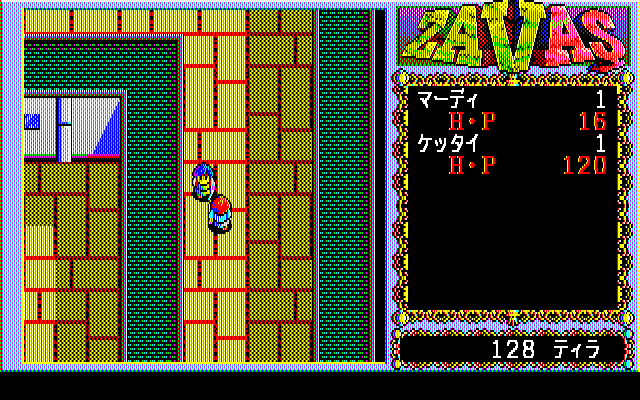
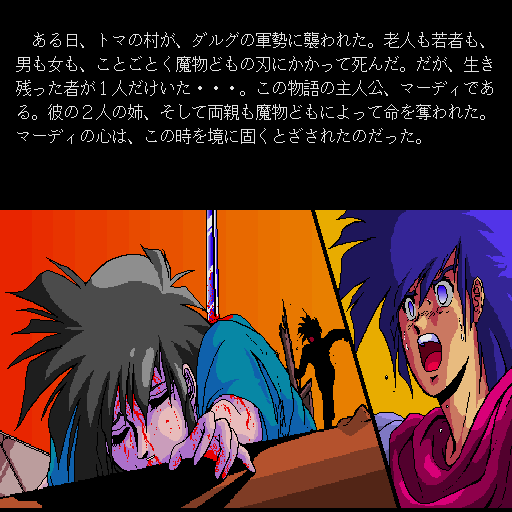
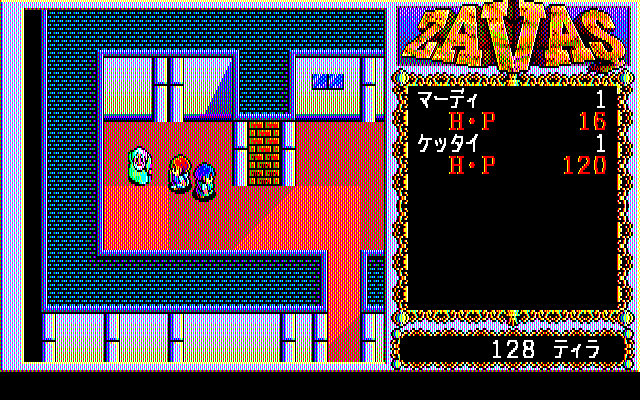
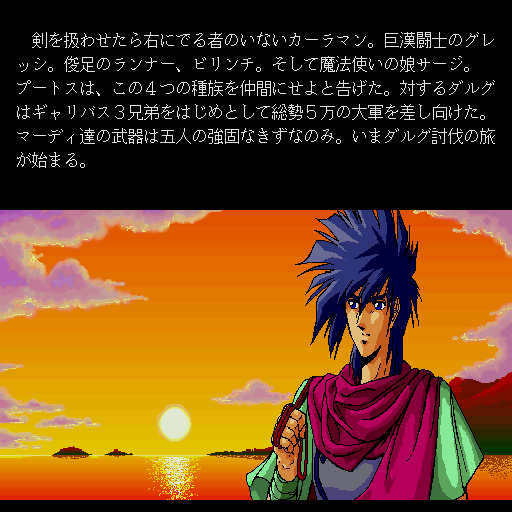
Visually, Zavas melds Japanese manga/anime aesthetics with a top-down Western RPG layout. Character sprites and portraits display that unmistakable anime flair—big expressive eyes, colorful outfits, and exaggerated hairstyles—yet they navigate environments that could easily have been lifted from an Ultima map. This intriguing blend lends the world a unique character: familiar in its RPG structure yet fresh in its art style.
The wilderness areas are expansive and varied, featuring lush forests, desert dunes, and winding mountain passes, all rendered in bright, inviting colors. Towns and castles are clearly distinct on the overworld map, making navigation intuitive. While the animations are fairly simple—walking cycles and basic attack moves—the overall presentation remains charming and functional, ensuring you always know exactly what’s happening on screen.
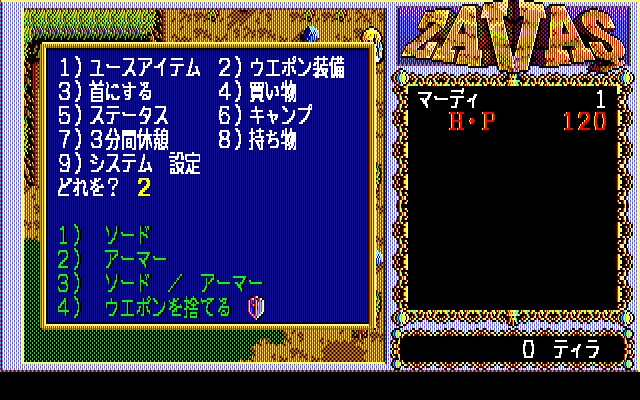
Menus and UI elements lean toward simplicity. Equipment screens, inventory lists, and status readouts are straightforward, prioritizing clarity over visual flair. Although there are no animated cutscenes or high-polygon models, the pixel art is clean, and the interface responds quickly to commands. For players who appreciate form following function, Zavas’s visual design hits the sweet spot between nostalgia and accessibility.
Story
Zavas buckles the trend of story-driven JRPGs and instead presents its narrative as a backdrop for exploration. You assume the role of Mardy, a knight wandering the realm of Fargana, which itself feels like an open playground rather than a tightly scripted campaign. There are hints of an overarching conflict and lore—ancient ruins, scattered manuscripts, and fleeting rumors of supernatural foes—but these elements serve more to flavor your journey than to dictate it.
Without a fixed storyline or in-depth character arcs, the game relies on environmental storytelling and emergent moments. Perhaps you’ll stumble across a besieged village in need of aid, or find that paying—or refusing to pay—a toll at a city’s gate leads to unexpected alliances or battles. While this approach may frustrate those who crave cinematic narratives and deep character development, it empowers players who prefer crafting their own sagas.
The lightly sketched Middle Eastern influences in certain towns—ornate domes, colorful market stalls, and desert motifs—add another curious layer to Fargana’s tapestry. Yet none of these locales push a main plot forward; instead, they offer side quests, trade opportunities, and new dungeons to conquer. If you approach Zavas as a sandbox first and a story second, you’ll appreciate how the sparse narrative allows your decisions to take center stage.
Overall Experience
Playing Zavas is like donning an adventurer’s cloak in a gameworld where rules exist only to be tested. Fans of Ultima and other classic Western-style RPGs will feel instantly at home in its sprawling landscapes and grid-based combat, while the Japanese anime visuals lend a warm, familiar charm. The absence of a strict storyline may be off-putting to some, but it’s also the game’s greatest strength, granting you the freedom to forge your own legacy across Fargana.
That said, Zavas does come with rough edges. The lack of deep NPC personalities means party members often feel interchangeable, and repetitive random encounters can become a slog without continual progression or new abilities to unlock. Food management adds suspense but can also slow down exploration if you’re constantly returning to towns to restock. Overall, though, these mechanics contribute to the game’s resource-focused challenge rather than detract from it.
If you’re seeking a narrative-heavy RPG with sprawling cutscenes and branching character arcs, Zavas may not be your ideal pick. But for players who relish open worlds, strategic freedom, and the nostalgia of early ’90s role-playing design, it offers a singular experience. Navigating Fargana, charting your own course, and surviving by your wits—all while surrounded by endearing anime art—creates a memorable adventure that stands apart from its contemporaries.
In the end, Zavas is an invitation to explore without bounds. It asks you to embrace both its minimalist storytelling and its systems-driven gameplay. The result is a distinctive RPG that bridges Eastern aesthetics with Western mechanics—perfect for those ready to write their own epic in a world that refuses to hold their hand.


Reviews
There are no reviews yet.