 Retro Replay Retro Gaming History, Reviews & Emulation
Retro Replay Review
Gameplay
The first hour of Rock Band 3 is wonderfully frictionless: pick a song, hand out instruments, and start trying to hold a band together. Because the full song selection is unlocked immediately, you never have to grind through a pile of unwanted tracks just to reach the one everybody came to play. That one decision makes it easy to treat the game as a casual living-room staple rather than a campaign you must clear before the fun begins.
When several people are playing, the best moments come from coordination rather than individual heroics. Everyone can build Overdrive and trigger it for a multiplier, and lining those activations up makes a successful performance feel like a group decision. The multiplier escalating when more bandmates activate together gives you a clear reason to watch each other, not merely your own note lane. It is a smart pressure point: a missed cue or an early activation can sting, while a clean shared burst feels earned.
The added keyboard and expanded vocal harmonies make the lineup feel broader than before. Up to three singers can split lead and backing parts, with stronger scoring for staying in harmony, so vocals no longer have to be a single-person assignment. Pro Mode is where the game becomes much more serious. Its guitar, drum, and keyboard requirements aim closer to real instruments, which is exciting if you want the challenge but potentially a sharp wall if your group only wants an easygoing party session.
Career progression is less about unlocking permission to play and more about giving you reasons to replay. Goals earn fans and unlock clothing or instruments, while Road Challenges turn performances into sets across different venues. Song stars become Spades, and the extra tasks—such as streaks during spotlights or carefully timed Overdrive—give veteran groups something specific to chase. The downside is that these demands can pull attention away from simply enjoying a song, but they work well when you want structure after free play starts feeling too loose.
Graphics
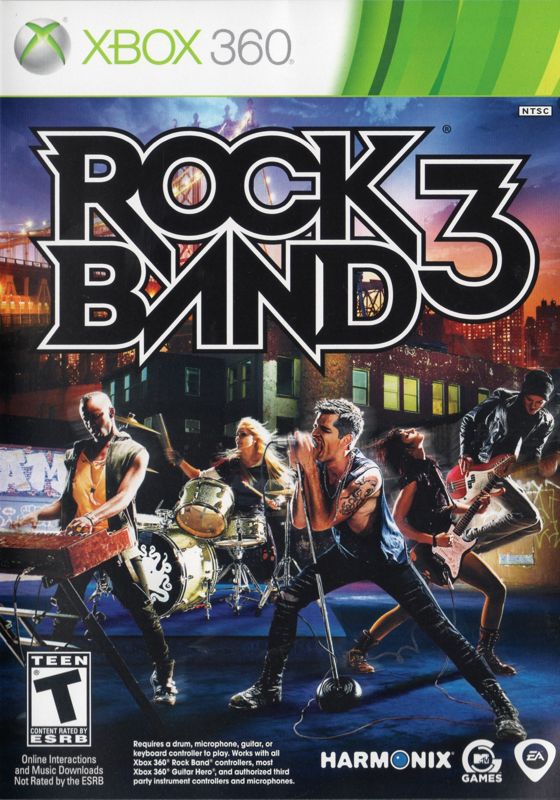
Rock Band 3 keeps the focus on a band performing songs with a range of instruments, including the newly added keyboard. Career rewards add clothing and instruments for your band, while Road Challenges move performances between different venues. The on-screen performance context fits the social, in-the-room energy of playing together.
Story
This is not a story-led music game. Instead, your band’s progress is framed through goals, fan growth, and the rewards attached to completing them. That is a better fit for a game built around jumping between songs than a forced narrative would have been.
The Road Challenge structure supplies the closest thing to an ongoing journey. You travel between venues, take on song sets, and convert performance stars into Spades that feed more goals and fans. It gives repeated sessions a sense of forward movement without blocking off the songs you actually want to play.
That light-touch approach means there is little emotional drama beyond the one your group creates for itself. A tense attempt at a bonus objective, a last-second recovery, or a synchronized Overdrive run becomes the memorable event. If you need characters and plot to carry you forward, this will feel thin; if you want the songs and the people beside you to create the stories, it does the job.
Overall Experience
Rock Band 3 earns its strong reputation by serving two crowds at once. It is accessible enough to put a group straight into a favorite song, yet it has enough scoring, goals, harmonies, and Pro Mode depth to reward sustained practice. Few rhythm games make casual participation and committed improvement feel so compatible.
Its biggest strength is that it turns cooperation into part of the musical fantasy. You are not just chasing separate high scores while standing near one another; shared Overdrive and harmony scoring encourage you to listen, coordinate, and celebrate a performance together. That makes it especially rewarding with a regular group willing to improve as a unit.
Go in for the immediate fun of a full-band song, then stay if the Road Challenges and Pro Mode catch your attention. The extra systems can become demanding, and not every gathering will want to optimize Spades or multipliers, but none of that stops you from simply selecting a song and playing. For a party rhythm game with real long-term ambitions, Rock Band 3 is an easy recommendation.


Reviews
There are no reviews yet.