 Retro Replay Retro Gaming History, Reviews & Emulation
Game Overview
Gameplay
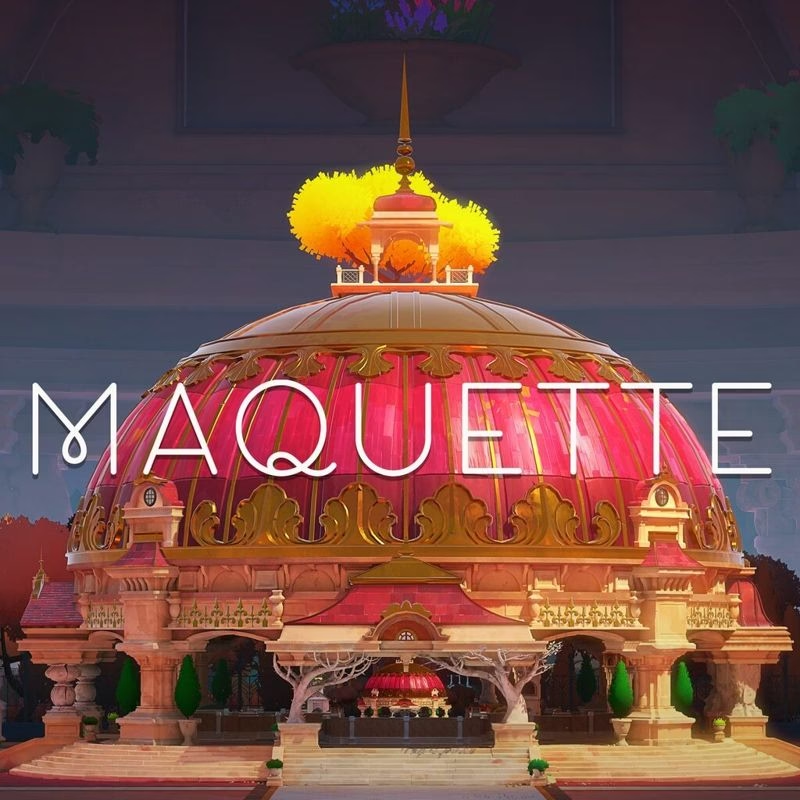
Maquette’s first-person puzzles begin with a premise that is easy to grasp and consistently strange to inhabit. Every building, plant, and object can be both tiny and enormous depending on where you are in the recursive world. Walk toward its center and you become a giant over walls and houses; travel farther away and those same spaces expand until a crack in the ground can become a chasm. It is a terrific setup because it changes your sense of scale without asking you to learn an elaborate vocabulary of systems.
What starts to click is the habit of treating size as the answer. A thing that seems useless at one scale may become the way forward at another, and Maquette gets real mileage out of that basic reversal. The pleasure comes from the mental snap when you stop viewing the environment as a fixed place and start viewing it as a nested object you can reason through. For the core concept and a useful official overview, see the Maquette publisher description.
The same openness that makes a solution satisfying can also make a roadblock feel opaque. When you have not yet identified the intended relationship between objects and scale, it is easy to circle an obstacle and wonder what you failed to notice. That makes Maquette a better fit for you if you enjoy sitting with a spatial problem than if you want constant forward momentum. The puzzles are memorable when they reward a new perspective, but the friction is real when that perspective does not arrive quickly.
Graphics
The recursive spaces are the visual star. Buildings and walls that look manageable near the center become huge landmarks farther out, while plants and small environmental details take on a startling sense of size. That shifting relationship gives the world an Escher-like look that is far more interesting than a standard first-person puzzle setting.
Maquette also gets strong imagery from its simplest contrasts: a tiny constructed world beneath your feet, then a vast version of that world surrounding you. The visual trick is clear enough to be immediately legible, yet strange enough that crossing the same kinds of spaces at different scales retains its pull.
Story
The game frames its puzzle world around a modern-day love story, using scale as an obvious but effective emotional metaphor. Everyday problems can feel tiny in one moment and overwhelming in the next, and Maquette’s recursive spaces give that idea a physical form. A small obstruction becoming an impossible barrier is not just a puzzle premise here. It is the language the game uses for its relationship drama.
That approach gives the abstract environments more weight than they would have on their own. You are not simply encountering objects at different relative scales for the sake of a brainteaser; the game is reaching for the feeling of revisiting a relationship issue after it has grown beyond its original size. It is a direct metaphor, but it matches the central mechanic unusually well.
If you want a story driven by concrete plot detail and constant character interaction, the emphasis on metaphor may feel slight. Maquette works better when you meet it halfway and let the changing scale carry some of the emotional meaning. Its strongest narrative idea is that perspective changes everything, whether you are looking at a wall, a gap, or a problem between two people.
Overall Experience
Maquette is worth playing for the moments when its recursive design makes your brain rearrange the world in front of you. Few puzzle premises communicate so quickly: you can be enormous and powerless, then tiny and suddenly able to see the route ahead. That makes even familiar objects feel newly suspicious, as though any of them might matter once you find the right scale.
It is not always a smooth ride. Spatial puzzles of this kind can create stalls, and the game asks for patience when its intended insight is not immediately visible. Still, the frustration has a purpose. Maquette is built around the act of revising your assumptions, so getting stuck and then seeing the world differently is often the point.
Give it a chance if you like first-person puzzles with a strong central idea and do not mind taking a break to think through an obstacle. The love-story framing adds a human angle to the recursion, while the shifting world supplies the memorable hook. Maquette does not make every puzzle equally elegant, but its best ideas linger because they turn a simple question of size into something personal.

Reviews
There are no reviews yet.