 Retro Replay Retro Gaming History, Reviews & Emulation


Retro Replay Review
Gameplay
The first few minutes deliver exactly what a giant-robot game should: Dendoh strides into a crowd of enemy machines and starts clearing space with punches, kicks, jumps, grabs, and combos. The side-scrolling portions have an immediate arcade-like pull because you are not waiting around for the game to explain itself. You fight forward, collect weapons and energy refills, and save enough power to make the special attacks count.
What makes Gear Senshi Dendoh more interesting than a routine brawler is the break at the end of each level. After a mini-boss, the action shifts into a 3D versus fight against Knight GEAR Orge. That is a genuinely good structural change: rather than simply asking you to defeat another wave, it makes you adjust to a duel against a rival mecha that resembles Dendoh and returns throughout the campaign.
The Data Weapons are the hook that ties those halves together. Winning a duel earns an animal-themed weapon such as Unicorn Drill or Dragon Flare, and it is not just a trophy. You can unleash it as a screen-clearing special attack or use it as a melee or ranged option in later fights with Orge. The downside is that the game repeatedly returns to the same boss and broad routine, so the novelty can fade if the combat itself does not grab you. Still, the brawler-to-duel loop gives each level a useful sense of escalation.

Graphics
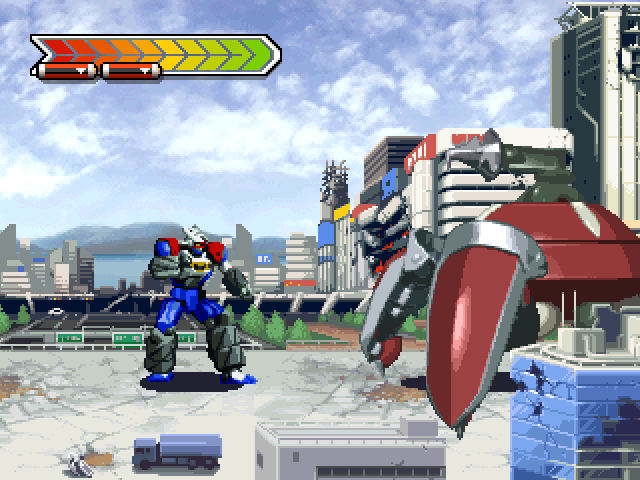
The game moves between 2D side-view stages and 3D versus arenas, matching its split personality. Dendoh and Knight GEAR Orge are the visual focus of the duels, while the animal-themed Data Weapons give the combat a welcome burst of anime-mecha flavor.
Story
Earth is under attack from Gulfer, a race of sentient machines determined to wipe out life across the universe. Two schoolboys are chosen by the giant mecha Dendoh to stand against the invasion, putting an uncomplicated but fitting anime premise behind the action.
This is a story built to get Dendoh into battle quickly, not one that asks you to untangle a dense science-fiction plot. The alien invasion supplies the stakes, while the growing weapon arsenal supplies the momentum. That directness suits the game’s short-form fighting structure.
Knight GEAR Orge works well as the recurring obstacle because his repeated appearances turn the campaign into an ongoing rivalry rather than a disconnected sequence of enemy waves. Each victory also has a clear story-gameplay payoff: Dendoh takes another Data Weapon from the enemy side and brings more force to the next confrontation.
Overall Experience
Gear Senshi Dendoh earns points for not settling into one mode. The side-scrolling brawling gives you the immediate satisfaction of mowing through machines, and the 3D boss fights interrupt that flow before it becomes completely automatic. It feels like a game designed around the pleasure of seeing a mecha gain another big weapon and immediately putting it to work.
Its limitation is equally clear: Knight GEAR Orge comes back every level, and the core rhythm does not radically change. If repeated rival fights annoy you, that persistence will become the main frustration. The weapons help keep the encounters from feeling identical, but they do not erase the repetition.
Give it a chance if you have affection for Dendoh, enjoy anime brawlers, or want a PlayStation action game that mixes crowd-clearing stages with direct mecha duels. It is not a sprawling adventure, but its central idea is sturdy: earn a new machine weapon, then use it to hit harder when the rival returns. For the right mood, that is enough.


Reviews
There are no reviews yet.