 Retro Replay Retro Replay gaming reviews, news, emulation, geek stuff and more!
Retro Replay Review
Gameplay
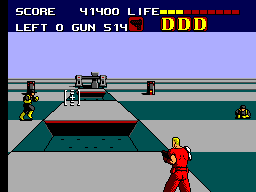
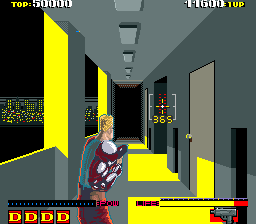
Dynamite Duke’s gameplay hinges on a blend of side-scrolling action and an over-the-shoulder viewpoint that ramps up the intensity of every encounter. As Duke, you move laterally through enemy-infested bases, mowing down snipers with your rapid-fire machine gun and deploying your cybernetic arm to dispatch foes in close quarters. The pacing never lets up, forcing players to juggle ranged assaults with sudden melee skirmishes, especially when knife-wielding soldiers appear from cover.
(HEY YOU!! We hope you enjoy! We try not to run ads. So basically, this is a very expensive hobby running this site. Please consider joining us for updates, forums, and more. Network w/ us to make some cash or friends while retro gaming, and you can win some free retro games for posting. Okay, carry on 👍)
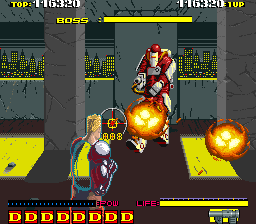
Boss fights punctuate each level, shifting the focus from regular soldiers to larger-than-life adversaries armed with unique attack patterns. These clashes call for quick reflexes—you’ll need to dodge projectiles, time your shots, and occasionally rely on hand-to-hand grapples to break an opponent’s guard. This interplay between shooting and brawling gives Dynamite Duke a varied combat loop that remains engaging across multiple playthroughs.
The controls are intuitive, letting you alternate between firing your machine gun, swinging your cybernetic arm, and rolling out of harm’s way without complicated button combos. While experienced action gamers will find the learning curve relatively gentle, newcomers might appreciate the accessible nature of the combat. That said, difficulty spikes can be sudden, especially later in the game when enemy density and toughness increase sharply.
Graphics
Dynamite Duke’s visuals adopt a pseudo-3D style courtesy of its over-the-shoulder perspective, delivering a sense of depth uncommon in side-scrollers of its era. Environments are richly detailed: industrial complexes, dimly lit corridors, and outdoor helipads all feature layered backgrounds that create immersive battlefield vistas. Enemy sprites appear crisply against these backdrops, making it easy to distinguish between different threat types even in the heat of battle.
The character animation stands out for its fluidity. Duke’s movement transitions—from running to aiming, from reloading to executing a powerful punch—are smooth and feel weighty. Boss animations are equally impressive, with exaggerated telegraphs that invite strategic responses rather than blind button-mashing. Particle effects for muzzle flashes and explosions are simple but effective, ensuring the action feels impactful without overwhelming the screen.
Color palettes shift from muted grays and browns in industrial areas to vibrant reds and oranges when grenades detonate, reinforcing the chaos of each firefight. Despite hardware limitations, the game avoids sprite flicker and slowdowns even when dozens of bullets and enemies populate the screen. This performance stability keeps the visual experience consistent, preserving immersion from first gunshot to final boss defeat.
Story
Dynamite Duke’s narrative is straightforward: you’re Duke, a lone operative with a cybernetic enhancement sent to dismantle a rogue military faction. There’s little in the way of lengthy exposition—dialogue is minimal, and cutscenes are scarce—opting instead for an old-school “action first, questions later” approach. While this bare-bones storytelling won’t win any awards for depth, it effectively serves as a backdrop for the nonstop action.
Character motivations are conveyed through brief text interludes between stages. You learn that Duke’s cybernetic arm was developed by a shadowy government program and that he’s uniquely qualified to infiltrate hostile bases teeming with genetically enhanced soldiers. The simplicity of the plot lets players focus on the core gameplay loop rather than wade through complicated lore, which can be a refreshing change of pace in an era of sprawling narratives.
Despite its minimalism, the story does inject moments of tension—especially when briefings warn you about formidable bosses or when mission objectives change on the fly. These little beats create a sense of progression, making each new level feel like a logical, if not particularly surprising, step in Duke’s mission. For players seeking character arcs or emotional development, Dynamite Duke’s narrative might feel skeletal; for those craving pure action, it hits the mark.
Overall Experience
Dynamite Duke offers a tightly focused action experience that excels at delivering adrenaline-fueled combat scenarios. Its blend of ranged and melee mechanics, coupled with robust boss encounters, ensures that gameplay remains dynamic and challenging. The accessible controls and over-the-shoulder perspective create a sense of immersion that few contemporaries match.
Graphically, the game punches above its weight, leveraging sprite work and layered backgrounds to create a visually compelling world. Performance is rock-solid, with minimal slowdown even during the most chaotic firefights. Though the story is minimal, it provides enough context to keep players motivated as they blast and brawl their way through increasingly hostile environments.
For fans of classic action shooters who relish high-octane sequences and strategic head-to-head boss battles, Dynamite Duke remains a standout title. Its straightforward design may not cater to those seeking deep narrative or RPG-like progression, but as a pure action pick-up-and-play experience, it consistently delivers satisfying thrills. Potential buyers looking for tight, no-frills combat will find this game a worthy addition to their collection.


Reviews
There are no reviews yet.