 Retro Replay Retro Gaming History, Reviews & Emulation

RETRO REPLAY EDITORIAL REVIEW
Ushio to Tora Review (Super Famicom)
By dadmin · November 9, 2026
The Stone Eater is a rude introduction to Ushio to Tora. By the time Ushio raises the Beast Spear, the creature is already threatening to turn his friends into dinner. Then the dialogue ends, the boss gets a life bar, and you find out how close you have to stand to land a hit. Yutaka’s 1993 Super Famicom brawler puts some of its meanest work right at the front.
Retro Replay Review
Retro Replay Verdict
The yokai and boss fights give this short brawler personality. Tora’s lightning and Ushio’s spear make a second run worthwhile, even when close-range hits turn into a rough trade.
Gameplay
You pick Ushio or Tora at the start and take that character through nine chapters. Ushio fights with the spear. Tora claws at enemies, hangs in the air longer if you hold the jump button, and can charge a lightning attack that strikes in several directions. Give Tora a second to charge in a street full of small enemies and he can clear space around himself. Try the same thing after a monster has already closed in and you may wish you’d moved first.
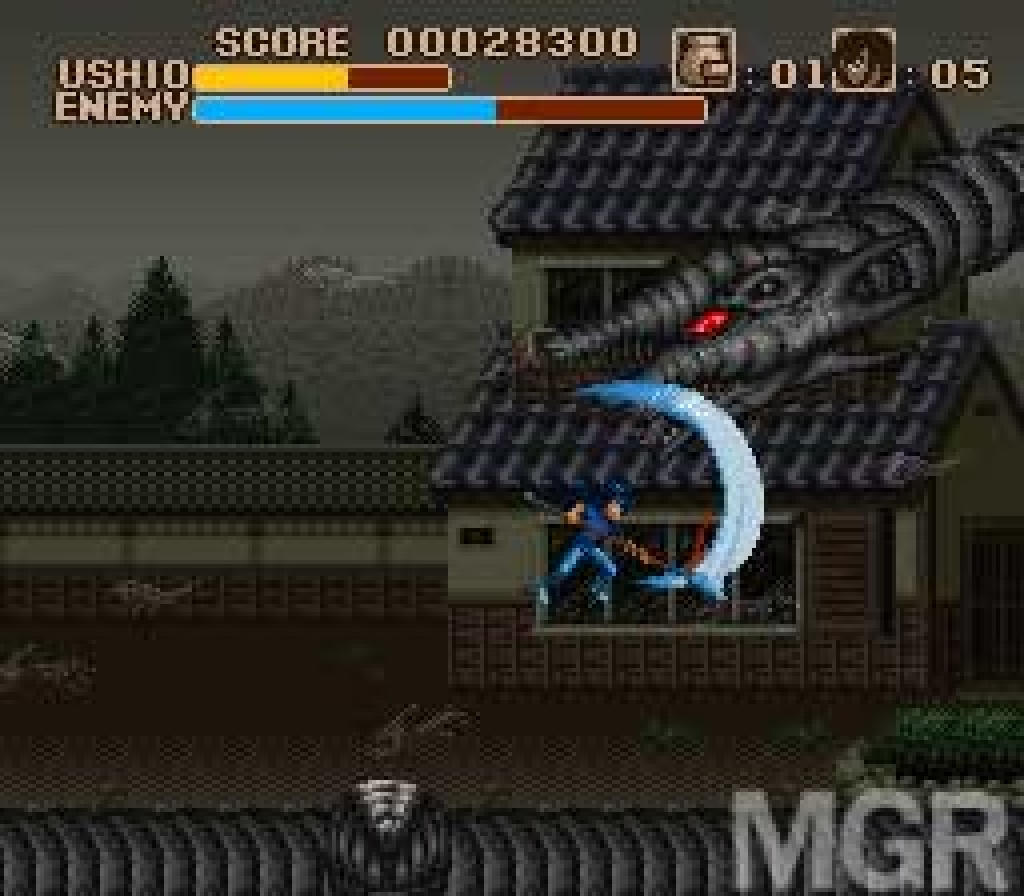
The short stages work best when a big enemy changes the way you read the screen. A centipede can fill most of the space above a rooftop, making the height of Ushio’s jump as important as the swing at the end of it. Ordinary scraps are less satisfying. You can land a blow and lose health in the same exchange, and the spear’s reach feels stingy for a weapon that looks like it should keep a monster at arm’s length. Unlimited continues make it easier to stick with a stubborn boss, though they can’t make trading hits feel any better.
Graphics and Sound
The monsters give the artists the best material. A huge green creature can crowd Ushio out toward the edge of the screen, while Tora’s orange mane is easy to pick out against a dark street. His lightning breaks up the browns and grays with a bright blue flash. The people and buildings can look a little stiff next to those oversized creatures, which makes the jump from a quiet street to a boss encounter all the more striking.
The combat audio is modest. Tora’s electric crackle has more character than the everyday hits, and that little burst is a welcome break when several smaller enemies come at you in a row.

Story and Presentation
Ushio finds Tora pinned beneath his family’s temple and pulls out the spear that has kept him there. The two have a practical reason to work together and plenty of reasons to argue. Tora’s defense of Ushio when the Stone Eater threatens him comes down to a wonderfully petty objection. If anybody is going to eat the kid, Tora wants first refusal.
The original Japanese dialogue gives those encounters room to breathe. You can follow the action by watching who enters the scene and what happens next, but that gets you only so far with a pair whose best moments come when they’re needling each other. Retro Replay’s English translation patch makes those exchanges readable in a separate patched playthrough.

Overall Experience
A second run makes sense if you spent the first one with Ushio. Tora changes the rhythm of the fights enough to make familiar rooms feel different, and he gets his own ending. The chapters themselves are brief, so the prospect of another trip is more appealing than it would be in a longer game padded with the same scrapes.
The rough hit exchanges make this a tougher sell as a straight brawler. As a trip through Fujita’s world, it has a better hook. The monsters look like they’re about to break out of the scenery, and the two heroes can barely agree on why they’re saving each other. That’s enough to make the next chapter worth seeing.
Gameplay screenshots from MGR Online’s Super Famicom coverage. Original game documentation is available in the Japanese instruction manual scans.
Reviews
There are no reviews yet.